Tuesday, May 29, 2012

Quote du jour/Henry David Thoreau


The bluebird carries the sky on his back.
Henry David Thoreau


Tom took this photo through the telescope.

Thursday, May 24, 2012

Farm and Garden Report - May 24

Last week Melody, a fellow New England blogger wrote:
If you asked me my favorite season... I'd always say fall or winter. I think I forget how much spring has to offer. New growth, apple blossoms, lush grass.... and things unfurling from their long winter's nap. The sweet smells of spring hang heavy in the air on damp days like this…
And I echo those words. I always go on and on about how much I love winter, and that cold crisp invigorating air, but I have to say that once May comes to Windy Poplars Farm, the days are so perfect with their sounds and smells and sights that I think there is no other time as beautiful. After all those months, which begin for us in October, of gray and brown and white, this green just amazes me. I stare and stare feasting on this color. Even if there were never any flowers, I could be happy with only green grass and trees and bushes. Some days it feels like my eyes can't look enough.


Just last week I picked a cup of rhubarb for that great Apple Rhubarb Cake, and now all my rhubarb plants are huge. This is just one plant, and I took the picture after I'd picked the rhubarb!


Today I picked and froze 14 cups. And there is still so much more. Some people say to blanch it before freezing, but I never have. I just quickly rinse, chop, and put in freezer bags.


The lilacs have come and gone. There were a few beauties but mostly I think this was an off year for them. I've decided to cut off the old flowers. I've not done it very often even though all the books say to do so. We'll see if it increases the amount of flowers next year. If not, at least the old brown ones won't be there.


The honeysuckle is in full bloom. We have an old pink bush from when we lived in my childhood home.


A few years ago we planted a cream colored one along the fence and it has grown beautifully.


And then there are the Tartarian honeysuckles which are now considered an invasive species. We had planted them ages ago before the label. We tried cutting them down, and they just grew up again so we'll just let them quietly stay.


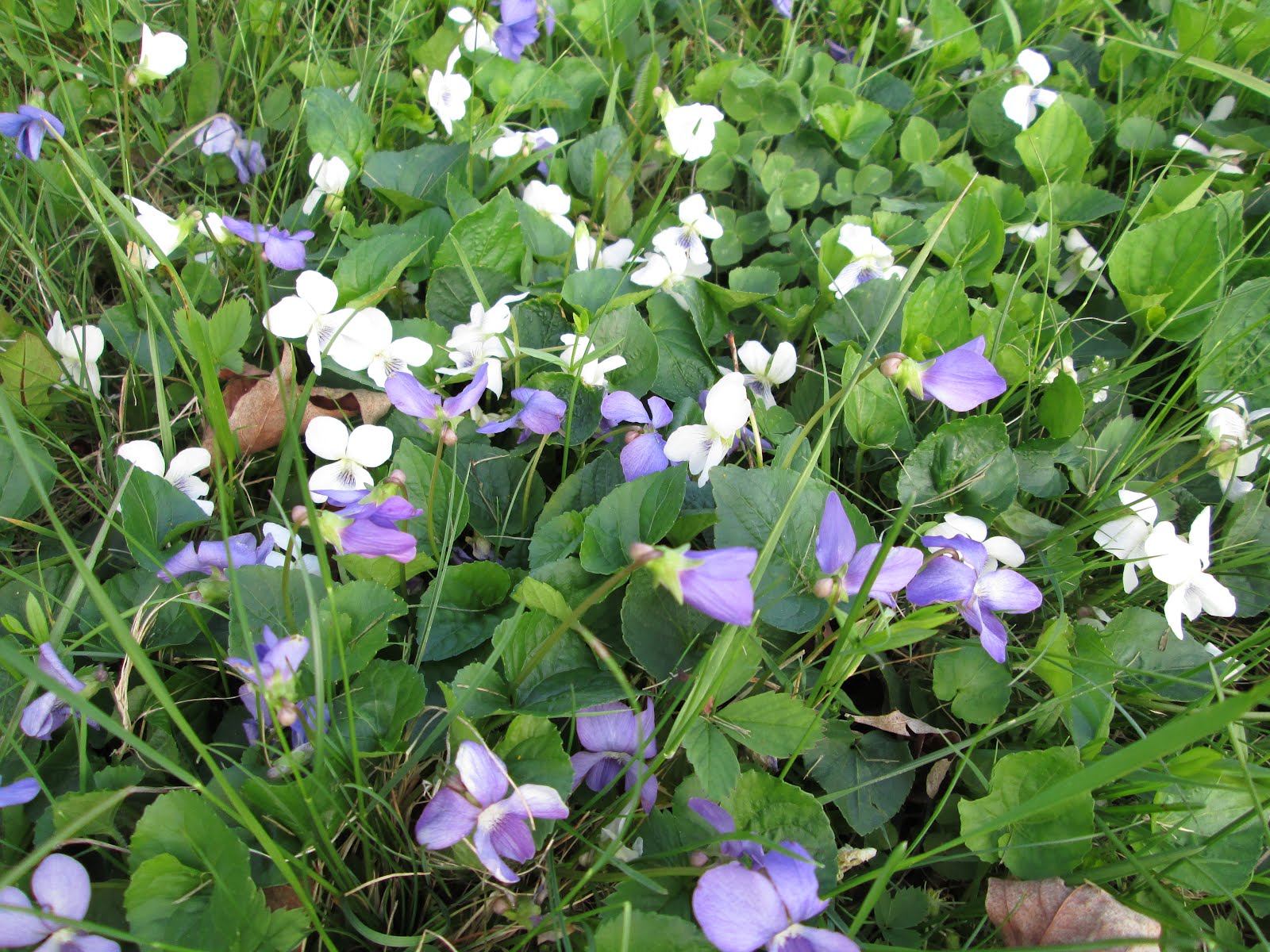
The violets were especially beautiful this year and have been in bloom for weeks now. We have whole bunches out in the lawn,


and Tom just mows around them this time of year. As you may see in the banner photo, the mountain bluets are in blossom. I've written about them before in my letters, and my favorite story is connected to a Eudora Welty book .

The bleeding heart flowers have appeared.


In the vegetable garden, we took a big chance and put out two tomato plants we started from seed.


We still have four more under the lights, just in case, but the weather forecasts haven't talked about any cold frosty nights in the near future. These plants are huge!


Truly, the biggest we've ever grown, and that may be due to this wittily named fertilizer called Chickity Doo Doo. I highly recommend it. And look at those hollyhocks! Speaking of hollyhocks, I've never had much success on this windy hill, so this year I decided to just think of them as annuals. I'm hoping they will bloom this year. They are the one flower I remember in my mother's flower garden - right up against the east side of the house. Here's hoping.

The peas are up,


and the lettuce is fantastic.


The leeks and onions are still pencil-like but they should come along.


My potatoes were sprouting so we decided to throw a few of them into one of the raised beds to see if they'll grow. We planted some beans from 2010 along the poles Tom put in last year. If they don't sprout, we've got some from last year that should work. Those bean poles haven't moved since Tom put them in last spring. They are sturdy and have withstood all the weather which winter brought.


We've planted corn in the space where the planter used to be, behind the daffodils.


And look at those panolas! Amazing, amazing little flowers.


I talked about them last month, and see how they've grown since then. They seem to be taking the place of weeds in the main walkway, and I say hooray.

Last month I reported that one of the goats died, and now we've had another death of a farm animal. This week Tom went in the barn in the early evening and one of the sheep was lying dead. Twelve years old. We can't wish a better life for a sheep. Grazing all summer, eating hay in the winter, being shorn in the spring. This is fullness of life for a farm animal on a vegetarian farm. Tom and Matt were out in the pasture digging the grave by headlights of the tractor.

Meanwhile, the remaining goat, Esther, continues to believe she is simply an outside dog. She has even walked across the terrace. The fence hasn't been made that can keep her from where she wants to go.


If you click on the picture maybe you can read the danger electric fence sign. Esther can't read it, and she just crawls through the strands whenever she feels like it.


Along with the little red squirrels and chipmunks, we have another dear visitor these days. One morning I looked out the bedroom window, and thought it was a stray cat down there next to the front door. I took this picture out the kitchen window.


Delightful creature. We've had a groundhog other years, and they never bother anything in the garden, except for parsley! And this year, we were hardening off some on the terrace that we had started from seed, and the dear little fellow found it. We don't begrudge any animal meals from our garden which may be why we've never had any trouble.

There is a lot of bird activity as you might expect. The bluebirds have returned, for the third straight year. This was taken through the screen so not very clear.


They are nesting in the house under the eaves.


Just across the hill from them are the swallows, back in their old home on the telephone pole.


The robins are somewhere nearby, possibly in the old apple tree. I hear the song sparrows and chickadees occasionally so I think they must be living close by. The phoebes are again in the barn, and they waken me each morning with their song.

Glorious May!

Wednesday, May 23, 2012

Today's poem by Linda Hasselstrom

Coffee Cup Café

Soon as the morning chores are done,
cows milked, pigs fed, kids packed
off to school, it's down to the café
for more coffee and some soothing
conversation.

"If it don't rain pretty soon, I'm
just gonna dry up and blow away."
"Dry? This ain't dry. You don't know
how bad it can get. Why, in the Thirties
it didn't rain any more than this for
(breathless pause) six years."

"I heard Johnson's lost ninety head of calves
in that spring snowstorm. They
were calving and heading for home
at the same time and they just walked
away from them."

"Yeah and when the cows
got home, half of them died
of pneumonia."

"I ain't had any hay on me since that hail
last summer; wiped out my hay crop, all
my winter pasture, and then the drouth
this spring. Don't know what I'll do."

"Yeah, but this is nothing yet.
Why in the Thirties the grasshoppers came
like hail and left nothing green on the ground.
They ate fenceposts, even. And the dust, why
it was deep as last winter's snow drifts,
piled against the houses. It ain't bad here yet,
and when it does come, there won't be so many of us
having coffee."

So for an hour they cheer each other, each story
worse than the last, each face longer. You'd think
they'd throw themselves under their tractors
when they leave, but they're bouncy as a new calf,
caps tilted fiercely into the sun.

They feel better, now they know
somebody's having a harder time
and that men like them
can take it.

Linda Hasselstrom
from Land Circle
Writings Collected From The Land

Sunday, May 20, 2012

Crooked House by Agatha Christie


29. Crooked House
by Agatha Christie
mystery, 1949
library book six
Nook book 9
finished 5/20/12

This book is one of my own special favourites. I saved it up for years, thinking about it, working it out, saying to myself: "One day, when I've plenty of time, and want to really enjoy myself - I'll begin it!" I should say that of one's output, five books are work to one that is real pleasure. Crooked House was pure pleasure. … I don't know what put the Leonides family into my head - they just came. Then, like Topsy "they growed." I feel that I myself was only their scribe.
Agatha Christie
From the Foreword to Crooked House


Her words stayed with me all through my reading of the book, and made it even more fun than it would have been not knowing it was one of her favorites. Well, 'fun' may not be quite the right adjective, though it can be fun to shiver with apprehension as one reads along. The book began with a young couple in love and is narrated by the man, Charles. My first thoughts about his beloved, Sophia were that she was to be one of Agatha's delightful, spunky, upbeat heroines. And she was, mostly, but it is hard to live up to all those adjectives when your grandfather is murdered and the killer must be a member of the family household!

The Leonides family consists of the grandfather, his second wife, his two sons, their wives, the three children of one of the sons, of whom Sophie is one, and the grandfather's sister-in-law (from his first wife, the sons' mother), as well as the old Nannie, and the two younger children's teacher. The house is divided into sections so each family group has their own quarters. Sophia tells Charles about the house.
"'And they all lived together in a little crooked house.' That's us. Not really such a little house either. But definitely crooked - running to gables and half timbering!"

Later she says,
"I think that's what I mean when I said we all lived together in a little crooked house. I didn't mean it was crooked in the dishonest sense. I think what I meant was that we hadn't been able to grow up independent, standing by ourselves, upright. We're all a bit twisted and twining."
And boy is that ever the truth! As the story goes on, we see all the little idiosyncracies in this family. Charles happens to be the son of a Scotland Yard policeman so he becomes quite involved in the post-murder life of the Leonides. His father appreciates him being a kind of johnny-on-the-spot, the eyes and ears of the police without intimidating the family. One of the sons was the father's favorite, even though he was an utter failure at the family business. The second son never got the attention he feels he deserved. Sophia's younger brother and sister, Eustace and Josephine, are odd, to put it mildly. The whole family hopes the killer is the young wife of the grandfather. They think that maybe she and the tutor are in love.

And with that, I have said enough. This is truly a book you'll want to discover on your own, making your way along in its pages, trying to figure out who on earth 'dunnit.' When there is a second attempt at murder, I became even more baffled. Crooked House would have made a fantastic movie, and I've just read that the most talented Julian Fellowes is doing the screenplay, the cast has been hired, and it is supposed to come out next year.

Friday, May 18, 2012

Today's short story - The Proxy Marriage by Maile Meloy

I was so happy when I saw that the May 21 issue of The New Yorker had a short story by Maile Meloy. I loved The Apothecary, and felt sure I'd enjoy the story, and I did. It is based on a fascinating fact. Only in the state of Montana may a couple get married by double-proxy, which means that two people may act as stand-ins during the actual ceremony.

In December 2001, Mr. Taylor, a lawyer is asked to do this for a soldier in Kandahar and his pregnant fiancée in North Carolina. He asks his daughter, Bridey and her classmate, William to be the substitutes. Because William has long loved her from afar, and because he is simply that kind of person, he takes his job very seriously. Bridey, however is cavalier about the whole thing. They do this a few more times before heading off to college. The years go by and we read of how their separate lives are going after high school as they pursue their dreams. I wondered if they would ever get together; if William would ever tell her how he felt and if she felt anything similar for him. The story is eight pages long, and beautifully written. I am glad to say that you may read it, too. It is online here. And then after you finish, there's a great interview with Maile Meloy.

There are nice drawings above the first two pages of the story done by Kikuo, quietly showing the passing of time, without giving away the ending at all.

Thursday, May 17, 2012

Today's song/The Folks Who Live On The Hill - Jane Seidel and Chuck Morgan

When I first heard this song a few years ago, I was stopped in my tracks. This could be about us! Tom and I are the folks who live on the hill, veranda and all. How I love these words, written by Oscar Hammerstein II and Jerome Kern in 1937. By the way in case you wonder, there is information about 'Darby and Joan' here.

Wednesday, May 16, 2012

Apple Rhubarb Cake

You know summer is on the way when the rhubarb stalks are being gathered.
Theresa Millang in The Joy of Rhubarb

Well, I gathered the first ones today! Because I had some apples in the refrigerator, I went searching for a recipe which would use both rhubarb and apples. I found not only a recipe, but a delightful video with a new-to-me chef! You'll see that Marcus Samuelsson mentions both baking soda and powder. The recipe calls for powder only. I used Sugar in the Raw for both the sugars. This is so delicious. Tom and I sat there raving about how good the cake is.


Apple Rhubarb Cake

Preheat the oven to 350°F.
Grease a tube pan and coat with 2 T. breadcrumbs and a little sugar.

Peel and core a couple medium size apples and slice each apple into 16 wedges.
Peel rough part off rhubarb and chop to make a cup.
Combine 1/2 t. cinnamon, 1/2 t. garam masala, and 1/3 cup sugar in a medium bowl.
Add the apple wedges and chopped rhubarb, and then toss to coat.

In the mixer, beat together until light and fluffy, about 2 minutes:
1/4 c. softened butter
2/3 cup sugar

Add 1 egg and continue mixing.

On low speed, add 1 1/4 c. flour and 2 t. baking powder.
Slowly add 2/3 c. milk.
Turn off mixer.
Add apple and rhubarb mix, and fold in well.

Pour the batter into the pan and spread evenly.
Bake until the center is golden brown, about 35-40 minutes.
Let cool completely.

Top with whipped cream.


Whipped cream

1 pint heavy cream
1/2 t. cinnamon
1/2 t. gram masala
1/2 c. confectioner's sugar


The ingredients.


The finished cake.


We ate it outdoors in the beautiful May sunshine.

Tuesday, May 15, 2012

Today's essay by Donald Hall

I read Out The Window in the New Yorker back in January.


I cut it out and put it in my computer desk drawer to have close at hand when I wrote about it. Well, here we are in May. I have thought about this essay a lot in the intervening months.

I first encountered the writing of Donald Hall in what I think is a masterpiece of nostalgic, sometimes elegiac writing, String Too Short To Be Saved published in 1961.


My copy is a second printing twenty years later and autographed by the author when he, his wife, the poet Jane Kenyon, and Maxine Kumin visited my little town in 1989. I think back on that magical evening and wonder if I dreamed it. I've read the book twice, and am feeling a pull to go back to those pages again, and soon.

Right from the start of Out The Window, he doesn't flinch from seeing his life as it is.
Today is January, midmonth, midday, and mid-New Hampshire. I sit in my blue armchair looking out the window. I am eighty-three, I teeter when I walk, I no longer drive, I look out the window.
And he tells us in poetic detail about what he sees from that window - the snow, the birds and squirrels, the cow barn,


built in 1865, which he gazes at 'every day of the year.' There is a chickadee perch
a rusty horseshoe, permanently nailed to the doorjamb by my grandparents
He lives in his grandparents' house.


The past is all around him, supporting him rather than crushing him. As he looks out the window, his thoughts turn to his family, of his mother in a nursing home, still reading before she died at almost ninety-one.
A week before she died, she read "My Antonia" for the tenth time. Willa Cather had always been a favorite. Most of the time in old age she read Agatha Christie. She said one of the advantages of being ninety was that she could read a detective story again, only two weeks after she first read it, without any notion of which character was the villain.
As he describes the narrowing of his life, he says that
New poems no longer come to me, with their prodigies of metaphor and assonance. Prose endures. I feel the circles grow smaller, and old age is a ceremony of losses, which is on the whole preferable to dying at forty-seven or fifty-two. [his wife; and his father] When I lament and darken over my dimishments, I accomplish nothing. It's better to sit at the window all day, pleased to watch birds, barns, and flowers. It is a pleasure to write about what I do.
And his pleasure is also mine. If there are to be no more poems, that's alright. I think, in fact I know, that I love his prose even better. I like the details, the descriptions, the longer form of telling.

There is also humor in this lovely piece.
My grandmother Kate lived to be ninety-seven. Kate's daughter, my mother, owed her early death to two packs a day - unfiltered Chesterfields first, then Kents. My mother was grateful to cigarettes; they allowed her to avoid dementia.
And then, Donald Hall offers a most telling sentence, one that I think defines him, as it does me.
When I was a child, I loved old people.
… After a life of loving the old, by natural law I turned old myself.
He writes of that 'antiquity,' that 'unknown, unanticipated galaxy.' We all know this feeling. Remember the first time the young check-out person at the supermarket called you ma'am? That is the beginning - when we are thirty-five, and those who are 20 see us as a whole other generation. What? Me, old? No, I'm the same. You just see me differently. It was Gertrude Stein who most brilliantly said, 'we are always the same age inside.' I wore a tee shirt with her face and that quote when I was younger. I believed it then and I believe it now. When a young friend of Matt and Margaret's said he saw saw me dancing at Rusted Root and knew it was me because of my white hair, I was taken aback, surprised, before I remembered that oh, yeah, I do have white hair now. It's a mysterious realm that we, who are lucky, get to visit. There are indeed 'limitations' and 'narrowing circles' but there are also depths of understanding, appreciation, and remembrance that come with those years. If only more of the young loved old people. Then the condescension, the dismissal by others wouldn't be a part of old age.

This essay is a brilliant piece of writing. It creates in me the strength of feeling that I usually only have when I read poetry.

I am happy to say that there is an online phone interview with Donald Hall done at the time the essay was published. I know twelve minutes can be hard to set aside in a busy day, but I so hope you can listen. There's another interview here.

I've written about Donald Hall quite a few times in my letters. If interested, you may type his name into the search box to find the postings.

I find this photo very touching. It's like his arm is around the chair which should hold his late wife or grandmother or grandfather on that porch where they all sat in their lifetimes.


This is my second essay for the Essay Reading Challenge - 2012

Saturday, May 12, 2012

All I could wish for Mother's Day weekend …


was having Michael, Margaret and her boyfriend Matthew, and Tom alongside me in the fourth row from the stage at a Rusted Root concert! We had THE BEST time. Every single person in the place was on their feet dancing for the whole show. It is amazing to realize that Margaret was 12 and Michael was 9 when the When I Woke album came out. It is still just as great all these years later, as is the band. If you ever get a chance to see them, don't pass it up. They put on a great show. The audience consisted of people younger than Michael and older than Tom and I. That's a rare band that appeals to all ages.

I mentioned their wonderful song, Send Me On My Way in a sad posting from four years ago.

Here's a video from a 2011 show.


Friday, May 11, 2012

Quote du jour/Mahatma Gandhi


To forget how to dig the earth and tend the soil is to forget ourselves.
Mahatma Gandhi (1869-1948)

Thursday, May 10, 2012

Decaffeinated Corpse by Cleo Coyle


24. Decaffeinated Corpse - Book 5 in the Coffeehouse Mystery series
by Cleo Coyle
mystery, 2007
fifth book for the Foodies Read 2 Challenge 2012
Nook book 6
finished 4/26/12


In every one of the Coffeehouse mysteries, Cleo Coyle teaches the reader more about this beverage. I'm constantly amazed at how much there is to learn. As you may have guessed from the title, this installment is all about decaffeinated coffee. Our heroine sleuth Clare Cosi and her team of baristas at The Village Blend are facing the fact that more and more people want this coffee option, and that they need to drop their prejudices against decaf, and look into it more seriously.
Most baristas viewed asking for decaf on a par with asking a French chef to hold the butter. Even coffeehouse slang had labeled it a "why bother?"
Still, the last time I'd researched the subject for a trade journal article, I'd learned that fifteen to eighteen percent of coffeehouse customers wanted the lead out. The Village Blend was coming up short in that department. Over the years, we'd given a number of decaffeinated methods a shot on our menu, but maintaining the trademark Village Blend quality had been a challenge.
Then the book goes on to explain the whole process.
Decaffeination robs beans of their acidity (coffee speak, not for bitterness but the lovely brightness of flavor that keeps the drink from tasting flat). On top of that, the best decaffeination methods required fifty-five bag minimums. To manage that amount, the Blend had to rely on a third party roaster, since decaffeinated green beans had a significantly shorter shelf life than untouched beans. But that solution went against our century-old philosophy of micro-roasting daily.
The product quality sank so low, we just pulled it.
Frankly, I could read a book that was just about the coffee world. I find this stuff fascinating - like olive oil or wine or whisky, there is so much involved. Esther, one of Clare's baristas had just read in a science magazine about how caffeine works.
Caffeinated coffee stimulates frontal lobe activity in the brain, so working memory is improved. It also lights up the anterior cingulum, which controls your ability to focus attention.
So, when Clare's ex-husband Matteo, whose work is traveling the world in search of the best coffee, announces that an old friend Ric has a new and better way to produce decaffeinated coffee, there is a lot of interest. Ric is coming to New York to the International Coffee Growers Exhibition to offer a taste testing of his revolutionary scheme. Upon arrival he is attacked and left in an alley, and does not want the police involved.

There's a lot going on in this book. In addition to the coffee angle, there are old friends bringing their pasts to the present. Clare and Matteo's daughter Joy is, as always, worrying Clare. Clare's policeman friend Mike Quinn makes a welcome appearance.

This book is an homage to New York City, as are the others in the series. As Clare drives around, we the readers are passengers looking out the window. When Clare arrives at Dag Hammarskjöld Plaza,


she says to her mother-in-law
"Dag Hammarskjöld Plaza. Okay, I've finally found a winner for the most obscure, hard to pronounce place name in New York City."
"Clare, I'm surprised at you. Don't you know who Dag Hammarskjöld is?"
"What do you mean who? Are you telling me Dag Hammarskjöld is a name?"
"He was secretary general of the United Nations. He died in a plane crash in Africa in the 1960s. He also won the Nobel Peace Prize. In my time, every schoolchild knew his name."


Though I'm many years younger than Clare's mother-in-law, 'in my time' we all knew his name as well. I was stunned that nearly forty-year-old Clare had never heard of him. This is another example of why I love these books. They offer history in a most palatable and interesting form.

The Coffeehouse mysteries are part mystery, part history, part cookbook, and pure fun. There are coffee tips and recipes, as well as desserts and main meals to go along with your coffee. Here's a fun one from Decaffeinated Corpse:

PB and Nutella Sandwich
Peanut butter
Nutella
2 slices of bread
In this sandwich, the jelly in your PB&J is replaced with Nutella.


What is Nutella? It's a wonderful hazelnut chocolate spread that originated in Italy, where the hazelnut is king. Most major American grocery stores now carry it. Look for the jar in the peanut butter aisle. And speaking of peanut butter, if you actually need the recipe, here it is:
Spread peanut butter on one slice of bread. Spread Nutella on the other. Put the slices together and enjoy. (Hey, didn't somebody once say peanut butter and chocolate go well together?)


Please do visit the incredibly complete website. I could easily spend a whole day or more there.

Tuesday, May 8, 2012

Quote du jour/William E. Gladstone


Be happy with what you have and are, be generous with both, and you won't have to hunt for happiness.
William Ewart Gladstone

Friday, May 4, 2012

Murder on the Rocks by Karen MacInerney


23. Murder on the Rocks - Book 1 in the Gray Whale Inn Mysteries
by Karen MacInerney
mystery, 2006
fourth book for the Foodies Read 2 Challenge 2012
Kindle book 13
finished 4/21/12


My favorite sweet foods are not chocolate cake or ice cream, but fruit concoctions, coffeecake-like breakfast foods, cookies, and brownies. Karen MacInerney must share my love of these foods since Murder on the Rocks is full of such dishes. Natalie Barnes owns a bed & breakfast inn on Cranberry Island off the coast of Maine. She spends a portion of each day baking up something wonderful for her guests' breakfasts, and the reader gets to stand alongside her in the kitchen while she mixes together the butter and sugar, and adds various fruits. And at the end of the book, the author kindly shares all these recipes. Over time I shall try them, and of course write about them in my letters. A few from this and other books in the series may be found here.

Natalie does a lot of her best thinking while she is whipping up something delicious, and she does a lot of it in this first in the series. She is worried about rumors that a giant resort may be built on the little island. Her finances are already fragile, and this could mean the death knell to her business. Not only would it probably ruin the inn she has put all her money into, but there is great concern that the nesting area of the black-chinned terns (not a real bird) will be destroyed. While walking on a footpath Natalie slips and falls down onto the rocks, and discovers the body of the developer himself, Mr. Katz. Later there are subtle, and not-so-subtle attempts on Natalie's own life, while she still has to keep things together at her inn, try to save the birds, and monitor the behavior of her niece who is working at the inn for the summer. She is, as you see, a busy woman. But she has a can-do attitude and cheerfully goes about her daily life in the midst of all her troubles. She has a bit of a crush on the local deputy (the island is too small for a real police force) though local gossip says that he has a girlfriend on the mainland.

There. All the elements of a cozy mystery. Locale, yummy sounding food, a potential love interest, and a great amateur sleuth. For the most part she doesn't commit the sin of getting herself into potentially dangerous situations, though there were a couple of occasions I wanted to call out and say, no. You don't want to do this.

I so enjoyed Murder on the Rocks and plan to read the next ones. And do some baking.

The Gray Whale Inn Mysteries page is here.


Murder on the Rocks is a perfect book choice for the Foodies Read 2 Challenge 2012.

Thursday, May 3, 2012

Parker Pyne Investigates by Agatha Christie


22. Parker Pyne Investigates - short story collection
by Agatha Christie
mystery, 1934
library book three
Nook book 5
finished 4/15/12


What if you were looking through the newspaper and happened upon an ad which said:
Are you happy? If not, consult Mr. Parker Pyne.
This is the premise for Agatha Christie's collection of most delightful short stories. Delightful? Yes, really. No terrible crimes. Just a large, retired man who wants to help people. He tells a client that
Theft and crime are not in my line at all. The human heart is my province.
One of his 'greatest assets' is his 'sympathetic manner' which puts clients at ease when they come to him. There are operatives who help in the work, including Ariadne Oliver who is first introduced in this book. Miss Lemon who later works for Hercule Poirot also makes her first appearance. And then there are the 'lounge lizard' and the sultry beauty who pretend to be various persons to aid Mr. Pyne in little dramas he stages. Even though I knew he employed them, I was often surprised when their identities were revealed at the end of a story. The first few involve clients who visit Parker Pyne's office, while the second batch of stories deal with people he helps while on vacation.

In her foreword to the stories, Agatha tells us which ones are her favorites, and where she got her inspiration for one of them - The Case of the Rich Woman. Agatha was looking into a shop window some years before when a woman came up and said:
I'd like to know what to do with all the money I've got. I'm too seasick for a yacht - I've got a couple of cars and three fur coats - and too much rich food fair turns my stomach.
When a 'startled' Agatha suggests, 'hospitals,' the woman replies that she doesn't want 'charity. I want my money's worth.'

And thus a story brews in an author's mind.

It makes me smile just thinking back upon these stories. Pure pleasure. Highly recommended.

Wednesday, May 2, 2012

I can't wait to see this!

It's coming to our little theatre the end of June. SO many of my favorite actors and actresses are in it. I may go twice! (And I've ordered the book, of course)

Tuesday, May 1, 2012

A Man Lay Dead by Ngaio Marsh


16. A Man Lay Dead - book 1 in the Inspector Alleyn series
by Ngaio Marsh
mystery, 1934
Nook book 2
finished 3/26/12


I am now officially a Ngaio Marsh fan! I read the first Inspector Roderick Alleyn book in March, and I loved it. Marsh is considered one of the great writers of the Golden Age of Detective Fiction, and now I know why. Her writing is crisp and clear, her characters well-drawn, and the mystery itself was a very good one. A number of guests have been invited to a country home and one of the entertainments is to be a game of murder. One person is to be the 'murderer' who shall choose his or her victim. When the murder occurs, the murderer is to ring the gong. The lights go out, the gong is rung, but instead of a game, a real murder has taken place.

Roderick Alleyn is educated and upper-class. He has connections with the aristocracy. He's an interesting character and I expect in the later books, the reader gets to know him better.

I did try the second in the series, The Nursing Home Murder but didn't finish. It involved a man who died just after an operation, and I just wasn't interested in all the medical details. I'll certainly pick up more by the author as time goes on.