Showing posts with label Book Reports. Show all posts

Saturday, January 11, 2025

First book of the year - quick review

I finished my first book of 2025 today.

And how I loved it! I was a big fan of Hayley Mills when I was a kid, as were most people my age. 

As she wrote about the movies she has been in, I realized that I may have seen only Pollyanna and The Parent Trap. I am going to try and get ahold of some of the more serious ones like Tiger Bay and Whistle Down the Wind, as well as some of the ones she did when she was older. 

She is a very good writer. Highly recommended.

Wednesday, January 26, 2022

Calendar of Crime - January / The Nine Tailors

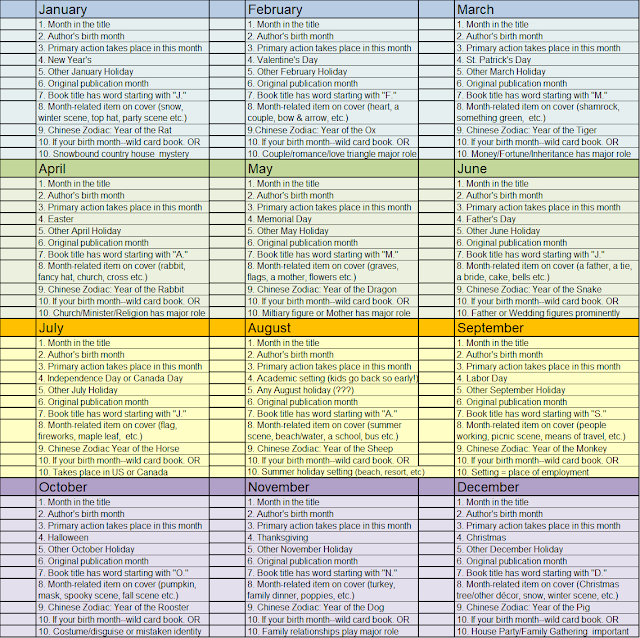
For my January book. I chose 4. - the New Year's category. The Nine Tailors by Dorothy L. Sayers begins with Lord Peter Wimsey and his manservant Bunter going off the wintry road into a ditch.They walk until they come to Fenchurch St. Paul.

It was past four o'clock and New Year's Eve; the snow that had fallen all day gave back a glimmering greyness to a sky like lead.

I bought a lovely used copy years ago. I have been meaning to read it in January, prompted to do so by Gladys Taber whose housemate Jill read it every year in that month. From Stillmeadow Sampler:

Jill, of course, reads Dorothy L. Sayers' The Nine Tailors again, although she almost knows it by heart now.

And from Stillmeadow and Sugarbridge, concerning which one book to take to a tropical island:

Jill would take Dorothy L. Sayers' The Nine Tailors and just reread it every few days.

I enjoyed the small parts of the book which focused on a dotty vicar and his long-suffering and much-loved wife. However, I simply cannot say that I liked the book. The main subject is campanology, which is bell-ringing. Sayers is clearly very knowledgeable on the subject, but this reader could not understand it at all! I felt like I was reading an unknown language. And the locale was so dismal and depressing that I couldn't stand being there, even if in the pages of a book! The villagers for the most part seemed as miserable as the locale.

I watched The Nine Tailors many years ago, and my memory of it is that I just didn't get what was going on. I felt sure that if I read the book, all would become clear. But, no. The book is well-thought of, and highly praised, but I  cannot add my voice to the throng.

Saturday, December 4, 2021

A Child's Christmas in Wales by Dylan Thomas


Each year I bring out this dear little book with all the other Christmas books. I don't think I have ever read it in its entirety until now. Most people seem to catagorize it as "prose poetry". Whatever it is called, I loved it so much, and I find myself admiring the film version even more because it is very true to Thomas' words. I've written about the movie here, if you would like to read it.

I had forgotten that I gave it to my mother.

It clutches at my heart and makes me cry - the way she wrote "my Nan". She died three years later.

Two years earlier, Tom had given her this album on the first Christmas after my father died.


I heard her play "And Death Shall Have No Dominion" a lot, and I think it was a comfort to her. There's a line "Though Lovers Be Lost, Love Shall Not". Deep fellow that Mr. Thomas.

And that depth comes through in "A Child's Christmas in Wales". His words convey so much feeling. He writes of "the distant speaking of the voices I sometimes hear a moment before sleep". Do we all hear those voices?  Of our long-dead parents or grandparents? And we never can remember because we fall into sleep right afterward? 

The heartfelt parts are balanced by the humorous remembrances like Miss Protheroe asking firemen who have been fighting a fire in the house, "Would you like anything to read?"

Thomas offers litanies of "useful presents" - "engulfing mufflers of the old coach days, and mittens made for giant sloths" and "useless presents" - "bags of moist and many-colored jelly babies" and "a tram-conductor's cap and machine that punched tickets". "And a packet of cigarettes: you put one in your mouth and you stood at the corner of the street and you waited for hours, in vain, for an old lady to scold you for smoking a cigarette, and then with a smirk you ate it."

After an adventure outdoors with friends, they "returned home through the poor streets where only a few children fumbled with bare red fingers in the wheel-rutted snow and cat-called after us..."

If you type his name into the blog's search, you will find more by Dylan Thomas, including the words that end both this book and the movie;

"Looking through my bedroom window, out into
the moonlight and the unending smoke-colored snow,
I could see the lights in the windows
of all the other houses on our hill and hear
the music rising from them up the long, steadily
falling night. I turned the gas down, I got 
into bed. I said some words to the close and
holy darkness, and then I slept."


Wednesday, November 11, 2020

Home For Christmas by Susan Branch


This is a wonderful, delightful reminiscence of Susan Branch's family Christmas in 1956. She was inspired to write it after reading a book last Christmas to her five and seven-year-old nieces. 

The book I chose for the girls told the tale of a grandmother describing to her grandchildren what Christmas was like when she was young, a passing of memories that took us back in time. I've always loved stories of life in the "olden days," hearing the jingling livery of a horse-drawn carriage, the sound of long skirts sweeping the floor, a teacup settling into a saucer in Emma's garden ... it's the closest thing to time travel I know.

I'm like that, too. I've always loved stories from the past. And Christmases in older times seem so special to me. 


Somewhat shockingly I must admit that Susan Branch's memories are of "olden days". Shockingly because those were my childhood days as well as hers. She was nine and I was eight in 1956. I tried to find a picture of me that Christmas but apparently my mother didn't take pictures of every Christmas and occasion in our lives. This fact in itself sets 1956 apart from 2020. Do you know I have over 70,000 pictures (and videos) in my iPhotos on the computer?! Granted they could use some culling - a dozen shots of one daylily for example - but still. I managed to come up with one of me in 1956. Wish I could see what that book is. It almost looks like a booklet of some kind.

It feels like just about every single thing is different. You don't see many large families anymore. It surprises Margaret when I tell her that I was the odd duck as a kid, being an only child. I can think of just one other in my class. Hazel knows several like herself. Susan writes:

... everything we had was made in America. Milkmen left glass bottles of milk on our porch, gas cost 30¢ a gallon and was pumped by an attendant. There were individual jukeboxes on lunch counters - for a nickel Elvis, Doris Day, Little Richard, or Buddy Holly would serenade you over your banana split. At school we practiced cursive on huge blackboards that covered the walls, and lined up to get our polio vaccines. Girls wore dresses for everything, to school, for roller skating, hopscotch, and cartwheels, too - and every boy on our street had a six-shooter and a coonskin cap. Drive-in movies were wonderful, under the stars, the whole family went to see Lady and the Tramp, us in our jammies. We had rotary telephones and a party line, and the new thing in the living room called television.

This was a middle-class white American family, like so many others in those days.

My dad got a job with General Telephone, so they moved from Long Beach to the San Fernando Valley. That's where I grew up, along with my seven brothers and sisters in a pink-stucco four-bedroom house my parents bought for $16,000 with help from the GI Bill. ... We didn't have a lot of money but just enough, apparently, because we had the basics, warm beds, clean jammies, friends, shoes, grilled cheese sandwiches, and parents who loved us. I always thought we were rich because I felt so happy. ... There wer 53 children living in the twelve houses on our dead-end street, and more coming all the time. ... Bikes made us totally mobile from about six-years-old. Parents didn't worry as long as we told them where we were going and were home for dinner.

Olden days, indeed. 

But the thing that still lives, that still rings as true as then is the love in the family. I would hope younger people than I am will read this to see that though some external things change, love in a family is timeless. 

"Are we rich" I asked my mom. "Not rich in money," she said, "but rich in love. We have each other. That's what counts." It was a highly satisfactory answer. It sounded exactly like "Yes."

This is Susan Branch's family in 1956.

Tuesday, March 5, 2019

Flowers in the Rain & Other Stories by Rosamunde Pilcher

From June 2005:
Flowers in the Rain by Rosamunde Pilcher 1991
Recorded Books read by Davina Porter
Fiction A+ 
This is a collection of stories, and my very favorite book among all her writing. The characters and situations seem real to me. The scenery and house interiors are described expertly.
And now here I am, 14 (!!!) years later rereading this little gem after Rosamunde Pilcher has died having lived a good, long life.

I love short stories. They feel like perfect little snapshots of a moment or a day or even a longer time. There is no excess. I think an author must be particularly talented to be able to take an idea and express it completely in just a few pages. And I think Rosamunde Pilcher was particularly skilled in doing so. 

This collection was published in 1991, but many of the stories appeared in various publications from 1983-1991. I can barely bring my mind back to the days of stories in "women's magazines". Her stories were in all the popular American ones, Good Housekeeping, Ladies Home Journal, and Redbook. (Were those available in the UK as well, or were her stories published in different magazines there?) These were all magazines my mother read, but by the 1980s, I didn't read any of them. My loss. I know some of you have collected these old magazines, and it must be wonderful to browse through them. There is an interesting article about them here. The old ones are really of their place and time. Though some are still going, they aren't like they were in my mother's day.

One of the aspects of Rosamunde Pilcher's work I adore is the coming together of different age groups. The young admire the old, and the old are accepting and understanding of the young. They are friends. This is something that has always been important to me. I have had older friends, women my mother's age, and now I have younger friends, the friends of my children. I feel very lucky.

The author has a great understanding of all ages. She writes about children as well as she writes about adults. And the children get along with older, caring adults. Readers are happy to spend our time in their company.

In November 2016, I put the following into a draft for a future posting, and it occurs to me that now is the time to use it.
Yvette left me this comment a while back on my In the Garden with the Totterings post talking about the old Victoria Magazine.
 "I've heard of the Totterings (probably from the same Victoria Magazine - gosh how I miss that magazine, the older issues, I mean. I have so many clippings and many of the covers)"
It seems to me that the 1990s were rather a golden time for homey types like me. There was Victoria Magazine, there were Rosamunde Pilcher's books, there was Mary Engelbreit, and there was Susan Branch. Each of them celebrated the simple, quiet joys of home and garden and family life. When I was in my forties and fifties these women sustained me in my own love of home. I was part of yahoo email groups whose members had the same kinds of interests. I now feel more adrift in my own boat. I do miss the camaraderie with women which the magazine and the books and the discussion groups used to make me feel.
Over two years later, I still feel the same way, and the feeling is made more poignant with the announcement of Rosamunde Pilcher's death. She was so important to me, and to fellow readers, that one of the groups we formed was called Rosamunde's Kitchen. It was so named because her books and stories always had the best kitchens! They were big spaces with room enough for a large table (always "scrubbed pine"), a writing desk which was the pulse of the mother's life, and often a couch. Her descriptions are still of my ideal kitchen! In every book, the author brought rooms and houses and gardens alive in the reader's mind.

Some of these short stories end with "happily ever after" and if not, they end with "hopefully ever after". A common theme is going back to the country, to a place where the character vacationed as a child, or lived as a child, or moving to the country as an adult and finding it is just where the person should be. She has fond memories of the places, the buildings, the gardens, the villages, and the people. These are stories of the healing power of nature. Rural life is a well-defined part of each story. And what a rural life it is, with dogs and horses and flowers and weather! Honestly, I read myself into the locale being written about, I become an observer, at close hand, of the beauty and calm of the various places.

Her characters are not people without pain. There are widows, there are children whose parent has died, there is unhappiness. They find a way to bear their grief, with the help of people showing them gentle kindness.

I wrote about one of the short stories, The Watershed here, if you'd like to read it. When I wrote the blog post, I had a few comments saying they didn't know Rosamunde Pilcher had written short stories. If you have read her novels, but haven't picked up the two books of short stories, you have such a treat in store. Each story is a mini-book.

Thursday, February 7, 2019

A Spool of Blue Thread by Anne Tyler

I read A Spool of Blue Thread in May of 2015. If someone had asked me, I would have said it had been only a year or so ago. As I read along the second time, I didn't remember the details that well. Hmm, in May 2015 Hazel was 17 months old and we had been taking care of her four days a week for a year, Campbell was a year old the day after I finished the book, and Indy was two months from being born.

When I begin an Anne Tyler book, it feels like I am entering the scene, not as a participant but rather an observer who can't be seen by the characters. And the scene is so often a family scene. She is a master of writing family relationships. The book spans four generations of the Whitshank family, though not in a linear way. After a fair bit of the book, we go back to the first generation in the house, and then move back to the present.

The house is a part of this family. And oh, how I wanted to see it - to walk its rooms, to see the "pocket doors" which are in every room but the kitchen, to sit on the front porch which is as deep as a room, and as wide as the whole house.
Under the shelter of the trees the front of the house didn't get the morning sun, but that just made the deep, shady porch seem homier.
Can't you just see it? 

Not only is it beautifully and carefully described, but we learn early on that the older Mr. Whitshank built the house for someone else. He designed every bit of it and often argued the owners out of some decision they had made about it because he knew best. And this reader is sure that he did. What a marvelous thing to build a house, but on the other hand such a sad thing if the house isn't yours. Happily, the family didn't like where they lived and the Whitshanks were ultimately able to live there.

This is also a story of making it in America, of the poor person making good and wanting more for his children. Sometimes the children accept this responsibility of being "more" than the parent, and sometimes they grow up and become what the parent is rather than what he wants his child to be.

And as in Rosamunde Pilcher's The Shell Seekers, we see that families do not have to be "blood" to be "real".

Okay, I haven't told you much of the storyline, but as I've written before, I personally don't like to know too much before I read a book. I don't like to know what's coming next. I want to move along the way the author meant the reader to. I do hope this book report might encourage you to at least give it a try.

There is a lovely quote relating to my new-found love of washing dishes.
Mrs. Whitshank was talking about dishwashing machines. She just didn't see the need, she was saying. She said, "Why, some of my nicest conversations have been over a sinkful of dishes!"
Hazel is still washing them, pretty much whenever she comes. Here's a picture from last week. The sun was streaming in so Pop wore the hat Campbell chose for him.


And yesterday, though I didn't get a picture, she did the whole sinkful all by herself!

Sunday, February 3, 2019

Calico Joe by John Grisham

Did you read The Bridges of Madison County when it first came out?


I did. And somehow I missed those words "a novel" on the cover.This was 1992. I read it believing it was a true story. When I finished, I rushed to the library and spent a long time in the little closet/room that held all their National Geographic magazines, looking for photographs taken by one of the main characters. Very gently, my librarian friend told me the book was fiction. 

And now it has happened again! This time, I knew Calico Joe 


was fiction, but I thought it was historical fiction about this real ballplayer, Joe Castle from Calico, Arkansas, nicknamed Calico Joe. I got about halfway through when I decided to look up Joe Castle. You guessed it. There never was a Calico Joe. I may be forgiven this time because there are a lot of real people in the book, real ballplayers I remember well. 

I loved this book. I grew up listening to the Red Sox on the radio. Whenever they were playing the radio was on in the house or in the car. In those days most of the games were during the day. It was one of the very few things my father and I shared. My mother listened too, but she wasn't as passionate about the game or the team. And I'll tell you, you had to really love the Red Sox in those days. They were in either 8th or 9th place most of my childhood. Now it is easy to be a fan because they win so much!

There is a lot of baseball in this book - stats, play-by-plays, personalities. I was riveted. However, even if you don't follow baseball there is so much human interest that I think you would be drawn into the story. The narrator is Paul Tracey looking back at 1973, 30 years ago, when he was 11. His father was a pitcher for the New York Mets. He was not a great pitcher, and he was by no means a good man. 

I don't want to tell any more because there really is a plot that is best discovered on your own. The book was published in 2012. I've recently read three of my blogging friends saying that Grisham's newer stuff isn't as good as the early books. I don't know where 2012, comes in his work, but I thought this was an excellent book. 

I've been looking back to see what books I've read by John Grisham. In the early days, I gave grades to my books.
Skipping Christmas A-  I read it twice, in 2002 and 2011. I wrote about it on the blog, here.
The Pelican Brief A
The Testament A-
The Firm A
Rogue Lawyer which I wrote just a bit about here.

I look forward to reading a lot more.

Saturday, June 24, 2017

Stir by Jessica Fechtor

Stir: My Broken Brain and the Meals That Brought Me Home
by Jessica Fechtor
nonfiction 2015

print
finished 6/9/17

I've read two perfect books so far this year, and Stir is one of them. (Stay tuned- I hope to write about the other one soon) 

When she was in her late twenties, Jessica Fechtor suffered a brain aneurysm.This is the story of a very lucky young woman who made it through what could have killed her. She intersperses her medical story with people and food from her past, and from her time of healing. We learn of the beginnings of her great love story with her now husband, Eli. We meet her family and friends. The author has a wonderful wry sense of humor that made me smile even as she went through some very difficult medical situations. We know she lives, and we know she is alright which makes the book really a joy to read. 

And that's pretty much all I want to say about the book. I don't want to spoil a minute of a future reader's pleasure in reading Stir. It is, of course, a foodie's delight. It is also an excellently written book by a most interesting, kindly, and witty person. I so enjoyed being in her company as I read along. 

It has been ages since I shared a post with Weekend Cooking, 


so here is a dish a friend made for Jessica when she was recuperating. We really enjoyed it, and will make it again.


There isn't a recipe in the book, just a mention of a dish her friend Julia made.
One of those things was farro, a tender Italian grain that feels nice to bite into. I'd heard of it, but never tried it until that night at our friends' table. Julia had cooked up a pot and mixed it with peas.
I have cooked farro before but only in a stew. This time I cooked it until softened. In the meantime I sautéed some onions, and cooked some peas. When the farro was done I stirred in the vegetables, making a delicious, simple, and filling meal. I have rarely cooked with peas, other than cooked fresh from the garden with butter. I used frozen peas in this dish, and really the taste was quite exquisite. They mixed well with the onions and farro. If you've not heard of farro, it is a grain-lovers treat. Here is a page offering high praise for the humble grain.

Saturday, February 4, 2017

Taken at the Flood by Agatha Christie

Taken at the Flood - book 27 in the Hercule Poirot series 
by Agatha Christie
mystery 1948
kindle 
finished 1/16/17  


The book cover picture comes from my one of my Agatha Christie reference books, 


 which has this to say:


Agatha uses the speech in her epigraph:

There is a tide in the affairs of men,
Which, taken at the flood, leads on to fortune;
Omitted, all the voyage of their life
Is bound in shallows and in miseries.
On such a full sea are we now afloat,
And we must take the current when it serves,
Or lose our ventures.

It has been ages since I've read an Agatha book, and the old familiar feeling came back as soon as I began; that feeling of ah, I can completely sit back and relax because my reading is in the hands of a master. She really can tell a tale better than almost anyone. As they say, even her worst writing is better than most people's good writing. Her intelligence, her good sense when it comes to characters, her settings all combine to make a great reading experience. 

Another of my reference books 


says that the bombing in the book comes from the bombing of her own house in London during the war. The houses right around hers were "completely flattened," while hers suffered only external damage. Most of the contents were fine. Just this kind of randomness happens in Taken at the Flood. The twenty-four year old Rosaleen married the sixty-two year old Gordon Cloade and two weeks later a blast 
blew the basement in and ripped off the roof. First floor practically wasn't touched. Six people in the house. Three servants: married couple and a housemaid, Gordon Cloade, his wife and the wife's brother. They were all down in the basement except the wife's brother...
The only survivors were the wife and her brother who come to the family estate in Warmsley Vale. Gordon did not make a new will in those two weeks of married life, so his family who were to be the beneficiaries now receive nothing because his old will is 'revoked by his marriage.' I was amazed at this law - that the wife automatically got the money. What hardships this placed on the family. 
The rich, childless man had taken all his relatives completely under his wing. ... Yes, they had all depended on Gordon Cloade. Not that any of the family had been spongers or idlers. Jeremy Cloade was senior partner in a firm of solicitors, Lionel Cloade was in practice as a doctor. But behind the workaday life was the comforting assurance of money in the background. There was never any need to stint or to save. The future was assured.
A stranger comes to town saying that perhaps the first husband is still alive, which would of course make Rosaleen's second marriage invalid, and the money would all go to the family. Or if she died, the same thing would occur.

I read this for the 


and I took special note of life in the third year after the end of the war. The young Wren who had done overseas service is thrilled to come home again ... for about three days. 
And already a curious dissatisfied restlessness was creeping over her. It was all the same - almost too much all the same - the house and Mums and Rowley and the farm and the family. The thing that was different was herself....
And her mother's life
Except for a rather unreliable woman who came four mornings a week, Mrs. Marchmont was alone in the house, struggling with cooking and cleaning. ...   The small but adequate fixed income which had kept them going comfortably before the war was now almost halved by taxation. Rates, expenses, wages had all gone up. 
A farmer says
"I'm only just keeping my head above water as it is. And what with not knowing what this damned Government is going to do next - hampered at every turn - snowed under with forms, up to midnight trying to fill them in sometimes - it's too much for one man."
There is mention of an 'ill will' and 'ill feeling' that is everywhere. 
On railways and buses and in shops and amongst workers and clerks and even agricultural laborers. 
The book offers such a strong sense of English life in 1948. The atmosphere is almost a character in the story. The characters' actions and reactions are in response to the social, monetary, and political situation of the post-war years. I really enjoyed the book and learned so much.

Saturday, January 28, 2017

The Crofter & The Laird by John McPhee

The Crofter & The Laird
by John McPhee
nonfiction 1969
print
finished 1/19/17

The Crofter and The Laird has been in our library for decades. I’ve often looked at it and wondered if I’d like to read it, but I’ve never actually picked it up. 

It was published in 1969, 1970. The reason for the two dates is that it was published in The New Yorker magazine first, and then was ‘developed with the editorial counsel of William Shawn, Robert Bingham, and C.P. Crow.’ 

The author begins the book with
The Scottish clan that I belong to - or would belong to if it were now anything more than a sentimental myth - was broken a great many generations ago by a party of MacDonalds, who hunted down the last chief of my clan, captured him, refused him mercy, saying that a man who had never shown mercy should not ask for it, tied him to a standing stone, and shot him.
That standing stone was on the Scottish island of Colonsay. McPhee brings his wife and four daughters over to live there for a time. He weaves together the past and the present, teaching us local history and showing us what life is like. At the time of the book there were 138 people on the island, and today there are 135 people. Amazing that fifty years later the population is the same especially because the crofters of the late sixties feared the young would leave and never come back. Some must have stayed, and perhaps others have moved there. There are a lot of activities that weren’t going on in the time of the book, for example festivals, and honey production. There is still a laird, and I found an article where he helped save the only pub five years ago.   

There is a tremendous amount of gossip that goes on. The author is told there is no mental illness on Colonsay, probably due to the degree of gossiping.
‘There is apparently a point at which gossip can become so intensely commonplace that it is not only beyond hurting anone but is, in fact, a release.' 
McPhee shares some of this gossip with the reader, using a great device whereby he notes the words of several people, listed one after another without mentioning anyone’s name. This particular topic went on for two pages.
“Donald Garvard is generous man. He would lend his last hundred pounds.”
“He comes in like a bit of a breeze.”
“He’s a hail fellow.”
“He has a strong, Highland sense of humor."

If you have an interest in Scottish island life from almost fifty years ago, this is your book. And if it isn’t a topic that you are particularly interested in, you may find yourself drawn into the book. I so enjoyed it. This is my second choice for 

Saturday, January 21, 2017

The Franchise Affair by Josephine Tey


The Franchise Affair - book 3 in the Alan Grant series (though he is barely in this one)
by Josephine Tey
mystery 1948
kindle
finished 1/21/17 


I have never read a book like The Franchise Affair
Here is the plot. A young teenage girl goes to the police and tells them that she has been kidnapped and beaten by two women, a woman in her forties and her mother. She describes their house and grounds in great and perfect detail. The women deny everything. Can you imagine if someone accused you of such a thing and ‘knew’ your home inside out? What a horror. The reader doesn't know who is telling the truth and who isn’t for a while. There is a wonderful small town lawyer who has lived a placid, easy life with a doting aunt. Suddenly he is swept up in the case and off on the adventure of his life. Alan Grant, the Scotland yard sleuth in the first two books in the series makes very few appearances. I guess that’s about all I’ll say except that this is one great story, and you don’t need to read the others in the series first.

I read it for the Birth Year Reading Challenge 2017


and the Read Scotland 2017 challenge


though I was going to read it anyway because I am planning to read all the books in the Alan Grant series, and Tey's non-series books as well. She was a very good writer who died too early. Her real name was Elizabeth MacKintosh. You may read more about her here and here. I've just bought a recent biography of her by Jennifer Morag Henderson. My thanks go out to my blogging friend Cath for introducing the author to me. 

Thursday, August 11, 2016

The Smartest Woman I Know by Ilene Beckerman

The Smartest Woman I Know
by Ilene Beckerman
nonfiction 2011
print
finished 8/11/16


I had planned to vacuum my downstairs today, but it was so, so hot (88º - remember we have no air-conditioning!) that I thought I’d better sit in front of the fan, beside the window on the north side of the house and read instead. 

I had ordered a book that was coming tomorrow, Kick: The True Story of JFK’s sister and the heir to Chatsworth by Paula Byrne, which I want to begin the minute I open the package. So, for my reading time today I knew that I needed a short book. I found this book on the shelf, and remembered that I had ‘won’ it on someone’s blog years ago. I did some searching, and found it was on the TLC book tours in 2011. There was a list of bloggers who wrote about it, and I found the one who sent it to me! 

The Smartest Woman I Know is a hundred page treasure. I thoroughly enjoyed it and highly recommend it! Rather than write a regular book report, I shall tell you about it with photos of some pages.


And one of those customers was


Tuesday, August 9, 2016

Half Wild by Robin MacArthur

Half Wild
by Robin MacArthur
short stories 2016
print
finished 8/9/16

“What are the women where you’re from like?”

This is a question posed by the man in Hannah’s life in the last story in this new short story collection by Robin MacArthur. He’s a ‘photographer with a trust fund.’ She works as a receptionist for a graphic design firm. They live the good life in Seattle. She has gone back to Vermont because her mother has cancer. The answer to the question comes at the very end of the story. ‘They’re wild. Ridiculous. Alone in these houses.' Women who when they know they are dying can still say, “It’s okay. Grace and beauty and life and love. It’s okay.”

These short stories are set in the fictional town of Vicksburg. It is rural Vermont, hardscrabble, poor Vermont, where people are selling their land because they need the money. Family farms are disappearing and expensive houses are being built where there used to be cows and hay fields. Some stories are set in the present and some in the past. Some characters appear in more than one story. Someone might be the narrator in one story, and in another there is mention of her death. Some are narrated by women, others by men.

This may surprise you, but the author who came to mind when I was reading was William Faulkner. Not that their styles are the same. Robin MacArthur doesn’t have any sentences that go on for pages. But both writers feature rural people who are real. The reader knows that they exist outside the minds of the writers. They are not ‘types.’ They are individuals with different life experiences. 

There is an old woman who feels guilty that she didn’t speak up for the young Abenaki man her father beat up. There’s a father who kills himself because he can’t live with how he drove his handicapped son to his death. There’s a woman completely addicted to opioids and heroin. These people live in double-wides or campers or ramshackle farmhouses they can’t afford to take care of, existences that the upper middle classes could not even begin to imagine. 

I hear on the radio that there are jobs available but people need to ‘relocate’ to find them. The word is thrown out as if it is nothing. It just isn’t that easy when you love a place. This is a book about the people who stay regardless of the circumstances. And even those who go away sometimes come back. In an interview, Robin MacArthur says that she and her husband have worked all sorts of odd jobs, 
which is really what most people who live in Vermont end up doing. It’s a place where you choose your location over your career. You find a place that you want to live and then you figure out a way to make a living.
There is a couple whose house is more ‘like a collection of rooms tied together than a house - each covered in tar paper and whatever kind of siding came our way at the time - tin, plywood, pine.’ They have no electricity or running water inside. They chose not to have children because they knew ‘they never could have stood it, or liked it, like Tub and I do.’ To an outsider this kind of life might seem intolerable, unlivable, but Robin MacArthur shows the reader that they are in love and deeply happy. The author goes below the surface trappings of life to the human beings underneath. 

Robin MacArthur is the granddaughter of a woman whose music Tom and I became interested in decades ago, Margaret MacArthur who moved to Vermont in the late 1940s. You may read her obituary here which will tell you about this remarkable woman. Robin now lives on her grandmother’s land. She is also a musician in a band with her husband called Red Heart the Ticker. She has a blog here.

I first heard of this book when the author was on a radio program. I bought the book immediately and began reading it as soon as it came in the mail. You may listen to the ten minute interview here.

I loved this book.

Tuesday, July 26, 2016

Ox-Cart Man by Donald Hall


Ox-Cart Man 
by Donald Hall
pictures by Barbara Cooney
children's book 1979
reread
print
finished 7/19/16

Donald Hall has made frequent appearances here in my letters. I mentioned once that in 1989 he, along with his late wife, poet Jane Kenyon, and the late poet Maxine Kumin made a visit to our town and gave readings at the elementary school. It felt like Tom and I had gone to literary heaven. We brought along this book so he could sign it. 


As you may imagine, it is one of my treasures. 

We have an old Larkin desk set up that holds all the children's books I saved from when my kids were little, some from Tom's and my childhoods, and a few I've bought just for myself.


Now that Hazel Nina is older, she goes over and picks out books for us to read. I was pleased the other day when this was chosen. As you can see we both took it quite seriously, because indeed it is not a frivolous book. It is a book of history - a book that tells children that life changes, that it wasn't always the way it is now, and that it may not be the same in the future.


This is a wonderful book for children and adults. In its pages, we learn what life used to be like in 'the olden days.' Days when a family spent much of their time together, working, yes, but enjoying that work. Children were necessary participants in the family. Their play was also their work. 

The book begins with the father about to depart on a long journey. You may click on the photos to see the words more clearly, if you wish.


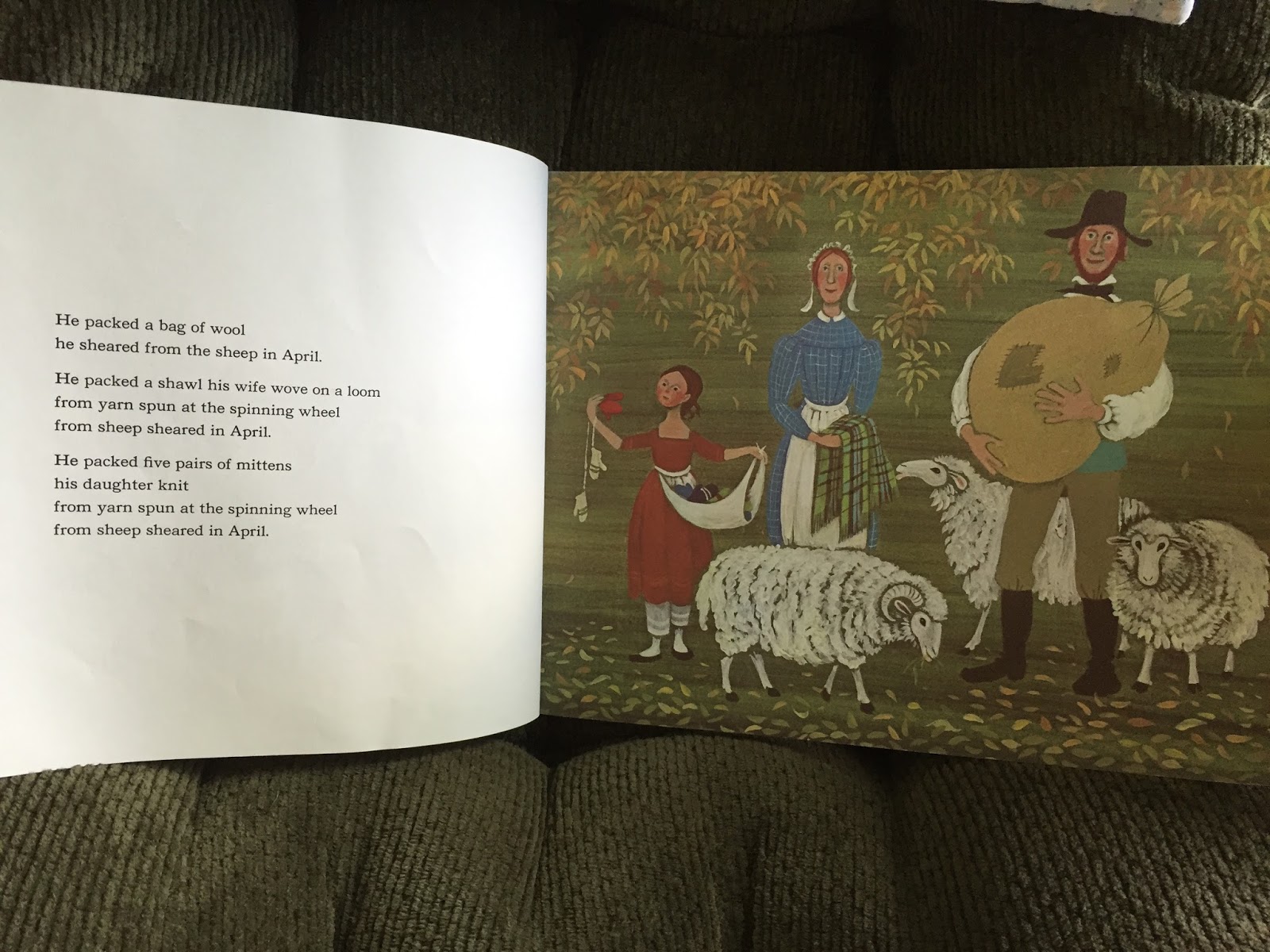
The book then proceeds to show the reader what the family did during the past year.


And then the trip begins.


There he sells his wares.


And with the money he earned,


He then walks the long way back to his home.


And the cycle of the year starts all over again.


A very satisfying book that quietly shows the warmth and love of family life, and the good, honest work that keeps the household going.