Showing posts with label A monthly reading of Jacob's Room is Full of Books. Show all posts

Tuesday, December 18, 2018

Jacob's Room is Full of Books - December


"I come inside. And close the door."
With these words, Susan Hill ends the month of December, and this wonderful book. I felt a sadness that surprised me. I am thankful I'm going to begin her book The Magic Apple Tree in three days, but I am still hoping so much that she will continue writing these nonfiction gems which are Howards End is on the Landing and Jacob's Room is Full of Books. I don't really have words for how much these books mean to me. She pulls me into her heart and into her thoughts over and over again. And it is just where I want to be.

If she continues on, I hope that she writes about the book which the title comes from. I was hoping for a few pages on Jacob's Room by Virginia Woolf. I am missing VW. It has been too long since I have been completely caught up in her books. I believe Mrs Dalloway was the last one I read, and that over a decade ago. I would also like to read Howards End again. It has been ages. I tried to watch the latest television version but just didn't enjoy it.

After reading,
Some words, some sentences, some names, some stories are part of the fabric of my mind, part of the store of references and images I was certainly not born with but which I began to acquire and memorise as a child and continued to absorb through all my growing up and into adulthood. I heard the Bible being read and the prayers of the Church of England services - the words of Morning Prayer, the Eucharist and Evensong, the Collects - all from The Book of Common Prayer and the hymns from The English Hymnal. I am still surprised at how much I know of all this by heart, and I was not from a vicarage family. I wasn't alone. Everyone used to know chunks of the Bible because they heard it without fail every Sunday, and those who could not read it did not really need to, they listened and remembered over the years. ...
It makes me sad that the Bible, the Prayer Book, the Classical canon are not part of my own children's fabric. The rot set in forty years ago or more. I doubt if they know anything much by heart and it is not their fault. Schools regard learning by rote as time-wasting and sterile and how does a rich store of literary and cultural references help one in Real Life? 
The Collects are a particular source of beautiful cadences and deep meaning. They are inspiring, and comforting, and they are all quite short, so reading the Collect of the Day each morning takes only a couple of minutes. You need not be a believer to gain a lot. This reading is a form of meditation and mindfulness and goodness knows, those are all the rage. I think the Collects strengthen one's mental immune system and guard against all manner of ills. Is that just me? 
Oh God, 
you know us to be set
in the midst of so many and great dangers,
that by reason of the frailty of our nature 
we cannot always stand upright:
grant to us such strength and protection
as may support us in all dangers 
and carry us through all temptations;
through Jesus Christ your Son our Lord. 
I decided that I'm going to take her words to heart and begin reading a Collect every day from the Prayer Book I received when I was confirmed.


She tells a lovely little story about being on the beach at this wonderful time of year when not many people are about.
A man came towards me and said in a low voice that on the old gate down there was an arctic finch. I followed his pointing finger to it. Pretty, nervous little bird, but sitting bold as brass on the top strut of the gate, and unmistakeable. 
Soon some birdwatchers appear. "Word had got out, It only takes one text message." But as she walked back to her car she was "hugging myself with secret delight that for a moment or two, the quiet man and I had had it all to ourselves."


She mentions in passing a book that I bought almost three years ago for Tom.


He loved this book, and learned a lot from it. Susan Hill said it was a best seller! Who would have thought. Makes me very happy.

And she introduced me to something completely new! Fat balls. I'm sure all my UK readers know exactly what they are. Over here we call it suet, and it comes in little square plastic containers. No plastic with the fat balls. I'm looking into getting some. They sound like a great idea. For my American readers, this is what they look like.

There are special holders/feeders for them. There's even an Alan Titchmarsh one!


So, Collects and fat balls! I ask you, does a writer get more eclectic than this?!

The pleasure I've gotten from reading this book over the past 12 months is immense. As I did with Howards End is on the Landing, I'm certain to read it again. And, as I said, I do so hope she continues on.

Thursday, November 15, 2018

Jacob's Room is Full of Books - November

I came away from reading the November chapter thinking how much I like this woman. I so like learning what she thinks about all sort of things. This month began with a mention of a hymn, For All the Saints. If you don't know it, here is a version with the words. I'm not wild about the pictures, but the videos from church services didn't offer words.


Personally, I like it sung just a wee bit faster!

Susan Hill writes:
'For All the Saints.' One of the best hymn tunes. As with the Bible and The Book of Common Prayer, you do not have to be a Christian, or even a believer, to appreciate and be uplifted by hearing a church full of people singing something out of Hymns Ancient & Modern. Modern hymns are awful. I don't know why they bothered. If they felt the words were outdated, and so of limited appeal to the young, it would not have been beyond the wit of an Anglican subcommittee to write new ones to old tunes. But no, the baby went out with the bathwater and we got slush and soup and sentimentality.
And to this, I say Amen! This is a subject very dear to my heart. Changing the hymns, changing The Book of Common Prayer, changing the old and beautiful language and for what? Did they really think that young people would come to church or stay in the Church if the language was different? I just don't get it. I grew up in the Episcopal church. I was a child, a teenager, a twenty-something. I never thought, oh, I wish the language was cooler, more colloquial, more relevant, whatever that means. Let's change the language of Shakespeare or Yeats or Wordsworth or Wodehouse so the proverbial young will understand it better. I'll get off my soapbox, but it was nice to hear someone speak about this.

A very funny section that I loved.
There is a shorthand, shared among people who have read the same book more than once, and mostly they are parents. Once learned, the words of the stories stay with you for a lifetime. In the doctor's surgery, I sat near a mother reading to her 3-year-old. 
'So Chicken Licken, Henny Penny, Cocky Locky and Drakey Lakey, scurried off to tell the King that the sky was falling in.'
She turned the page.
'You've missed out Ducky Lucky,' I said, beating the 3-year-old to it by a nanosecond.
And
A friend made a comment on Facebook about someone's new dog. 'It looks like Bottomley Potts,' she said. 
'All covered in spots,' someone chimed in at once.
Someone else contributed, 'Hercules Morse ...'
'As big as a horse ...'
We had finished the entire book in the time it takes to drink your morning coffee, (Facebook being the solitary writer's social break in the middle of work.) How many people know Hairy Maclary from Donaldson's Dairy as well as our little gang?
I wanted to raise my hand and say I do! Well, I don't remember all the words, but we read it in this house, and I walked around frequently saying Bottomley Potts. I wonder if the kids remember? I might get a copy for the little ones.


Living on a hill, and not near water, I was amazed to read
There have been morning mists, beautiful soft mounds of it lying over the water, but today there was a dense fog. Apparently, ambulances were not able to go out last night, it was so thick - visibility down to a few yards in places.
Susan Hill, who is in her seventies, writes something all of us who have a few years on us can surely appreciate.
Snow in Yorkshire. Snow forecast nearer here. I hope we are going to get a hard winter. Today the advice of those non-medics employed to nanny us is for the over 65s to keep warm in cold weather, by eating hot meals and drinking hot drinks and wrapping up. I wonder if they ever sit back and ask themselves to whom they are talking? Those of us who lived through the years before central heating, who were not sent out in the morning without having eaten a bowl of porridge, who wore liberty bodices for Heaven's sake, and a vest and a school skirt and a cardigan and a coat with a lining and long socks inside of boots and ... Meanwhile, I sometimes pass school bus stops on bitterly cold mornings and see all the teenagers waiting to be transported to school, without coats and the girls in skirts reaching only to their thighs, hatless, bootless ...
Toward the end of the November chapter, she writes about Christmas lights. Actually this is another thing I have quite a strong opinion on.
The Christmas lights switch on. Always fun, always too early. The lights themselves are hideous, as they all are now, because they are the starry bright white halogen sort, and do that insane chasing round and round. What with that and the electric blue ones, it's enough to give anyone a migraine and epilepsy combined. The churches' lights are always pretty, though, softer, slightly golden - and theirs stay still.
So, you might ask, what does Nan object to in the current Christmas lights? Well, I should begin by saying I am a Christmas traditionalist. I have a real tree. I put it up after Thanksgiving. I have a creche. I play only Christmas music in the house. But most importantly I use the big, hot, primary color Christmas lights. To me they say Christmas. All the other lights I see are small, neon-ish in color, and yes, some of them do chase. I avert my eyes and shake my head. I'm not sure what she means by the "starry bright halogen sort." We have white lights that hang along the porch year-round. We've always called them "fairy lights", I suppose from some reference we read ages ago.Those I love. Not for my tree though.

In light of the news today from England, I thought I'd try and find out if Susan Hill was for leaving or staying. I had a hunch it was leaving. I found a little piece she wrote here, if you are interested. To an American, this divisiveness is much like it is over here between people who are for or against the president. Personally, I don't choose my friends based on their political beliefs. Our very best friends, the people we love best in the world next to our kids, are polar opposites to us when it comes to almost anything political. But it doesn't matter. They know us and we know them. We accept each other, period. No judgement. Just love. (I feel like I'm channeling Gladys Taber here.)

There is only one more month for this book. I'd be very sad if I didn't have The Magic Apple Tree to look forward to.

Monday, November 12, 2018

Jacob's Room is Full of Books - October

As I near the end of this most wonderful book, I find myself hoping so much that Susan Hill will write another and another and another like this and Howards End is on the Landing. They are as food and drink to me. My mind and heart are expanded with every chapter. I am in the presence of a real scholar, though she says of herself, "I am not scholarly material."

I feel like October is a pensive month, especially the second half. The days get shorter, daytime itself gets darker, and often the rain or snow prevents outside activities. This makes me happy, as I've noted probably too many times before in the almost twelve years of Letters from a Hill Farm. I am an introvert (not shy), I like sitting and reading, I like time to be quiet and think. So October and November suit me perfectly. The October chapter is 31 pages of many deep thoughts, and I was in reading heaven.

Susan Hill writes about Rievaulx Abbey.


If you arrive late and out of season, when the sun is going down, you really can get some sense of what life was like in this bowl of the Yorkshire Dales, where sheep bleat through the soft air and the light gleams through the majestic ruins, archways, slit windows, whole 'rooms' and magnificent spaces.
And
I am glad there is so much left of Rievaulx. When you stand alone there, even though the sky and not a roof is over your head, you can hear the whispers of monastic chant and the faint ghostly swish of the heavy robes, see the shadowy procession of hooded figures on their way to and from the chapel. And there is nothing remotely spooky about it. 
The author goes on to talk about Aelred of Rievaulx.
I came to love Aelred because I came to know him. So much of that time is very distant and different, yet there is enough left of Aelred's writings, we know so much of his life and personality, that he can come closer to us than many who have lived later. ... Aelred was a great and good man.
And how did she come to learn about him? Well,
A decade ago I did what I had longed to do since 1963, when I received my first degree, and started to read for another, an MA this time in theology. Having been brought up in a Catholic convent, and spent many years as an adult Anglican,  ... I felt - and indeed, still feel - that I knew too little about the basis of and background to it all and about various aspects of Christian history. But I wasn't about to return as a full-time student to what is now called the campus, I studied by distance learning. If you have already taken a first degree, and especially if you are older and doing this voluntarily, and so anxious to learn and put the hours in, this is an ideal way. The internet has made it all possible. My essays were e-mailed in and marked and returned by the same route, but nice, fat, printed books of the modules came by post.
I loved the course from Day 1. I immersed myself in it as in a warm bath.
So, you see what I mean about her being a scholar!

Suddenly, she stops and writes this beautiful sentence.
A long skein of pink-footed geese has just gone over towards the marshes.
She offers a wonderful granddaughter story.
Lila was only two and visiting once when the owl man appeared to do his ringing. He brought a white cotton drawstring bag, and came right to the house, by the back door, so that we could all watch. My grand-daughter stared in amazement, her eyes really like saucers, as he drew out the young owl from the bag, inspected it, let it open its wings to their full extent - which even on a baby owl is pretty wide - and then ringed it without any fuss, folded its wings gently together and slipped it back in the cotton bag. Two and a half years later and she still remembers.
Susan goes on to write about her granddaughter and books.
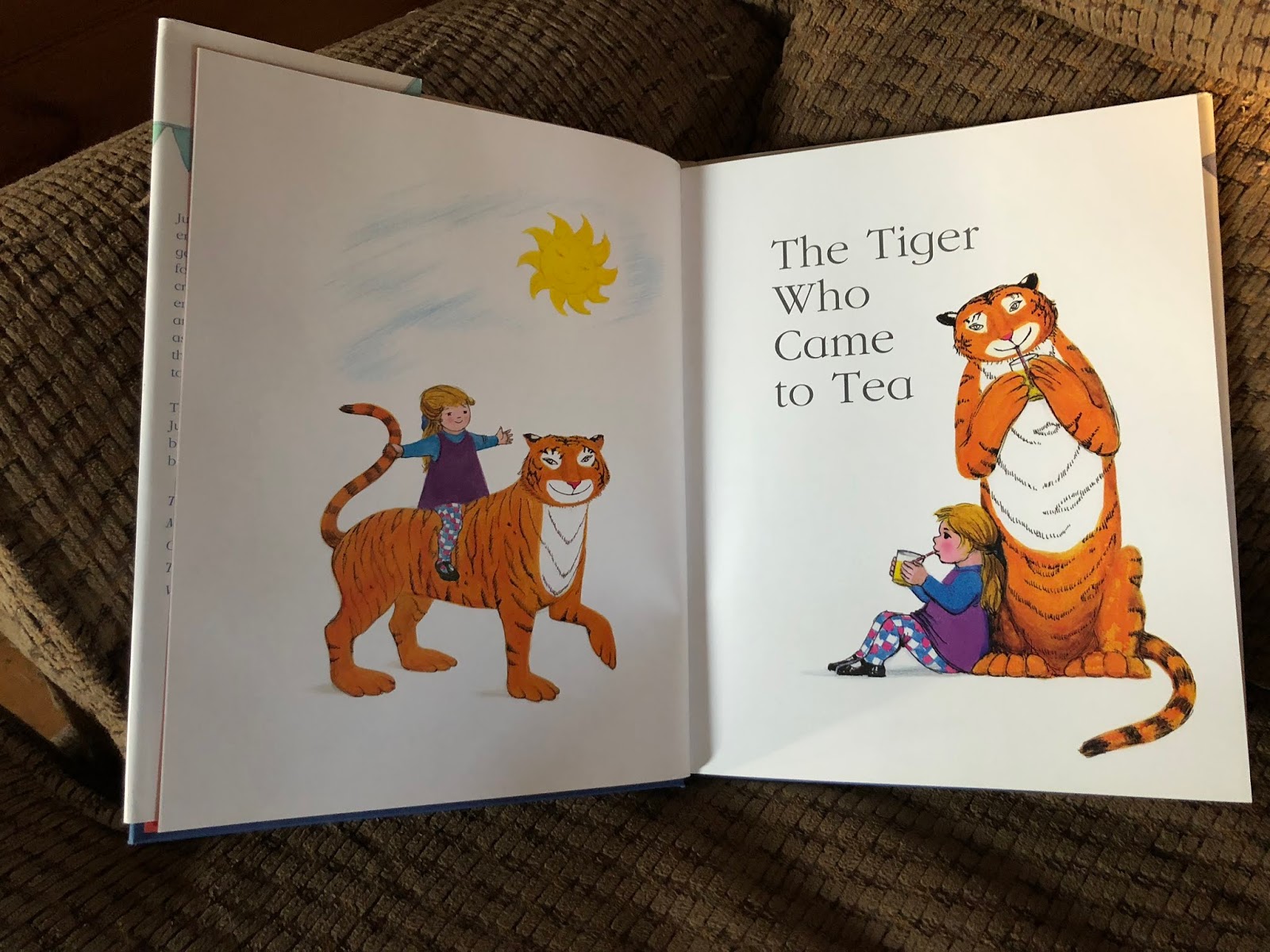
It is a joy that she is now having read to her some of the stories we read to her mother, and often from the very same copies. The most recent favorite is Tales of Polly and the Hungry Wolf by Catherine Storr, which was loved by us all thirty-five years ago. Lila's father does a very impressive wolf's voice. And so the same stories are re-born over and again. The Elephant and the Bad Baby, Stanley & Rhoda, Each Peach Pear Plum, Burglar Bill, Mog the Forgetful Cat, The Tiger Who Came to Tea and so on, to My Naughty Little Sister, that everlasting favourite, and now, to my delight, The Magic Faraway Tree.
As you might guess, I loved this so much! We have passed along quite a few of Margaret and Michael's books to them so they can read them to their little ones. We've read a bit to Hazel over the years, though not too much because often with children, much of the reading happens at bedtime. We're looking forward to Hazel, Campbell, and Indy staying overnight when they get older. In fact, right now we are working on the HCI room! Tom has finished the painting. We'll go about it gradually, buying beds, etc.

I think I've mentioned that when we brought the kids to England, Ireland, and Wales in 1992, we bought tapes over there to listen to in the car. The very most favorite was The Magic Faraway Tree. My kids still do perfect imitations of the narrator saying, "Saucepan". We also own two of the stories Susan Hill mentioned - Mog the Forgetful Cat and The Tiger Who Came to Tea.


They are in this collection


which was given to me by my long-time blogging friend, Val, last year. Of all the books we have, this is the one Hazel asks for the most.

This month's The Oldie magazine has an article on Judith Kerr.


She is 95, and still takes walks and has written a new book! In this country I think she is best known for When Hitler Stole Pink Rabbit. It was in Tom's classroom library when he taught 7th and 8th grades.

There is much, much more in the October chapter about authors and prizes and writing and even eels (yuck, me says).

Monday, September 24, 2018

Jacob's Room is Full of Books - September

Susan Hill's September entry was only 11 pages, the shortest yet, but somehow it didn't seem short. Perhaps because there were fewer "subjects" with more information on each? September finds her in a rental cottage in France. Doesn't that sound nice? I would like to say, "September finds me in a cottage in the French countryside." The weather however was very hot for some of it, and she, like me, wilts in the heat and humidity. 34º C. which is about 93º F. Yuck. Thank goodness my September has been cooler. We've even had a couple frosts, though they haven't been the "killer" frosts when even covering the tomatoes doesn't help. So we continue to eat tomatoes right off the vine.

Of course what Susan Hill does on such a vacation is to read. She's brought books from home, but also is interested in the books that other renters have left-behind. I love that idea of leaving books you are done with, and picking up some that others have left. It's like those little free libraries that have sprouted up in the US (and other places?).

If you were hoping for a list of authors, as I was, she doesn't disappoint.
They fascinate me, those holiday reads, and I have studied a good many in my time. Indeed, I have compiled a list of the authors whose books - always in paperback - are most often found in rented properties, both at home and in France. I start going through them as soon as I have unpacked and I rarely score fewer than five.
The list does change every few years.
This year the bookcases have contained, in no particular order: Joanna Trollope, Dan Brown, Jenny Colgan, Stephen King, Daphne du Maurier, Victoria Hislop, Ian McEwan, Val McDermid, P.D. James, Ruth Rendell, Jojo Moyes. And Gone Girl and The Girl on the Train. Captain Corelli's Mandolin has not been found for a while. 
 Several authors dropped off the bottom a couple years ago - Catherine Cookson, Dean Koontz, Gerald Durrell, Peter Mayle. John le Carré comes and goes.
This year there are a few surprises. Olivia Manning's Balkan Trilogy is here. So are books by Julian Barnes, Martin Amis, Elizabeth Bowen, Patricia Highsmith, Jeanette Winterson - and Jane Austen, Dickens, Charlotte Brontë, Hemingway and Raymond Carver. An upmarket bookcase then.
Would you be tickled to find such authors in your rental house?

Susan Hill goes on to discuss Olivia Manning in quite some detail, which pleased me because last year I bought both The Balkan Trilogy and The Levant Trilogy. Of course, I haven't read them yet, but they wait patiently on my shelf.

I am struck in this month's passage, as I am every month, at what a reader Susan Hill is. Writing of the two trilogies, she says
This summer's re-reading must be my fourth, and each time the books yield something new, perhaps because as I grow older I understand more.
FOUR re-readings!!

You know how in late spring the buzz is always about what the upcoming "summer reads" will be? I've never quite understood because my reading doesn't change with the seasons. And I don't go to the beach. If I did, I'd be swimming or walking, not reading.
... beach reads. I was slightly mortified when a friend on holiday in Turkey reported seeing three people reading one of my crime novels on a beach - I have never taken them too seriously, but for a split second I thought, 'I didn't realise they were as bad as that.' 
What a delight this woman is to me. She is scholarly, interesting, informative, witty, and funny. Reading this book is a bit like taking a course from her, and I am loving it.

Friday, August 24, 2018

Jacob's Room is Full of Books - August


The August chapter of Susan Hill's Jacob's Room is Full of Books seemed to zoom by. I actually counted each chapter's pages because it seemed shorter. August was not the shortest but it was second shortest. June was 13 pages, while August was 15. Most were in the teens, with April and May in the twenties, and May a whopping 30. Why this interests me, and why I thought it might interest you, I have no idea. I suppose it is just like writing a letter or a blog post. Sometimes we have lots to say and other times we don't.

Anyhow, though so short, it was one of my personal favorite months. Not the least of the reasons is that Susan Hill led me to a book, Corduroy, which I had bought on the recommendation of a blogging, Instagram, and Facebook friend who is also an author. I wrote about her book here. She and I share a love of the Olde Country, and when she recommends a book I know I will enjoy it.

Hill quotes a passage from a book, and then says, "I wish I had written that." Those words may just be the highest praise a writer can give to another writer. That book is Corduroy, "the first book in a trilogy about Suffolk country life before the last war by Adrian Bell."

I won't quote the whole of it because it was quite long, but this will give you an idea of the beauty of the writing.
'The men move homeward from the field; the last load creaking up the hill behind them, the hoofs of the horses thudding, their breath sounding short. Peace comes, a vision of the fairy armour of moonlight, the peace of 'man goeth forth unto his work until the evening'
Having just finished a book last evening, I was ready for a new one, and went right to the shelf and pulled down my Corduroy. How could I resist after reading such words?! You may read more about the author here. Hill says that Bell's books are a "record of farming life written by an outdoors person who had a poet's eye and pen." As I have noted here before, the time period and place I would most like to live in is England between the Wars. So, this will be a perfect book for me. Who knows when I would have gotten to it if not for Susan Hill mentioning it?

I don't pay attention to book awards so I had no idea of the controversy surrounding the 2011 Man Booker prize, for which Susan Hill was a judge. She says,
It has gone into folklore as the year the judges were of inferior and 'populist' quality who had not a clue about literature. I read that I was 'supremely unqualified' for the task. I do wonder how else I might have improved my chances of being qualified. I have a first class honours degree in English from King's College, London; I have published over fifty books, including several prize-winning novels; I have been a regular reviewer of fiction in a wide variety of newspapers and journals since 1963; I introduced a TV book programme, presented BBC Radio 4's Bookshelf and A Good Read; and I have been not only a previous Booker Prize judge but a judge for every other major fiction prize. In what way was I 'unqualified'?
Before I go on, I just think it is horrible how people - all people, not just politicians - are criticized by the media. One must have to have an awfully tough skin to not feel terrible afterwards. What right does anyone have to say such things about a person? I just hate it.

She said that 2011 "was not a vintage year for literary fiction." Still, the judges had to read over 120 novels. 120!! Can you imagine? It was very difficult for them to come up with a longlist of books they
felt were worthy, and if the criterion was, as it must be, that every book included was a potential winner of the prize, then we failed because, hands on heart, we did not feel that one or two of our longlist choices were worthy of winning.
As for the shortlist they had no doubts, and yet when it was announced they were strongly criticized to put a novel on that list by a certain person because he was gay. It was an absolutely ridiculous accusation. One of the judges wouldn't answer on principle, another said he hadn't even known, and others felt it was completely irrelevant - that the winner is chosen by the book not on the author's sexuality.

I wouldn't be a judge for love nor money! Susan Hill talks, as a reader, not a judge, about her own reading of winners.
I always wait until at least a year after any of the prizes before reading those on the lists which appeal. It is amazing how everything settles down and finds its natural level. Hype never did any reader much good.
She writes of the book that actually won the Man Booker in 2011.
I recently re-read The Sense of an Ending, the Julian Barnes novel which won the 2011 Man Booker Prize, for which I was a judge. The Barnes was my choice. It was the almost-unanimous choice of the panel. It is a slim book - Barnes is not one to turn out 700 pages. But within its short space it contains truth, beauty, sadness, shrewdness, observation, intelligence, poignancy, self-pity, a man's coming to terms with his past... everything one can think of about the human condition and more.
And now I have only four months to go in this wonderful book. Each month I learn so very much about many subjects, and am so enjoying myself.

Thursday, August 2, 2018

Jacob's Room is Full of Books - July

My blogging friend Cath at read_warbler wrote today that she hates the month of July, and in Jacob's Room is Full of Books, Susan Hill says
The deadly months. July and August. The weather often disappoints, the birds have stopped singing, the roads round here are crammed with mobile homes and caravans being towed, the beaches are also crammed full and, yes, it is thoroughly selfish of me to complain about it. But winter is best here. Empty everywhere. In high summer it is best to get back from any shopping trip by ten o'clock and then stay in the garden, to read, or write, cold drink to hand, intermittently watching the swallows high overhead.
Anyone who lives near the ocean, or the mountains, or any tourist destination knows this sentiment. Often these areas are dependent upon tourist money to keep afloat. Many people do the seasonal jobs, and switch them with the seasons. There is a bit of a love/hate relationship with all the people who come. I've not had this kind of job, but I know that some workers are driven crazy by the demands the occasional tourist puts upon them.

I found this interesting.
It is a sad thing when you discover that a book you loved beyond many, a book of which you knew whole paragraphs and conversational exchanges by heart, a book you thought you would be wedded to for life, has lost its appeal, its charm, its ability to amuse and entertain, delight and impress. How does this happen? Does it mean the book has become dated, or outdated, its humour old-fashioned, its charm rusty, its brilliance tarnished? Was it a book you simply grew out of? Or one that, as you read more and got more life experience, could not keep up with you? Was it simply not up to the job, did it not bear any more re-readings, yield any more wisdom, reveal any new aspect to the wit, so that you laughed again but in a slightly different way?
Do you feel this way about any particular books or authors? For a reader this is kind of like a break-up, or a slipping away of a friendship. You can't always put your finger on it, but you know that something has changed. Susan Hill goes on to tell the reader
What I am saying is that my love affair with E.F. Benson's Mapp and Lucia novels seems to be over. There are odd things that still delight... But I droop after reading three chapters of any of them and I no longer smile at all. It was a blow when this first happened. I decided it was just me and left the books alone for a while. But it went on happening. I found myself becoming impatient with these silly people - and that was fatal.
Over the years of email groups and blogging, I've known a lot of people who absolutely love these books. I wonder if they would understand what she means. Personally, I saw Mapp and Lucia first on PBS ages ago, and could not stand the women! I never even tried the books.

Susan is very concerned about the decrease in small nesting birds.
In his Natural History of Selborne, Gilbert White records not only dozens upon dozens of sparrows but of every other sort of 'common' bird - thrushes, blackbirds, finches, tits - as well as the migrants. ... Even in my own childhood, there were probably several hundred percent more song birds than now. The telephone wires were lined with swallows and martins, the air thick with swifts.
The loss of so many over the last hundred years or so is forgotten - everyone talks about the pandas and the tigers and the giraffes, and of course they are important. Meanwhile, not far from home, people trap thousands of small birds for food.
And she later writes
Watched a hen harrier on the marshes. There are several pairs, always visible, swooping across, looking for prey. They were rare once, but now they are common. The campaign to make hawks protected birds has seen to this, so they breed safely and murder small birds unhampered.
It is really difficult for me to read all this. Heartbreaking.

She writes of one of her (and my) favorite writers, P.G. Wodehouse. She has encouraged people to read him, and
some cannot get past the receding chins, the brainlessness, the vacuousness, the frippery, the juvenile mentality of the characters. The only one to whom none of the above descriptions apply is, of course, Jeeves. Lord Emsworth sometimes succeeds where Bertie Wooster fails, but I never press home my argument about Wodehouse, because if the magic doesn't work, it doesn't and never will. It is the uncomprehending reader's loss. Nobody half likes Wodehouse... You are an addict or you are left stone cold.
I openly admit, I am that addict. I've often said that his writing is second only (maybe) to Shakespeare's. I agree when Susan notes that he is a "master of the language, whose plots and characters are of second and third importance to the writing."

Another wonderful month spent in Susan Hill's company.

Sunday, July 15, 2018

Jacob's Room is Full of Books - June

The only mention of the natural world in the June entry of Susan Hill's Jacob's Room is Full of Books is that she goes to France for a month every year, sometimes in June and sometimes in September. When she goes in June, she misses the irises and the peonies, "but June is the best month in France." She doesn't offer much description except to mention the roses and swifts. And the wild boar which are "menacing then because they have young." One year she hit one on the road. To me, these are among the world's worst creatures. They did not originate here but were introduced in the 1500s. You may read more here, if you really want to!

The rest of her month is devoted to a variety of interesting subjects. She begins with literary prizes.
It ill behooves me to complain that there are too many book prizes, having won some in my early career. They came at just the right time, they were lifesavers in terms of the money, but more - they gave me confidence that I was right all along. They were recognition. And they are there. No one can take them away. Forty-five years later, they still count.
So I can't complain. But every year the prizes proliferate and every year, a few of them at least come to mean less - particularly the lucrative prizes for the best short story of the year. £20K or £30K for one story? These almost always go to unknowns who may have written a single stunning story and then vanish without trace. The point about book prizes is partly to give the recipient's career a boost, to provide time and financial support for them to climb the next rung of the ladder.
Such an interesting section because she has been both a winner and a judge so she has a unique outlook on the whole business.

Susan goes on to talk about "lit fests." Have you ever been to one? I wonder if they are similar to the various mystery conventions we have in the US. Anyway, she says the large ones
get large sponsorship, from newspapers or TV companies or local magnates with deep pockets and cultural aspirations. Small ones survive on volunteers and goodwill. Often they cannot pay authors, in which case the authors have to decide whether the gig is worth their while.
But the joy of the lit fest is meeting with people who come to say they have always loved your books, or that this one has meant much to them, or that one kicked off their teenager's love of reading, or was their late mother's favorite ...  I asked the organiser of one small book festival why they didn't apply for Arts Council or area arts funding. They had. They were turned down because lit fests are, apparently, too middle class.
Completely fascinating.

She has a personal slant on Edward VIII, who became the Duke of Windsor, and Wallis Simpson. They are an endlessly interesting subject to so many people, and I loved reading what Susan Hill had to say.

She offers The Old Shepherd's Prayer by Charlotte Mew which brought tears to my eyes.
Heavenly Master, I wud like to wake to they same green places
Where I be know'd for breakin' dogs and follerin' sheep.
And if I may not walk in th' old ways and look on th' old faces
I wud sooner sleep.
Susan Hill ends the month with three cautionary tales, two of them concerned with social media and the other with bullying. Lives were changed. A doctor was
tricked and betrayed by her fellow partners, maligned and undermined by a process of passive-aggressive bullying, to the extent that she was forced to resign and lost her confidence as a doctor. ... It broke her, and when she was exonerated and proven innocent of all the trumped-up charges, it was too late. The damage was done.
She took early retirement and has not worked since.

The other two instances, one involving the author herself, were horrendous examples of the dangers inherent in bullying on a huge scale via the internet. Very upsetting.

I am so enjoying this book. Honestly Susan Hill knows so much about so many things that I read her with awe.

Monday, May 28, 2018

Jacob's Room is Full of Books - May

I wonder if any readers are drawn to read either Howards End is on the Landing or Jacob's Room is Full of Books who are not familiar with the books in Susan Hill's titles. Just for fun I went to Facebook and typed in EM Forster, and was pleased to see that the page is "liked" by some 65,000 people! Now that is heartening! Of course the new film of Howards End must lead some viewers to the book. Forster is one of those authors whose books have been made into movies, so he may indeed be an older writer who is still read. I did a search for Virginia Woolf, too, and that page has over 900,000 "likes". Makes me very happy.

One of the joys in reading Susan Hill is all the different things she writes about. I find it delightful that she can go from PD James to Texas Hold'em poker in the blink of an eye.

This poker was quite a surprise to me!
I learned Texas Hold'em, teaching myself via an app, and then played a lot online. Too much. I had to stop, not because I was losing - I was breaking even overall and anyway, I never played for high stakes - but because it is very addictive and time-wasting. No, not 'wasting'. I enjoyed it, it was a mental challenge, and I was improving all the time. But time-consuming, certainly. I began to find myself playing every night until the early hours. Time to stop.
And then she continues
But knowing the game has made re-reading Casino Royale much more exciting.
She writes of Thomas Hardy
Hardy was a melancholic man, glass only a quarter full. He had no optimism, no hope for man or the universe. ... What a delineator of character he was. And people talk about Jane Austen. 
I loved Hardy when I was in college but I haven't read him since. I think the gloom may have been easier to take before I knew much of the world.

Soon after reading this sentence,
The cuckoo is driving me mad, from dawn, yet for several years he was barely heard here. I defy anyone to explain. 
we, too, had a bird return. The whip-poor-will is back! It has been gone from Windy Poplars Farm since the 1980s. They have been declining in the Northeast for decades, and the Audubon Society is trying to figure out how to bring them back. This is a most interesting article. The first night it was down the road, another night it was quite distant, but the past two nights and early mornings it has been close to the house. In other bird happenings, we have a red-eyed vireo for the first time. And the phoebe which has nested in the barn for years is gone, but at Margaret's house a phoebe came back to the very same nest it made last year on the porch. Susan Hill is right. Who knows? There is no real explanation about birds. Just magic.

She ends her May entry with a discussion of Gilbert White, my favorite writer whom I've never read. I've read snippets, I've read about him, but never sat down with his Natural History of Selborne. So I've finally bought a copy.
It is always a delight to read his Natural History of Selborne, at random or 'on this date' 250 years ago. He seems so close to us, with his weather and nature and gardening reports. So many things remain. He waits for the first hirundines, records when the swifts are very late, weighs the tortoise and seems to grow enough cucumbers to feed the county. He feels friendly to me as I read, cheerful, methodical, modest, inquisitive, a man in tune with the natural world around him as if it were part of him, ... White is useful, too, for correcting one's feeling that never was a July as hot as this, swallow so early, oak so late in leaf, winter so mild, tortoise so regular in its habits. The sun rises and sets and the moon waxes and wanes and the tides are high and then low and the Earth turns on its axis, for us as for Gilbert White. That is comforting.

Sunday, May 20, 2018

Jacob's Room is Full of Books - April


I read the April entry of Jacob's Room is Full of Books in the proper month, and decided to re-read it again before I did a post.

In one of those glorious moments of serendipity which happen now and again, I read Susan Hill writing about A.E. Housman's Loveliest of Trees, 
And since to look at things in bloom
 Fifty springs are little room. 
just after I had seen Monty Don's Instagram photo of blossoms (maybe apple not cherry) and his words:
No apologies for yet more blossom. There is no life long enough to have too much. 
If you'd like to follow him, you may go here. So much beauty - plants and his dogs!

There is quite a lot about the author Edith Wharton this month. I've only ever read Ethan Frome and that's when I was a kid. I hated it.
I discovered Ethan Frome and disliked it. Others think it a small work of genius, but there is something stark and cold about it and it did not ring true to me because it was set in rural America, and above all Edith was a city woman. Still, it is regarded as a great short novel, so I am probably wrong.
I was surprised to hear her say that. I don't think any reader has to feel badly if they go against the flow of opinion about a book. I'd be apologizing all the time in that case! I'm always surprised when I like a book which has also gotten public acclaim.

Susan Hill really likes The House of Mirth, The Age of Innocence, and The Custom of the Country.
She was a great student of human nature. She understood women, but she also knew an unnerving amount about men. She writes about social ambition, social aspiration, social climbing - the nuances of society, and about the cruelty with which it can appear to accept, only to exclude and cast off, any who are not within its charmed circle by right of birth or at least marriage.
Susan Hill writes about Wharton herself:
If you are born into an aristocracy of whatever country, you are an aristocrat for life. You are rooted in a society to which so many aspire to belong and which has formed your taste, manners, beliefs, assumptions, for good, no matter where else you may travel to or in what other country you may settle. It is important to remember this in order to realise just how extraordinary Edith Wharton's life turned out to be, and how unlike most of her own class she became.  ...  She was one of those children who are unhappy not only in their families and backgrounds, but even in their own skin. She was destined to fulfil herself as an adult but her early years were unhappy, because she was bright and noticed things, and because her mother was cold to her. She loved her father deeply, but he was a weak man who vacillated when she asked him to stand up for her against his wife, who even forbade EW from reading novels until she was married.
I found this fascinating. Though I am not interested in her novels, I agree with Susan Hill that "You could find much interest and enjoyment from reading all about her in the good biographies without reading a word of her fiction, and there are coffee table books about the gardens she created, and about her interior design, mainly but not only for her own houses in both America and France."
She was living in Paris when the First World War broke out and very soon afterwards, in August 1914, she opened a sewing workroom for thirty unemployed women, feeding them and paying them a modest wage. The thirty soon doubled to sixty and their work was in demand. She established a hostel for Belgian refugees, and organised the Children of Flanders Rescue Committee, which eventually looked after almost a thousand child refugees who had fled their towns after they had been bombed by the German army. With her friend Walter Berry she even travelled by car to the war zone, coming within a short distance of the trenches, in order to see at first hand what conditions were like. She compiled and edited a book in aid of war victims, prised money for them out of wealthy Americans and was awarded the Légion d'honneur by the French government. And all this time she continued to write novels, essays, stories - and kept up a large correspondence.
Whew! I quoted so much because I found it amazing, and I thought you would be interested if you didn't already know. The biography she thinks best is the one by Hermione Lee.

She writes of having trouble with moles in the lawn. She won't let anyone kill them so she tries solar mole spikes "and they are not cheap." You put them in the middle of the hills and they emit a noise the moles don't like so they move along. They work! We don't have a big problem with moles. Mostly they are in the field. But I'm glad to know a solution if they do start building on the lawn.

The author has some beautiful pages about trains. There is steam train near her that offers "special steam events - the Santa Train, the annual 1940s weekend" but it also runs on regular days, too. I can't imagine how wonderful it must be to get on a steam train to go do your errands. She says that "steam to those of us who knew it well had an especial charm - though not so much for the railwaymen, who mostly died of lung diseases caused by the smoke and coal tar, or were old at fifty, backs broken from shovelling the coal."

She quotes some wonderful poems about trains, and tells the reader about nicknames for trains.
The last time I heard anyone refer to the old railway companies by their nicknames was in the 1970s when a friend said he was off to watch the cricket but was not taking his car. 'I shall go by the Slow and Dirty.' That was the Somerset & Dorset Joint Railway. LNER (London & North Eastern Railway) was Late and Never Early. LMS (London, Midland, & Scottish) was Late, Mouldy and Slow. And of course the GWR (Great Western) was God's Wonderful Railway.
Aren't they just great?!  She had to learn W.H. Auden's Night Mail by heart when she was in school. I wonder if anyone does that now.
This is the night mail crossing the border,
Bringing the cheque and the postal order.
Just those two lines make me feel nostalgic for something I've never even experienced. The only trains that went by my house were freight trains but we always ran to the 'banking' and looked down as they passed. Now those are gone, too.

Susan ends this month with a long passage on some people she knew - the artist John Piper and his wife Myfanwy. Her descriptions of them and their home were most appealing.
An Oxfordshire stone farmhouse, with a big barn to the right, converted as John's studio for his larger paintings. ... Myfanwy was a natural and instinctive cook and, long before it became fashionable, always used local produce, real meat, veg from the garden, other things from farmers or cheesemakers around. And it was far less easy to find those things then. ... I always slept in the Book Room, which was literally that, dark, comfortable, ever-interesting. You only had to look round, reach out a hand to a shelf, to find treasures, and often signed treasures by old friends. The 1920s and 1930s and 1940s, poetry, fiction, topography, France, Venice, art, John's own books, complete Shell Guides to Britain which he produced with John Betjeman. ... I could have spent days in there, looking and reading.
She goes on for pages describing her visits - the food, the conversation, the music, the studio, and John's work. I was thinking what a nice couple and what a lovely life they led. And yes, it was lovely but then we see that all of us have sadnesses, even those whose lives seem so perfect. Their son died, their granddaughter died, and John got Alzheimer's. I just stopped and thought quietly after I finished this April chapter.

Saturday, April 7, 2018

Jacob's Room is Full of Books - March


Though there is mention of many spring flowers, Susan Hill's Norfolk seems decidedly cold in March. She describes the wind thus:
I am not going out again probably until June. The wind is like a razor blade shaving off a layer of skin.
Can't you just feel that wind through her words?

And:
In the end I decided it was far too dangerous to go out. Slates were flying.
At the time of writing the book she has lived in Norfolk for five years. She muses on the notion of one's place.
Funny old county. Norfolk, though as I have only lived here for five years, I suppose that I am not entitled to comment. And I will never feel 'Norfolk' any more than I felt 'Gloucestershire'. What does that mean? It is a sort of patriotism, of the right kind. It is an instinctive rooted-ness in the corner of the country where one first saw the light of day. It is attachment. Love. Yes. But an adopted county can never be the same. I have lived in other counties for far longer than I lived in Yorkshire, where I was born, but they haven't left much trace.
Do you feel this way about where you were born compared to other places you may have lived? I wonder if this is a common feeling throughout the world. Do my American readers feel differently about this subject than my English readers? I wonder if living in a small country makes a difference. Fascinating food for thought.

I live about 8 miles from the house I grew up in. I lived on a street in a town, and now live in the country in another town. I don't look upon the old house as more 'home' than here. But I do look at my childhood hometown as 'my' town. Now this may be because I don't live in town, now. I don't walk the streets, and I don't know that many people here. My house and land here make up my world, whereas when I was a kid and later a young adult, the whole town was mine. As I said, fascinating thoughts.

There is quite a sad bit that Susan Hill shares with the readers of Jacob's Room is Full of Books about the late Duchess of Devonshire. Susan had (has?) a publishing company and
Nearly twenty years ago, I enjoyed thinking up, editing (with Sophy Topley, her younger daughter) and publishing Debo's book, Counting My Chickens. We had massive amounts of fun. ... My small publishing company sold many thousands of that book, and it rode high on the best-seller lists for ages. Her dedication reads 'To the co-editors, with love'. So I must have done something right.
But one day, about a year after it was published, I received a tiny envelope in the post which contained a letter on a tiny sheet of paper. I am not exaggerating. She was given to using very small sheets of headed notepaper inside very small envelopes. In this letter, Debo told me that she had put together a second volume of her pieces - my heart leaped - and that it was to be called Home to Roost. John Murray was to publish it. It was a done deal. 
What I did wrong and why she did not think my small publishing house worthy of her any more, I will never know, because we never communicated again. I was deeply hurt and very upset.
Susan had even "put together and privately printed" a collection of tributes - To Debo, on Her 85th Birthday. From Her Friends. She says that Debo cried when she got her copy.

This was really painful for me to read. But I don't think it is an uncommon experience to have someone suddenly "drop" another person, with no explanation.

She writes about two formerly well-known writers who are not well read today: C.P. Snow and J.B. Priestly. Have you read their books? Susan Hill knew both the men, and says of Priestly:
But I think he would have minded very much that no one much under the age of fifty has read or even heard of him - at least not beyond the brilliant revival of An Inspector Calls which is also a standard GCSE text these days. At least he would have been pleased about that.
It is a melancholy thing to consider once famous writers being forgotten, and how they would feel about it. On the other hand, they might be re-discovered. The British Library Crime Classics publications are bringing back writer after writer that many of us find delightful. And the whole e-books industry has introduced me to many authors I had never heard of. So, perhaps there is hope for Mr. Snow and Mr. Priestly.

Susan Hill tells a very funny story.
Took some books to the charity shop. Included a couple of my own, spare paperbacks.
Nice lady serving. 'Oh, thank you so much. Oh, and a Susan Hill book! She is very popular.'
SH: I'm pleased to hear it.
NLS: Actually - here are two on the shelf that are signed copies. 
SH: Wow!
NLS: Oh yes. (Leans over confidentially.) We can get 10p more for them if they are signed.
A little like being at one's own wake, isn't it?! 

She notes that:
I am certain that writers are formed in part by the books they have read and absorbed and it troubles me that not all writers or aspiring writers are Reading Writers. Increasingly, I meet creative writing students who do not read. They are ignorant of the best. They are often even ignorant of the worst. So how on earth can they want to write themselves? How do they know what it is all about? Read, read, read is the only advice I give, if asked. Read those writers who are better than you or I will ever be. In the end, that is the only way you will learn.
 Susan Hill's March chapter was quite pensive, with many thoughts about writers and reading from the Ladybird books to Robert Lewis Stevenson. I learned a lot and greatly enjoyed her literary month.

Monday, February 26, 2018

Jacob's Room is Full of Books - February


The reviews of Jacob's Room is Full of Books haven't been all positive. I don't have an opinion yet, but probably will by the end of December. It isn't much like Howards End is on the Landing. It is less about books and authors, at least so far, but I rather like the rambling from one thing to another.

The words from Jabberwocky popped into my head as I sat down to write about the February entry.

"The time has come," the Walrus said,
"To talk of many things:
Of shoes - and ships - and sealing wax -
Of cabbages and kings -
And why the sea is boiling hot -
And whether pigs have wings."

I'm not a big Lewis Carroll fan, but I do love this. Susan Hill goes from subject to subject, and I wish I were there beside her so I could say, "yes!" or "I don't agree." She even talks of cabbages (!) in the context of the bright colors at the greengrocer.

She writes of not liking stories with fairies in them, preferring goblins and trolls. She says,
What does our individual taste in matters like this, matters that actually don't matter, say about us? I wish I could understand. I am not keen on folk tales either. Or folk songs. Cecil Sharp must have been a bore.
I don't like fairies or the scarier creatures. And I would so love to have known Mr Sharp. I am very interested in the work he did. It would have been fun to say that to her, and ask if she had liked the Natasha Solomons book (The Song of Hartgrove Hall), and if she has read Electric Eden.

She wrote of a website where various people offer five books on a theme. She was so interested in this, and I just didn't care at all, but then she began writing of Iris Murdoch's Alzheimer's disease, and my metaphorical ears pricked up.
I have always felt that, in writing his [her husband's] memoir of her decline and then in allowing it to be filmed - the whole sad, sad detailed saga of it - he had betrayed her and, above all, betrayed her dignity. She had no say, no opportunity to say no - or, of course to say yes. 
As much as I loved the book and the movie, I certainly understand her view, and even agree with it. It is possible though that they may have helped someone who was going along the same path as John Bayley was in those years. And of course, without the movie, we wouldn't have that perfect Hathaway line in Inspector Lewis when he goes into a cluttered house and describes it as the Iris Murdoch school of decorating!

In Howards End is on the Landing, Susan Hill was living in Gloucestershire, and that house seemed my dream place. Her descriptions were so good that I could see it as I read along. There's a nice piece here that talks about this. In Jacob's Room is Full of Books, she has a new home by the sea in Norfolk. She describes it:
Norfolk is the least horsey of all the counties I have ever known. I don't think there is even a hunt. It isn't much of a sheep place either, though there are a few flocks round here. No horses. No sheep. Instead, pigs. Pigs and sugar beets. And churches. And the sea. The sea. ... If you have been born and bred by the sea, you can be content watching it for hours.
As I read along I wondered why she moved. I understand the appeal of the water, especially if one is born near the ocean, but leaving that house? Well, this article might explain. 

The author does, of course, talk about books.
Not the weather for standing around more than two minutes admiring the spring flowers, the weather for clearing out bookshelves. If we ever leave this house, we will not want to start doing it as the removal men are at the door. I thought I had cleared out all the books I would ever need to lose five years ago, but books breed. They beget second copies because you have mislaid the first and buy another, the day before you find the first. They interbreed, too, so you have The Cambridge Companion to the Bible next to the Oxford ditto, and several copies of Quentin Bell's biography of Virginia Woolf next to the one by Hermione Lee. 
And whenever I go to the shelves to start an hour of de-stocking, I come upon a forgotten treasure. 
Susan Hill's birthday is 20 days before mine, and she says
I found a great quote for a birthday, too, from May Sarton's Journal of a Solitude: 'Do not deprive me of my age. I have earned it.' It gives the lie to all those who want to remain young, and although they surely must know that they cannot do that, they still give it a go, via facelifts and Polyfilla.
Later in the February essay, she attempts to de-stock again. Some of the work is easy, like
...ephemeral detective stories you will never re-read, and duplicate copies, the books that don't belong to me, the books that have had coffee or wine spilled over them, been left out in the rain or fallen in the bath and retrieved, more in hope than in expectation of a good outcome.
 She then goes on to talk of "small collections" she has made over the years.
Most people have obsessions and these usually come and go. Once you have fallen out of love with your passion, you do not want books about it to take up several yards of shelf space, though you may feel fond and nostalgic enough to save one. Or perhaps two.
One of Susan Hill's passions might surprise the reader. Not, of course, Virginia Woolf books, either by her or about her, but an obsession with Marilyn Monroe?!

I ended January's installment by saying that I was going to re-read Jacob's Room by Virginia Woolf, and I did begin on her birthday, January 25, but I put the book back on the shelf because I realized that I wanted to read a print book that I haven't already read. I do hope to get back to it, but unless I begin reading more than one print book a month, I really must pick up those unread books.

Thursday, January 18, 2018

Jacob's Room is Full of Books - January


I have read Susan Hill's other book about books twice. Howards End is on the Landing is one of my all time favorite books. I've written about it twice in my letters, here, and here.

Because Jacob's Room is Full of Books is divided into months, I decided to read it that way. But I'll tell you, it was very hard to stop when I reached the last page of January!

Again, I feel like this woman is inside my head. I called to Tom twice as I read her January entry because she put into words thoughts I've had for a long time.

One is about the Kindle.
I had a Kindle. I read books on it for maybe six months, and then I stopped and went back to printed books. I did not do this for any reasons whatsoever other than organic ones. I prefer holding a real book.
But this is the part that got to me.
I gave up reading on a Kindle because I found I wasn't taking the words and their meaning in, as I do those in a printed book. They went in through my eyes but seemed to glide off into some underworld, without touching my brain, memory or imagination, let alone making any permanent mark there. I was puzzled by this, until I learned that if we use an e-reader or a laptop before going to sleep, our brains are affected so that we are more likely to sleep badly. It is something to do with blue light. I've forgotten. The e-reader is cold, and what I mean by that I cannot put into words or explain. I can only feel that it is the right way of describing the experience, as against the warmth of a physical book.
Well, even though she says she can't really explain, I understood. I have gone on probably too much in various blog entries about my relationship with the Kindle. I began using one, and a Nook, though I didn't like it as well, for one reason alone. Well, really for two, I guess. The first was because I got a shoulder injury from lying on the same side, holding my book the same way. It was so bad that it was a few years before I could sleep on that side again. The little e-reader is perfect. It just sits there and I don't have to do anything but 'turn' the pages. So, for that I am completely grateful that it exists. Before the Kindle, I listened to audio tapes for years and years. Yes, tapes. Once tapes weren't around anymore, I tried books on CD but I couldn't control it like I did the tape. I'd go too far forward or back. I know a lot of people now use their phones and listen via Audible or some other company, but I just can't do it. I'm not a phone person. I don't have many apps. I use it mainly for texting and photographs. I have Instagram, but I don't have Facebook on my phone. I hate doing searches or going to web pages on the phone. I like my big screen on the desktop computer.

My second reason why I am so very grateful that e-readers exist is all the old books that are available for them. Books I used to search all over the internet for, and often not find, are right there in the Kindle store. I have discovered so many older authors and my reading life is much, much richer.

Still I understand what she means about not "taking the words and their meaning in." I simply don't remember what I read on the Kindle as well as what I read in print. Maybe it is the blue light thing Susan Hill talks about. When I'd fall asleep listening to audio books I never had this trouble, so it can't be drifting off as I read on the Kindle. I remember the audio books almost better than print books. " 'Tis a puzzlement." But I feel like I understand a bit better after reading her words.

The second time I called Tom into the room, she was talking about May Sarton. Now there's an author I've always thought I 'should' like. I've read a few of her books, and try as I might I don't like them much and I especially don't care for the author, but yet, I continue to read her occasionally. Susan Hill is re-reading Sarton's Journal of a Solitude.
I have never known such a self-regarding, self-indulgent author. Yet isn't writing a journal bound to be an outpouring of self? No. I can think of so many diaries and journals that of course are about the writer and her or his life and experiences, feelings, thoughts, beliefs, friends... but which do not seem self-centered in this way. May Sarton was, by all accounts, including her own, the most infuriating woman to know. She believed she was a major poet, that poetry was her form. She was wrong. She thought she was a fine novelist. She was an OK one. How harsh this is. But she is dead and cannot read me.
She was a woman tormented by her own temperament, by her rages, storms of tears, hysterical outbursts, jealousies, passionate, possessive love affairs with other women; a woman who complained about the interruptions from her readers, her friends, her daily domestic routine and said all she longed for was to be left alone with her art. But when she was, she was lonely and miserable and craved company, as she had always craved attention and affection. Her well was so empty, no one could ever fill it.
But I am enjoying this one of her journals all the same. She has an eye for beauty, an ability to describe a sky, a snow storm, a plant, a bird, a wild cat, the antics of her parrot Punch, so that one is there with her, and she was respectful of her country neighbours, whose lives were rough and poor and harsh but who had a dignity and a pride in manual work and an honesty she valued. 
There you have it. I quoted the whole portion on May Sarton because she is writing what I've so often thought. And yet, we both keep reading her for those reasons in the last paragraph. If you type her name into my search bar, you will see several poems I have put up over the years. I do like them, and she does capture the natural world in a way that I admire. I've waited for many years to read a book that I plan to begin on February 25, the day I turn 70, May Sarton's At Seventy.

The January entry isn't all about books. Susan Hill has a wonderful section about a particular type of British comedy, " the sort of humour beloved of old-fashioned vicars and their wives." This American had never heard of Joyce Grenfell or Flanders and Swann, but I will be looking them up on YouTube.

Walking outdoors and seeing a woman picking up trash reminds her of a friend of her aunt's who, in her retirement used to go out for two hours each day doing the same, "with a black sack and a stick with a prong on the end." And then as she remembers this woman, she thinks of two women who taught at the same school, one of whom is the poet U.A. Fanthorpe whom I have heard of, and her partner Rosie Bailey, whom I haven't. More to look up.

She ends by telling the reader that she receives many questions from prospective writers on how to write. They all want to know how to do it. I won't tell you how she writes, but she ends with, "I would never achieve an MA in Creative Writing."

I've been wondering why it was hard for me to stop at the end of January, but not hard for me with Gladys' book. I think the reason is that though Gladys Taber writes of many things, she does spend a lot of time on the actual weather and life in a particular month. Susan Hill mentions the outdoors a little, but mostly she is writing about literature and people and memories. I did love this bit.
The last day of January, apropos of which a friend said, 'Now that can't be bad.' Yes and no. Yes, we are on the right side of the year - a little lighter in the mornings and evenings, more birds singing. And yet February and March and often April ('the cruellest month') can disappoint, and even May can be wet and windy and cold.
Her England sounds much like my New England.

Although I didn't re-read Howards End when I read Howards End is on the Landing, I do intend to re-read Virginia Woolf's Jacob's Room this year. I haven't read it in a very long time.