Showing posts with label Short Stories. Show all posts

Tuesday, September 10, 2013

Today's short story/ Meals-On-Wheels by Bailey White

Meals-On-Wheels
first story in the collection Nothing with Strings
by Bailey White
published 2008
16 pages long


Off and on for over thirty years, I volunteered for Meals on Wheels. This government program brings a daily meal to the elderly in their homes. I knew that in some cases, I might be the only person they would see that day, and I took my visits very seriously. I didn't just put the meal on the table or into the person's hands. I would linger a while, chatting and checking in on them. I learned early on that these visits are much more than just dropping off food. It is the personal contact which is important. I was aware though that not everyone did it the way I did. The program actually didn't 'encourage' us to stay too long.

There was one memorable day when I visited the turquoise trailer on a lonely hill as I did every week. This day, no one answered the door. I walked around, peering into the windows and saw the old man lying on the floor. It turned out that he was dead.

I remember a former professor who came out to greet me each time in a suit and tie. And the cheery wife of a man who couldn't walk anymore. There was a highly educated woman whose living room had upholstered chairs with antimacassars who taught me something every time I stopped by. There was a woman who used to work in the Connecticut tobacco fields.

I was reminded of my work as I read Bailey White's story. We meet Ida in her house where the morning glories have begun 'nosing in between the screen and the window frame.' They have fairly taken over the living room leaving purple stains on the furniture when the flowers drop off. 

"Why don't you just cut them off at the window and drag the vines away?" said the Meals-On-Wheels girl. "This purple will never wash out of your slipcovers." The Meals-On-Wheels girl irritated Ida sometimes with these thorough and practical suggestions. "Why don't you just …" with the just implying that it would be the simplest thing in the world for any person of even the most meager intelligence, and only an old fool would not know what to do when Heavenly Blue morning glories came into the house and stained the furniture purple.
Sadly, I think we all know, or know of, people who are condescending to the elderly in this manner. The only other person with whom Ida is in contact is her daughter Judy who calls every day, and says,
"How was your day?" just like she always did. All Judy really wanted to know was if Ida was still alive and well enough to answer the telephone. There was always a sigh of relief from California after Ida's hello, and the "How was your day?" was just extra talk really.
Ida tells her daughter
 'a little story about Mr. Rice down at the birdseed store, so Judy could hear that her mind was still sharp and her speech not slurred.'
In just the first two pages I knew a lot about Ida's lonesome life. The only person she sees isn't particularly nice, and the only person who calls her isn't really interested in her as a human being. Achingly sad, but all too common I thought. And then comes a paragraph that shocks the reader. Apparently Richard Nixon regularly shows up in the kitchen making scrambled eggs. The action puzzles Ida and she tells herself it is 'only that Richard Nixon dream again.'

Then another person comes into her life - a new Meals-On-Wheels girl. She brings life and conversation and activity and interest into Ida's world. She really talks with Ida, not at her. She looks upon the morning glories and thinks they are beautiful. She doesn't just set down the meal with the enclosed plastic cutlery. She opens the cupboard and gets one of Ida's own plates, which I suppose haven't been used in a very long time. Ida is delighted to see the old dishes again. One day the girl brings her a homemade cake.

"Just because you are old, that doesn't mean you should have to eat this goop," she said, and threw the Meals-On-Wheels Jell-O into the garbage. 
She sits down with Ida while she eats, and tells her own story of how she used to cook for prisoners, and baked them their own individual cakes. When Ida tells her daughter, Judy responds just as you might expect.
"She sounds like a nice little friend for you, Mama."
Well, she is that and so much more. She makes Ida feel that she isn't crazy. Her answer to the Richard Nixon visits is
"You couldn't pay me to eat an egg cooked by Richard Nixon!"
As the story went on I kept feeling happier and happier for Ida. One day when the girl polishes Ida's silver for her, she asks Ida to sit down and 'keep me company.'
It had been a long time since Ida had kept anyone company. It felt good to sit and talk about just anything at all.
And then the old Meals-On-Wheels girl returns after her months-long illness.

Bailey White is one of the most compassionate writers I've read. She is never unkind toward her characters regardless of their status in life or their degree of eccentricity. I have loved her books Quite a Year for Plums, Sleeping at the Starlite Motel, and Mama Makes Up Her Mind. She tells an annual Thanksgiving story on NPR, and you may listen to them if you go to the site and type 'Bailey White' into the search bar.


I came upon a simply wonderful video of an interview with Bailey White. If you don't know her work, this is a great introduction and if you already love her writing, you will so enjoy this conversation with her.

Wednesday, November 21, 2012

The Night Before Thanksgiving by Sarah Orne Jewett

The Night Before Thanksgiving
by Sarah Orne Jewett (1849-1909)


I.

     There was a sad heart in the low-storied, dark little house that stood humbly by the roadside under some tall elms. Small as her house was, old Mrs. Robb found it too large for herself alone; she only needed the kitchen and a tiny bedroom that led out of it, and there still remained the best room and a bedroom, with the low garret overhead.

     There had been a time, after she was left alone, when Mrs. Robb could help those who were poorer than herself. She was strong enough not only to do a woman's work inside her house, but almost a man's work outside in her piece of garden ground. At last sickness and age had come hand in hand, those two relentless enemies of the poor, and together they had wasted her strength and substance. She had always been looked up to by her neighbors as being independent, but now she was left, lame-footed and lame-handed, with a debt to carry and her bare land, and the house ill-provisioned to stand the siege of time.

     For a while she managed to get on, but at last it began to be whispered about that there was no use for any one so proud; it was easier for the whole town to care for her than for a few neighbors, and Mrs. Robb had better go to the poorhouse before winter, and be done with it. At this terrible suggestion her brave heart seemed to stand still. The people whom she cared for most happened to be poor, and she could no longer go into their households to make herself of use. The very elms overhead seemed to say, "Oh, no!" as they groaned in the late autumn winds, and there was something appealing even to the strange passer-by in the look of the little gray house, with Mrs. Robb's pale, worried face at the window.
 
 
II.

     Some one has said that anniversaries are days to make other people happy in, but sometimes when they come they seem to be full of shadows, and the power of giving joy to others, that inalienable right which ought to lighten the saddest heart, the most indifferent sympathy, sometimes even this seems to be withdrawn.

     So poor old Mary Ann Robb sat at her window on the afternoon before Thanksgiving and felt herself poor and sorrowful indeed. Across the frozen road she looked eastward over a great stretch of cold meadow land, brown and wind-swept and crossed by icy ditches. It seemed to her as if before this, in all the troubles that she had known and carried, there had always been some hope to hold: as if she had never looked poverty full in the face and seen its cold and pitiless look before. She looked anxiously down the road, with a horrible shrinking and dread at the thought of being asked, out of pity, to join in some Thanksgiving feast, but there was nobody coming with gifts in hand. Once she had been full of love for such days, whether at home or abroad, but something chilled her very heart now.

     Her nearest neighbor had been foremost of those who wished her to go to the town farm, and he had said more than once that it was the only sensible thing. But John Mander was waiting impatiently to get her tiny farm into his own hands; he had advanced some money upon it in her extremity, and pretended that there was still a debt, after he cleared her wood lot to pay himself back. He would plough over the graves in the field corner and fell the great elms, and waited now like a spider for his poor prey. He often reproached her for being too generous to worthless people in the past and coming to be a charge to others now. Oh, if she could only die in her own house and not suffer the pain of homelessness and dependence!

     It was just at sunset, and as she looked out hopelessly across the gray fields, there was a sudden gleam of light far away on the low hills beyond; the clouds opened in the west and let the sunshine through. One lovely gleam shot swift as an arrow and brightened a far cold hillside where it fell, and at the same moment a sudden gleam of hope brightened the winter landscape of her heart.

     "There was Johnny Harris," said Mary Ann Robb softly. "He was a soldier's son, left an orphan and distressed. Old John Mander scolded, but I couldn't see the poor boy in want. I kept him that year after he got hurt, spite o' what anybody said, an' he helped me what little he could. He said I was the only mother he'd ever had. 'I'm goin' out West, Mother Robb,' says he. 'I sha'n't come back till I get rich,' an' then he'd look at me an' laugh, so pleasant and boyish. He wa'n't one that liked to write. I don't think he was doin' very well when I heard, - there, it's most four years ago now. I always thought if he got sick or anything, I should have a good home for him to come to. There's poor Ezra Blake, the deaf one, too, - he won't have any place to welcome him."

     The light faded out of doors, and again Mrs. Robb's troubles stood before her. Yet it was not so dark as it had been in her sad heart. She still sat by the window, hoping now, in spite of herself, instead of fearing; and a curious feeling of nearness and expectancy made her feel not so much light-hearted as light-headed.

     "I feel just as if somethin' was goin' to happen," she said. "Poor Johnny Harris, perhaps he's thinkin' o' me, if he's alive."

     It was dark now out of doors, and there were tiny clicks against the window. It was beginning to snow, and the great elms creaked in the rising wind overhead.
 
 
III.

     A dead limb of one of the old trees had fallen that autumn, and, poor firewood as it might be, it was Mrs. Robb's own, and she had burnt it most thankfully. There was only a small armful left, but at least she could have the luxury of a fire. She had a feeling that it was her last night at home, and with strange recklessness began to fill the stove as she used to do in better days.

     "It'll get me good an' warm," she said, still talking to herself, as lonely people do, "an' I'll go to bed early. It's comin' on to storm."

     The snow clicked faster and faster against the window, and she sat alone thinking in the dark.

     "There's lots of folks I love," she said once. "They'd be sorry I ain't got nobody to come, an' no supper the night afore Thanksgivin'. I'm dreadful glad they don't know." And she drew a little nearer to the fire, and laid her head back drowsily in the old rocking-chair.

     It seemed only a moment before there was a loud knocking, and somebody lifted the latch of the door. The fire shone bright through the front of the stove and made a little light in the room, but Mary Ann Robb waked up frightened and bewildered.

     "Who's there?" she called, as she found her crutch and went to the door. She was only conscious of her one great fear. "They've come to take me to the poorhouse!" she said, and burst into tears.

     There was a tall man, not John Mander, who seemed to fill the narrow doorway.

     "Come, let me in! " he said gayly. "It's a cold night. You didn't expect me, did you, Mother Robb?"

     "Dear me, what is it?" she faltered, stepping back as he came in, and dropping her crutch. "Be I dreamin'? I was a-dreamin' about - Oh, there! What was I a-sayin'? 'T ain't true! No! I've made some kind of a mistake."

     Yes, and this was the man who kept the poorhouse, and she would go without complaint; they might have given her notice, but she must not fret.

     "Sit down, sir," she said, turning toward him with touching patience. "You'll have to give me a little time. If I'd been notified I wouldn't have kept you waiting a minute this stormy night."

     It was not the keeper of the poorhouse. The man by the door took one step forward and put his arm round her and kissed her.

     "What are you talking about?" said John Harris. "You ain't goin' to make me feel like a stranger? I've come all the way from Dakota to spend Thanksgivin'. There's all sorts o' things out here in the wagon, an' a man to help get 'em in. Why, don't cry so, Mother Robb. I thought you'd have a great laugh, if I come and surprised you. Don't you remember I always said I should come?"

     It was John Harris, indeed. The poor soul could say nothing. She felt now as if her heart was going to break with joy. He left her in the rocking-chair and came and went in his old boyish way, bringing in the store of gifts and provisions. It was better than any dream. He laughed and talked, and went out to send away the man to bring a wagonful of wood from John Mander's, and came in himself laden with pieces of the nearest fence to keep the fire going in the mean time. They must cook the beefsteak for supper right away; they must find the pound of tea among all the other bundles; they must get good fires started in both the cold bedrooms. Why, Mother Robb didn't seem to be ready for company from out West! The great, cheerful fellow hurried about the tiny house, and the little old woman limped after him, forgetting everything but hospitality. Had not she a house for John to come to? Were not her old chairs and tables in their places still? And he remembered everything, and kissed her as they stood before the fire, as if she were a girl.

     He had found plenty of hard times, but luck had come at last. He had struck luck, and this was the end of a great year.

     "No, I couldn't seem to write letters; no use to complain o' the worst, an' I wanted to tell you the best when I came;" and he told it while she cooked the supper. "No, I wa'n't goin' to write no foolish letters," John repeated. He was afraid he should cry himself when he found out how bad things had been; and they sat down to supper together, just as they used to do when he was a homeless orphan boy, whom nobody else wanted in winter weather while he was crippled and could not work. She could not be kinder now than she was then, but she looked so poor and old! He saw her taste her cup of tea and set it down again with a trembling hand and a look at him. "No, I wanted to come myself," he blustered, wiping his eyes and trying to laugh. "And you're going to have everything you need to make you comfortable long 's you live, Mother Robb!"

     She looked at him again and nodded, but she did not even try to speak. There was a good hot supper ready, and a happy guest had come; it was the night before Thanksgiving.

"The Night Before Thanksgiving" first appeared in the Boston Evening Transcript, Saturday 16 November 1895.

Thursday, July 5, 2012

Today's short story - War Memorial by Elisabeth Grace Foley

I found myself thinking this morning that ebooks are a little like the magazines of the past which used to include short fiction within their pages. The reader is able to buy one short story for under a dollar, and get to know a new author. War Memorial is a wonderful story that would have easily been accepted by the magazines of yore, probably for the July 4 issue, or the November 11 issue.
This is a story of how meeting 'the enemy' face-to-face changes a person's view on war. In this case it isn't soldiers, but a soldier and a sixteen-year-old young woman in 1863 just before and after the battle of Gettysburg. The story begins in 1946 with the Darrell family sitting around listening to the radio on a rainy day when the power goes off. While bustling around looking for matches and candles, one of the children opens an old box on top of the piano. Inside are tucked away mementos, and at the very bottom is 'a small lump of some dull gray metal, of a vaguely recognizable shape, heavy for its size.'

When Matthew asks what it is, his father Paul tells him

"That's a bullet from the Civil War. That was taken out of a Confederate soldier after the battle of Gettysburg."
"How do you know?" asked Matthew somewhat suspiciously, viewing the lump of lead with eight-year-old skepticism. …
"I know," said Paul, smiling a little as he tossed the bullet gently on his palm, testing its familiar weight. "You see, this was my grandmother's most prized possession."

Well, that certainly gets the family's and the reader's attention. Soon the short story goes back to that long ago year, and we learn the remarkable truth behind this bullet.

War Memorial ends with the children going up to bed
… in the dark, with the warmth of the past close around them.
So beautiful. I dearly loved this story, and went looking for more by the author. I bought Elisabeth Grace Foley's collection called The Ranch Next Door and Other Stories. It is available for the Nook and Kindle, and is also in paperback.

War Memorial is, as far as I know, available only on the Kindle. It was published in 2012.

You may have seen the author's blog under my 'Bookish' blog list on the sidebar. It is called The Second Sentence.

Friday, May 18, 2012

Today's short story - The Proxy Marriage by Maile Meloy

I was so happy when I saw that the May 21 issue of The New Yorker had a short story by Maile Meloy. I loved The Apothecary, and felt sure I'd enjoy the story, and I did. It is based on a fascinating fact. Only in the state of Montana may a couple get married by double-proxy, which means that two people may act as stand-ins during the actual ceremony.

In December 2001, Mr. Taylor, a lawyer is asked to do this for a soldier in Kandahar and his pregnant fiancée in North Carolina. He asks his daughter, Bridey and her classmate, William to be the substitutes. Because William has long loved her from afar, and because he is simply that kind of person, he takes his job very seriously. Bridey, however is cavalier about the whole thing. They do this a few more times before heading off to college. The years go by and we read of how their separate lives are going after high school as they pursue their dreams. I wondered if they would ever get together; if William would ever tell her how he felt and if she felt anything similar for him. The story is eight pages long, and beautifully written. I am glad to say that you may read it, too. It is online here. And then after you finish, there's a great interview with Maile Meloy.

There are nice drawings above the first two pages of the story done by Kikuo, quietly showing the passing of time, without giving away the ending at all.

Wednesday, January 11, 2012

Short Stories on Wednesdays - The Ambitious Guest by Nathaniel Hawthorne

The Ambitious Guest by Nathaniel Hawthorne (1804-1864)
first published in New-England Magazine, 1835, and later collected in the second volume of Twice-Told Tales, 1837. The Great Stone Face and Other Tales of the White Mountains which contains The Ambitious Guest and other stories of the region was published in 1889.
9 pages long.

Hawthorne actually died while on a trip to the White Mountains, in Plymouth a town some miles south.


If it had not been true, the tale of the Willey family could have been a short story. It certainly has a twist worthy of the master, O. Henry. This is the account of what happened on an August night in 1826 in Crawford Notch in the state of New Hampshire.

During the fall of 1825 Samuel Willey, Jr. of Bartlett moved into a small house in the heart of Crawford Notch with his wife, five children, and two hired men. The first year the three men enlarged and improved the house which the family operated as an inn to accommodate travelers through the mountains on the desolate notch road. The little cluster of buildings was situated in the shadow of what is now called Mount Willey. In June, following a heavy rain, the Willeys were terrified when they witnessed a great mass of soil and vegetation, torn loose from the mountainside across the river, slide in a path of destruction to the valley floor. As a result, Mr. Willey built a cave-like shelter a short distance above the house to which the family could flee if a slide threatened their side of the valley. During the night of August 28, 1826, after a long drought which had dried the mountain soil to an unusual depth, came one of the most violent and destructive rain storms ever known in the White Mountains. The Saco River rose twenty feet overnight. Livestock was carried off, farms set afloat, and great gorges were cut in the mountains. Two days after the storm, anxious friends and relatives penetrated the debris-strewn valley to learn the fate of the Willey family. They found the house unharmed, but the surrounding fields were covered with debris. Huge boulders, trees, and masses of soil had been swept from Mt. Willey's newly bared slopes. The house had escaped damage because it was apparently situated just below a ledge that divided the major slide into two streams. The split caused the slide to pass by the house on both sides leaving it untouched. Inside, beds appeared to have been left hurriedly, a Bible lay on the table, and the dog howled mournfully. Mr. and Mrs. Willey, two children, and both hired men were found nearby, crushed in the wreckage of the slide. The bodies were buried near the house and later moved to Conway. Three children were never found. The true story of the tragedy will never be known. Poets and writers have conjectured many possibilities. Perhaps the family, awakened by a threatening rumble, fled from the house to their cave, and were caught in one stream of the slide. It seems more likely the Willeys started to climb the slope of the mountain to escape the rising floods and were caught in the landslide. Whatever the circumstances of the tragedy, it has endowed this part of the White Mountains with a legend enhanced by the awesome crags which rise as guardians over the site of the former Willey home. Following the tragedy, an addition was built onto the house which was operated as an inn until it burned in 1898.

There is more about the Willey House, including pictures, here.

Painting of Crawford Notch by Thomas Cole, 1839, just 13 years after the storm.


Information reproduced from the Web site White Mountain Art & Artists authored by John J. Henderson and Roger E. Belson. Visit their Web site at http://whitemountainart.com/.


One writer who wrote his own version of the Willey family tragedy is Nathaniel Hawthorne.

You may read The Ambitious Guest at The Library of America webpage, and if you scroll down to the end of the page, there is a place where you may sign up for the 'story of the week.' This is a wonderful opportunity to read short stories, and other short pieces by a wide range of authors.
Every Monday The Library of America will feature a free Story of the Week. It could be anything: a short work of fiction, a character sketch, an essay, a journalist's dispatch, a poem.

Our story begins with a traveler who stops for the night at a little house on a mountain. It is both a family home and a wayside inn. He feels so much at home among these people that he begins to tell of what is in his heart. He fears that he will die unknown and unremembered by the world. In the course of the conversation the man who owns the house tells of his own yearning, to have a farm in the countryside off the mountain, for this family lives in an uneasy relationship with this mountain which
towered above their heads, so steep, that the stones would often rumble down its sides, and startle them at midnight.
The family has even built
a sure place of refuge, hard by, if he [the mountain] should be coming in good earnest.
Well, you know what happens, but the story is riveting and most interesting all the same. The conversations, the descriptions of the wind outside and the cozy fireside within, and a couple possible premonitions make The Ambitious Guest very appealing. I've not read a lot of Hawthorne, but if you have and haven't cared for his writing much, I think you'll still like this story.

If you are interested in Hawthorne and don't know too much about the man, may I suggest the wonderful American Bloomsbury by Susan Cheever. I wrote about it in May 2007, and read it again in 2010 and liked it just as well. In fact, I've thought of reading it again this year. It really is that good. I think it would be a great college course, and reading experience, to begin with American Bloomsbury, and then read biographies of the writers and their works. I did start The Peabody Sisters (one of whom married Hawthorne) by Megan Marshall but didn't finish. I really should go back to it.


Short Stories on Wednesdays is hosted by Risa at Breadcrumb Reads.


Wednesday, December 21, 2011

Short Stories on Wednesdays - Christmas Every Day and Other Stories by William Dean Howells (plus a poem)


80. Christmas Every Day and Other Stories
Told For Children
by William Dean Howells
juvenile fiction - short story collection, 1892
third children's book for The Christmas Spirit Reading Challenge
Kindle book, 48
finished, 12/20/11

Not every story in this most delightful collection is about Christmas but each one is a little Christmas present.

I 'bought' (it was free) this for the Kindle, on a whim, thinking it would be nice to read some old stories. Well, they may be old but they are fresh, and great fun to read. There's nothing stuffy about the way Mr. Howells tells a story. Usually the narrator is a father, or an uncle begged by one or more children to tell a story.
... the little girl had snuggled in his lap into just the right shape for listening.
Don't you just love that line?

These children are very funny. They are impertinent, demanding, and they 'pound' our kindly storyteller when he tells about pigs, or pretends to forget, or makes a bad joke. The reader is able to sense the great love between the teller of tales and his young listeners. I was reminded of the wonderful Henry Wadsworth Longfellow poem, The Children's Hour.


Between the dark and the daylight,
When the night is beginning to lower,
Comes a pause in the day's occupations,
That is known as the Children's Hour.

I hear in the chamber above me
The patter of little feet,
The sound of a door that is opened,
And voices soft and sweet.

From my study I see in the lamplight,
Descending the broad hall stair,
Grave Alice, and laughing Allegra,
And Edith with golden hair.

A whisper, and then a silence:
Yet I know by their merry eyes
They are plotting and planning together
To take me by surprise.

A sudden rush from the stairway,
A sudden raid from the hall!
By three doors left unguarded
They enter my castle wall!

They climb up into my turret
O'er the arms and back of my chair;
If I try to escape, they surround me;
They seem to be everywhere.

They almost devour me with kisses,
Their arms about me entwine,
Till I think of the Bishop of Bingen
In his Mouse-Tower on the Rhine!

Do you think, O blue-eyed banditti,
Because you have scaled the wall,
Such an old mustache as I am
Is not a match for you all!

I have you fast in my fortress,
And will not let you depart,
But put you down into the dungeon
In the round-tower of my heart.

And there will I keep you forever,
Yes, forever and a day,
Till the walls shall crumble to ruin,
And moulder in dust away!


Along with the warmth, there is a great deal of wit and humor in these tales, with a quiet, little moral, if he is able to slip it in without the children being aware, for they hate morals to stories. Christmas Every Day tells what life would be like if it were Christmas all year long. I know that even I, grownup that I am, feel a sadness to let December go. I love the bustle and the lights and really, every single thing about these days coming up to Christmas. In fact I just told someone that I wish there were two Decembers in the year. But would I really be happy if it were Christmas every single day of the year? In the story, as the days go by, everyone gets 'crosser,' and
at the end of a week's time so many people had lost their tempers that you could pick up lost tempers anywhere; they perfectly strewed the ground. Even when people tried to recover their tempers they usually got someone else's, and it made the most dreadful mix.
All the shopkeepers got rich, while the buyers got poorer and poorer, and had to go to the 'poor-house.' Care isn't being taken anymore in wrapping and labeling gifts.
people didn't carry around presents nicely any more. They flung them over the fence, or through the window, or anything. ... Nearly everyone had built barns to hold their presents, but pretty soon the barns overflowed, and then they used to let them lie out in the rain, or anywhere.
And because all the best story times between parent and child involve conversations, the little girl says:
"I thought you said everybody had gone to the poor-house."
"They did go, at first," said her papa; "but after a while the poor-houses got so full that they had to send the people back to their own houses."
And on it goes, until the little girl is perfectly content with the ending.

The participation of the children continues in a tale called Butterflyflutterby and Flutterbybutterfly. There are orphan twins, a prince and princess, and one child remembers which name belongs to the prince, and the other to the princess, so that when the uncle reads along, one of them pipes up with the proper name.

I hope that you can see from these little examples the joy and fun and cleverness of the stories. I can well imagine that a child of 2011 would enjoy them as much as did a child in 1892. I enjoyed them so much that I am going to buy a print copy with illustrations. This is a book I'll happily read over and over again.

I've added several more books by Howells to my Kindle library, including one for the Venice in February challenge called Venetian Life.

Short Stories on Wednesdays is hosted by Breadcrumb Reads.


This lovely book is offered for the Visions of Sugarplums section of The Christmas Spirit Reading Challenge.

Wednesday, December 14, 2011

Short Stories on Wednesdays - Journey into Christmas by Bess Streeter Aldrich

Journey into Christmas
first story in the collection, Journey into Christmas and Other Stories
by Bess Streeter Aldrich (1881-1954)
Illustrations by James Aldrich
published, 1949
17 pages long


This collection of Christmas stories was given to me by a dear friend just this year, with the directions to 'open before Christmas!' I've had this book, and its author, Bess Streeter Aldrich, on my reading radar for a number of years, and I am so happy to finally own some of her work. As I read about her life here, I couldn't help but think this story was very close to her heart. It tells of a sixty year old woman, Margaret who is facing Christmas utterly alone. Although her children are grown and have families of their own, still every year some of them have been back at the family home at Christmastime. Her husband has been dead for a long time. Bess Streeter Aldrich' own husband died young, leaving her to raise four children, which she did through her writing.

Margaret understands the reasons why they can't be home. But as she says,
The head may tell the heart all sorts of sensible things, but at Christmastime the heart is stronger.
She begins to take a journey back through Christmases past, and the memories she finds there help to sustain her on this first Christmas Eve without any of her family around her. And then the phone rings, and she receives the best Christmas gift of all.

I loved this story. It was heartfelt and genuine. There were sad moments, but they were real moments. Anyone whose children are grown, and especially those whose children live far away will certainly understand Margaret's feelings. It is reminiscent of one of my most beloved books called Little Christmas by Agnes Sligh Turnbull. I wrote about it in one of my early letters. Coincidentally, the mother's name is also Margaret, and it was written about the same time. It saddens me that such writings are not published anymore. I long for the days when Family Circle Magazine contained stories like this, by writers such as Gladys Taber. There are still stories in various publications, such as The New Yorker, but I'm quite sure something like Journey into Christmas would never be accepted. When I was a girl, I read about people my own age, but I also read about older people. That is one way we learn about life and growing up and the way people think at different stages of life.

I am especially fond of the cover illustration. This is much the way my home town looked at Christmastime while I was growing up. Oh, for the days of diagonal parking!!


Short Stories on Wednesdays is hosted by Breadcrumb Reads.


I am offering this as a contribution to The Christmas Spirit Reading Challenge.

Wednesday, November 30, 2011

Short Stories on Wednesdays - Children of Christmas by Cynthia Rylant


76. Children of Christmas
by Cynthia Rylant
juvenile fiction, 1987
first children's book for The Christmas Spirit Reading Challenge
finished, 11/27/11


Instead of one short story this Wednesday, I'm going to write about a collection of six children's stories for Christmas by a most wonderful writer, Cynthia Rylant.
These are stories for the older school-age child, but are interesting and heart-warming to an adult reader as well. I have read them more times than I can count, both with my children and by myself. They are little vignettes, glimpses into the lives of six people. As I read them again this year, I thought that just perhaps I've not read anything quite so fine, so clear, so full of quiet description.

The Christmas Tree Man is about Garnet Ash who has lived all by himself since his parents died many years ago. He runs a Christmas tree farm, and that is the only time of year he sees people, other than when he goes into town for supplies. This may sound deeply sad, but it really isn't. Just as in all of Cynthia Rylant's tales, characters aren't terribly unhappy even if they live lives outside the norm. They have times of true happiness and contentment, which is what each of us hopes for.

Halfway Home is about Frances and her father who have stopped to eat at a diner after shopping on Christmas Eve. There are only a few people inside, as you might expect on such a night. And then a cat appears.

For Being Good is about eleven-year old Philip who hasn't seen his grandfather for many years. The grandfather comes to visit for Christmas from Florida, and each receives an unexpected gift.

Ballerinas and Bears is a story of young Sylvia in New York City who walks and walks to escape the terrible loneliness in her apartment; her home where her mother never is, and where there is no food or comfort for a child. She feels a sense of peace only when she walks, and this night she receives consolation in shops and a church, and finally in the kindness of an unknown taxi driver.

Silver Packages tells of a man who once had a car accident in the mountains, and was taken care of by a local person. On the twenty-third of December, every single year he stands on the rear platform of the train, and throws presents to the children as a way of repaying the kindness which saved his life. For some, it is the only present they will receive. There is one little boy who always wishes for a doctor kit, and though he never gets one, when he grows up he realizes the great gifts he has received and returns to give his own gift to the people of his home area.

The last story is All The Stars In The Sky, and it is about a homeless woman, Mae. I couldn't help but wonder if perhaps the little girl in Ballerinas and Bears may one day be like her. Mae has no memory of an earlier life, but she knows what she needs to know; where to go for food and shelter and clothes. This night she is feeling ill and cannot remember where to go when she is sick. She wanders into a library with her three dogs and comes upon nourishment for both her body and her soul.


The book is illustrated by S.D. Schindler. The black and white pictures are perfect. Each story has just one. He also did the cover which offers little Christmas cards of each story.


The picture in For Being Good


This is my first book for the Visions of Sugarplums section of The Christmas Spirit Reading Challenge.


Short Stories on Wednesdays is hosted by Breadcrumb Reads


Addendum: I found a lengthy biography of Cynthia Rylant here.

Wednesday, November 16, 2011

Short Stories on Wednesdays - Rikki-Tikki-Tavi by Rudyard Kipling


You may visit Breadcrumbs Reads for more short stories this Wednesday.


Today's story is by Rudyard Kipling from The Jungle Book. The title Rikki-Tikki-Tavi is very familiar to me, but as I began I realized that I didn't know this tale at all. Even though I was all alone in the house this afternoon, I decided to read the story aloud. The narrative is very poetic, and there are two song-poems which bookend the story.

I see now why this story is so famous. It is well-written, gripping, exciting, and informative. That may have been one of Kipling's gifts, the ability to teach his young readers about the natural world within the pages of a terrific story.

Rikki-tikki, the mongoose, is washed away from his family burrow during a great flood and manages to live only by clinging to a blade of grass. A small boy finds him, and thinking he is dead wants to have a funeral for him. His parents bring the little mongoose into the house and wrap him up warmly. When he sneezes, they are delighted he is alive. Rikki-tikki is welcomed into the household, and says to himself:
'There are more things to find out about this house than all my family could find out in all their lives. I shall certainly stay and find out.'
The mother is a bit frightened that he might hurt their young boy, Teddy, but her husband tells her that the mongoose will not bite him.
'Teddy's safer with that little beast than if he had a bloodhound to watch him. If a snake came into the nursery now - '
And the story goes on to show the truth of these words. And what a story it is. Can you imagine a cobra slipping into your house? Coiling itself around a jar near the bathtub all ready to strike when you come into the room, defenseless? And how unappealing is just the idea of twenty-five (!!) cobra eggs hidden in a melon bed 'about the size of bantam's eggs, but with a whitish skin instead of a shell.' I would sure want a mongoose to protect me!


In the course of the tale we learn that
It is the hardest thing in the world to frighten a mongoose, because he is eaten up from nose to tail with curiosity. The motto of all the mongoose family is, 'Run and find out.'
And that
it is impossible for a mongoose to stay frightened for any length of time.
And after Rikki-tikki had done his good work, he
had a right to be proud of himself; but he did not grow too proud, and he kept that garden as a mongoose should keep it, with tooth and jump and spring and bite, till never a cobra dared show its head inside the walls.
Oh, such a wonderful story. If you have children please try and read it to them, and if you don't or if your kids are grown, give yourself a real treat and read Rikki-Tikki-Tavi aloud. You'll be happy you did, I promise.

Painting of Rudyard Kipling done by Sir Philip Burne-Jones, 1899


Rikki-Tikki-Tavi
fifth story in The Jungle Book
19 pages long
first published in magazines, 1893-94
first published as book, 1894
this copy published 1987

Wednesday, November 9, 2011

Short Stories on Wednesdays - The Adventure of the Christmas Pudding

Please visit Breadcrumb Reads for more short stories this week.


I am particularly fond of this old cover because it best expresses what Agatha Christie meant when she offered this collection. She says in the foreward:
This book of Christmas fare may be described as 'The Chef's Selection'. I am the chef!
Isn't that delightful?! It is just the sort of humor I imagine the great writer to have had. She goes on to say:
There are two main courses: The Adventure of the Christmas Pudding and The Mystery of the Spanish Chest; a selection of Entrées: Greenshaw's Folly, The Dream and The Underdog, and a Sorbet: Four-and-Twenty Blackbirds.

She tells the reader that this story 'recalls to me, very pleasurably, the Christmases of my youth.'
After my father's death, my mother and I always spent Christmas with my brother-in-law's family in the north of England - and what superb Christmases they were for a child to remember! Abney Hall had everything! ... So let me dedicate this book to the memory of Abney Hall - its kindness and its hospitality.


The story begins with a man from the government asking Hercule Poirot for help. He is accompanied by a young man, an engaged 'potentate-to-be, the only son of the ruler of a rich and important State' who has committed an indiscretion in England. While dining with a woman, he let her wear a famous ruby from his country's collection. She leaves to 'powder her nose' and disappears with the jewel. The government fellow, Mr. Jesmond requests that Poirot spend Christmas at a country house where he expects the ruby's thief will be in attendance. Hercule Poirot is not enthusiastic about the idea, thinking the place will be cold and uncomfortable. 'In the winter, I do not leave London.' Mr. Jesmond woos him by saying the old house has been modernized with central heating and hot water and radiators in all the bedrooms.

A lot happens in this short story. Someone tries to drug Poirot. He receives a note telling him not to eat the plum pudding. The owner of the house almost chokes on a piece of 'red glass' in his Christmas pudding and Hercule Poirot quietly pockets it. There is a staged murder which may be the real thing. And there is a group of young people with high spirits and great energy. And at the end M. Poirot is even kissed under the mistletoe! A thoroughly enjoyable and fun mystery! I expect I shall read more of these stories in the next few weeks.

The Adventure of the Christmas Pudding, an expanded version of a story with the same name which first appeared in The Sketch magazine December 11, 1923. It also appeared in other collections over the years, including Double Sin and Other Stories, 1961, in which it was called The Theft of the Royal Ruby. This collection was published in England in 1960.

Wednesday, November 2, 2011

Short Stories on Wednesdays - The Merry Widow by Margaret Drabble


Please do visit Breadcrumb Reads for more short stories this Wednesday.


The Merry Widow, eleventh story.
18 pages long.
First published in Woman's Journal, September 1989.
A Day in the Life of a Smiling Woman
Complete Short Stories published 2011.


The words 'merry' and 'widow' seem mismatched and shocking to us. Can a widow be happy? Isn't she bereft, lonesome, lost without her life's partner? It would seem not necessarily. There are all sorts of marriages that we, as outsiders to the relationships, know nothing about. Once in a while we'll be with a couple and see the little jabs and criticisms between them, or given by one to the other, but mostly people hide the bad and offer only the good sides of their lives, their marriages.

Before Philip died, he and Elsa had booked a two-week vacation cottage in Dorset. The expectation is that she will now cancel, but the truth is that she cannot wait to go on this solo adventure.
If she were honest with herself, which she tried to be, she had not been looking forward to the holiday while Philip was alive: it would have been yet another dutifully endured, frustrating, saddening attempt at reviving past pleasures, overshadowed by Philip's increasingly ill-health and ill-temper. But without Philip, the prospect brightened.
... the emotion she expected to experience in Dorset was not grief, but joy. She needed to be alone, to conceal from prying eyes her relief, her delight in her new freedom and yes, her joy.
Well, that certainly tells us what Elsa is feeling, doesn't it? Most people thought that Philip's sickness was the reason he was grouchy, but Elsa knows that it only 'accentuated' his natural state of mean-spiritedness. As the story goes on, we begin to see the small, and not-so-small, indignities and verbal abuses Elsa has endured all these years. He would make fun of her choices in television shows and books and recreational pursuits. Oh, how it must have worn her down over the years, and how light she now feels without this oppressive negativity. This feeling even extends to Elsa's children and grandchildren.
She had found herself bored by them, irritated with them. After years and years of cravenly soliciting their favours, of begging them to telephone more often, of blackmailing them into coming for Christmas (or, lately, into inviting herself and Philip for Christmas), she now, suddenly, had found herself bored, had admitted to herself to be bored.
Whew, that isn't something you read all the time, is it? Parents aren't supposed to think like this, are they? But when you read something like Rosamunde Pilcher's The Shell Seekers, and see those selfish, money-grubbing children you may understand the relief Elsa feels in admitting that hers aren't perfect beings.

So, we follow our heroine to her cottage, and see her wonderment at all the so-called 'little' things that she may now do, without criticism or opposition. There is a bit of a thorn amongst the roses in the shape of a gardener intruding on her peaceful solitude. She fears she is going mad with her response to his just being there, but she comes to understand her feelings in a metaphorical sense.

I can't believe how great this story was. The descriptions of Elsa's state of mind, and the cottage and its environs were superb. Margaret Drabble's genius lies in making the reader understand exactly how Elsa feels and why.

Wednesday, October 26, 2011

Short Stories on Wednesdays - Home for the Day by Rosamunde Pilcher

Please visit Breadcrumb Reads to see what others are reading this Wednesday.


I tried to find a live version of this song, but there wasn't one where the words were as clear as this.


You might wonder why on earth I would begin a posting on a Rosamunde Pilcher short story with the song, I'm A Woman sung by the great Maria Muldaur. Well, it's because I was reading along in the story, and came upon the line:
James tried his hand at hanging out a sock or two, but it was dull and fiddly work, so he abandoned it and went back to work at his makeshift desk.
and the words to this song came to mind.
I can wash out 44 pairs of socks, and have 'em hanging out on the line.
I started laughing and thought I've got to find the song and put it up on the blog.

The story begins as James is returning from a business trip with the beginnings of a cold. His boss tells him to go home and do his work from there.
He realised, with some surprise, that he could not remember when he had ever taken a day off during the week. Revelling in idleness, he felt youthful, like a schoolboy with an unexpected holiday.
He does work on his report, but more often he spends his time noticing things. He has never known what home life was like during the day.
Sometimes it occurred to James that Louisa's life, when compared to his own, must be very dull. "What have you been doing today?" he would ask when he got home, but "Nothing much" was all she ever told him.
On this day off, James learns the millions of things that women at home do every day. He marvels that the Saturday housekeeper isn't there, and Louisa tells him the several days a week she doesn't come. He doesn't even know why the children aren't home until she reminds him they'd gone to stay with someone.
"You knew they were going."
He had known. He had simply forgotten.
The room where he wants to work is cold, and his wife tells him she doesn't light the fire until five o'clock. He happily smells cooking, and is surprised when a huge meal isn't for his lunch. She's making it for a dinner some days ahead and will freeze it. The phone rings off the hook all day long. She paints, she helps the man who cuts up a downed tree, she irons.

James isn't made out to be an unkind man. Until this day at home, he really and truly did not understand what Louisa did in the hours when he was away. When he is on his way home from work the next day, he stops and gets her flowers. She is delighted and asks, "But why?"
Because you are my life. The mother of my children, the heart of my house. You are the fruit loaf in the tin, the clean shirts in the drawer, the logs in the basket, the roses in the garden. You are the flowers in the church, and the smell of paint in the bathroom, ... And I love you.
This is the sort of story that makes one breathe a sigh of pleasure at the end. What a lovely writer Rosamunde Pilcher is. Her people are so often like James, not unkindly, just unknowing, and what a joy when he finally does understand.

Home for the Day
22 pages long
first published in Good Housekeeping magazine, as "Louisa" - February 1979
included in The Blue Bedroom & Other Stories, 1985

Wednesday, October 19, 2011

Short Stories on Wednesdays - The Case Of The White Elephant by Margery Allingham

For more short stories this week, please visit Breadcrumbs Reads.

When my Auntie Laura died sixteen years ago, I was lucky to receive a few of her books, including a two-volume mystery compilation.


I love to think of this former schoolteacher sitting in her cozy living room reading from them. These books are treasures for the mystery lover. They contain novels, novelettes, and stories from many of the great writers. Here you will find unabridged works by such authors as Agatha Christie, Georges Simenon, Ellery Queen, Rex Stout, Daphne Du Maurier, and Cornell Irish whose short story, It Had To Be Murder was the basis for Alfred Hitchcock's movie, Rear Window. The story was featured here in the early days of this blog.

Today I decided to read a story by Margery Allingham, featuring her detective Albert Campion. I've read only one Campion book, and keep meaning to read more in the series.

The story begins with Campion's young friend, Juliet wanting him to tell her all about the jewel robberies that have been taking place in London. During the course of their conversation, we learn about her fiancé Philip, his 'Auntie Flo,' otherwise known as Florence, Dowager Countess of Marle, and Philip's 'man' whom he fired after learning he had a criminal record. Juliet is appalled by this, and being a feisty young women she got him a new job with the unknowing Aunt Flo. Two other characters are a traveling manicurist, and Campion's policeman friend Chief Detective Inspector Stanislaw Oates. In just these few pages, we get a mystery presented and solved in the most interesting and entertaining manner. The Dowager Countess turns out to be an older version of Juliet, a strong, assertive, and compassionate woman.

I really like Margery Allingham's writing. There is wit and humor in the midst of a mystery. When Juliet wants to tell Campion about Philip,
Mr. Campion smiled ruefully. It was a sign of the end of the thirties, he supposed, when one submitted cheerfully to the indignity of taking a young woman out only to hear about her hopes and fears concerning a younger man.
The author was 32 when this story was published, and the reader may imagine her little smile as she wrote those words.

Perhaps 2012 will be the year I read more of the Campion books. I look forward to them with great joy.

The Case Of The White Elephant
14 pages long
first published, 1936 in Mr. Campion: Criminologist
included in A Treasury of Great Mysteries
edited by Howard Haycraft and John Beecraft, 1957.

Wednesday, October 12, 2011

Short Stories on Wednesdays - A Scandal in Bohemia by Arthur Conan Doyle


Please visit Breadcrumb Reads for other short stories this Wednesday.

Here's how I chose this week's story. Tom just began reading Laurie R. King's The Language of Bees, and mentioned that it features Damian Adler, the son of Sherlock Holmes and Irene Adler. I did a search and discovered that Irene Adler is mentioned in four stories, but A Scandal in Bohemia is the one in which she plays a starring role. I realized that while her name is part of the popular culture, and I have been familiar with it for ages, I've never read the story about her. I actually haven't read very much of the Sherlock Holmes canon. But that will change. I loved this story. I thought the detail was fantastic, and I really got to know Holmes and Watson quite well.

A Scandal in Bohemia is in

Look at that price! It is a 1978 edition.

I really enjoyed John Watson's telling of the tale. Sherlock refers to him as his 'Boswell,' the biographer of Samuel Johnson in the 1700s. Watson says that he hasn't seen Holmes too much lately because of his new marriage.
My marriage had drifted us away from each other. My own complete happiness, and the home-centered interests which rise up around the man who first finds himself master of his own establishment, were sufficient to absorb my whole attention; while Holmes, who loathed every form of society with his whole Bohemian soul, remained in our lodgings in Baker Street, buried among his old books, and alternating from week to week between cocaine and ambition, the drowsiness of the drug, and the fierce energy of his own nature.
I've not taken cocaine but I think that it is not what may be called a 'drowsy' sort of drug, and Conan Doyle's saying this shows the reader that Holmes' natural energy level is amazingly high! This little paragraph also shows us the difference in the two men. It got me thinking about a few other male companions who are the same sorts of opposites. Jeeves and Bertie Wooster; Nero Wolfe and Archie Goodwin; Hercule Poirot and Arthur Hastings. The first ones are geniuses, while the second ones are not as brilliant but are certainly more kindly souls. Together they make rather a perfect human being, so paired together they each fulfill what the other lacks. I find this utterly fascinating. I like both men in each group, almost equally well.

Since he is in the neighborhood, Watson decides to drop in one evening. Though Holmes is not 'effusive' in his greeting, Watson feels quite certain that the great detective is glad to see him. Holmes immediately notices that Watson has gained weight and has been tramping around in wet conditions, astounding John Watson as always. Holmes explains that most people 'see' but do not 'observe.'

Holmes reads a letter he has just received telling of an upcoming visit by a masked man who wants to keep his identity secret. From the writing paper and the way the note is written, Sherlock Holmes tells Watson that the writer is a German writing on paper from Bohemia. When the man arrives, he begins an involved tale but using the famed powers of observation, Holmes already knows who the man is - the King of Bohemia. He is about to be married, but an old love interest has a photograph of the two of them and has threatened to send it to the family of his fiancée. He wants Holmes to get ahold of the picture.
This woman is Irene Adler, 'the well-known adventuress'
Born in New Jersey in the year 1858. ... Retired from the operatic stage.
There have been five attempts made to get the photo back, with no success. Sherlock Holmes takes on the case and we find out why, in John Watson's words,
To Sherlock Holmes she is always the woman.
I had the best time reading this story. It is wonderfully engaging. I so enjoyed all the characters, and all of Holmes' deductions and schemes. My previous connection with Holmes has been through the Laurie R. King series, and though I am very, very, very late to this party, I'm now an Arthur Conan Doyle fan!

A Scandal in Bohemia
18 pages long.
first published, July 1891 in the Strand Magazine.

Wednesday, October 5, 2011

Short Stories on Wednesdays - The House On Sand Creek by Thomas McGuane


I have been meaning to read McGuane for ages, just because he is Jimmy Buffett's brother-in-law! I know, I'm shallow. :<) I knew nothing at all about the man or his writing, but according to this he has had quite a tumultuous life.

My opportunity came with the October 3 edition of The New Yorker magazine. The story begins with a rather mis-matched couple moving into a rental house in Sand Creek, Montana. Right off the bat, there's an ominous feeling about the place. It isn't haunted but it does have a rather violent and odd history. Monika is from the former Yugoslavia who is stranded in the US at architectural school when the troubles began back home. She and our narrator meet, get married, move into this house, and soon separate. Monika moves back home, marries a Nigerian and has a baby. Then after a while she comes back to Montana sans new husband, but with a little baby named Karel.

There is another character, a neighbor named Bob, who offers quite delusional stories about his life. But he and the narrator get along well enough, and the baby takes so well to Bob that he ends up being the babysitter, after things don't work out with the teenage girl who had been doing the job.

This doesn't sound like much of a story, but it was. I liked it. I liked the narrator, the tone, the relationship between the two men, and even quirky, unusual Monika. Little Karel is presented as utterly adorable, and we even get to meet his father. A lot happens in just a few pages, and I find myself thinking about these characters, wondering just what happens to them later on. It was an optimistic story which surprises me given some of the things that occur. There's humor in the midst of decidedly unfunny events. I will definitely look into more by Thomas McGuane.

After I finished, I read a nice interview with the author about his story. You may read it here. If you don't subscribe to The New Yorker, I think it is an interesting enough short story to borrow this issue from the library, or even buy it. It's a great publication.

Wednesday, September 28, 2011

Short Stories on Wednesdays - Whistle for the Wind by Rosamunde Pilcher


Short Stories on Wednesdays is a weekly event hosted at Bread Crumb Reads to encourage people to read at least one short story a week.


Whistle for the Wind, fourteenth story.
17 pages long.
First published in Good Housekeeping July, 1991.
Flowers In The Rain & Other Stories published 1991.


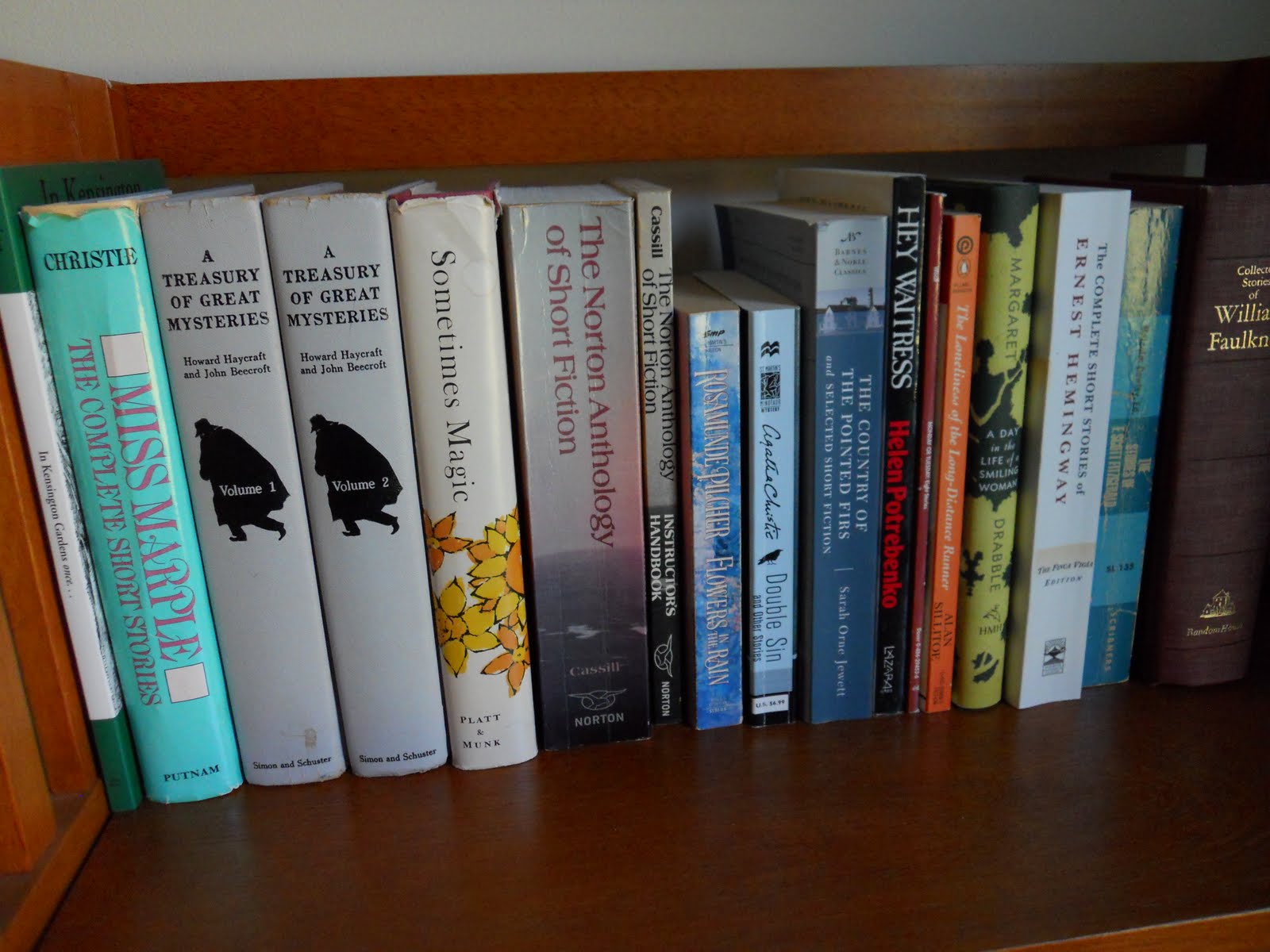
Now that I've committed to reading a weekly short story, I look forward to Wednesdays. I have put all my short story collections on the same shelf,


and as Wednesday draws near I begin to wonder what I will read. Sometimes I pick up a book, find a story, and know immediately that this shall be my selection. But sometimes a day like today happens. I have been irresolute and unsettled all day. I'd go to the shelf, pick something up, begin a story, and put it back on the shelf. I tried Hemingway. I tried Ngaio Marsh. I read a bit of Katherine Anne Porter and Irwin Shaw and Kay Boyle. Then I stopped and thought, well, I guess no story this week. But then I saw Rosamunde Pilcher's Flowers In The Rain, and thought that's where I want to be - inside a Rosamunde Pilcher story. And so, even though I offered one by her a month ago, I'm offering another today. Maybe I'll write about a Pilcher story on the last Wednesday of every month.

I begin to think that I like her stories even better than her books. I'm not sure why. Maybe it's just because I love these stories so much. I think I mentioned that I've read the whole book before, but it has been quite a few years.

When I was a girl and had to fill out forms, the address line always said 'town.' Now it says 'city.' More people live in cities than ever. I wonder how many towns there still are in this country. What I know is that people who choose to live in my area, do so because they love it. The jobs are not high paying. Many people work two or three jobs, and almost every two-parent family has both parents working outside the home. But we love our mountains and our air. We are even sort of proud of our winters. We're rooted to this land. And this may be why I'm so drawn to the writings of Rosamunde Pilcher. Her people are one with their surroundings - the lochs or the sea, the hills or the beaches. Wherever the books are set, you know that her characters are where they belong. In this story, young Jenny Fairburn loves her homeplace so much that her mother had to talk her into going to Edinburgh to take some courses, and when they are done, she comes right back home. And when she was younger and at boarding school, she was so miserable that her friend Fergus Fenton 'persuaded her parents that Jenny would do just as well, and be a thousand times happier, at the local Creagan High School.'

And Fergus, who is six years older, also taught her to fish. The title comes from the words Fergus would say:
"Too still for fish. We'll need to whistle for the wind."
Now Fergus has become engaged to a television actress, and bought a flat in London.
What could you do about a man who had been part of your life since you were a little girl ... and finally turned out to be - she knew - the only man she could ever love?
When his fiancée, Rose asks Jenny,
"you've always lived here?"
"Born and bred. I even went to school here. I was in Edinburgh for the winter but it's heaven to be back."
To which Rose replies, "but you can't stay here for always."

If you've ever read even one Rosamunde Pilcher book you know that Rose is wrong. Jenny is as much a part of the land as her beloved river. There is some conflict in the story, but the reader is very sure it will all work out in a most satisfactory way, and it does.

A lovely, calming, uplifting story. I loved it.