Showing posts with label A Year with Gladys and Rachel. Show all posts

Wednesday, May 30, 2012

May with Gladys and Rachel


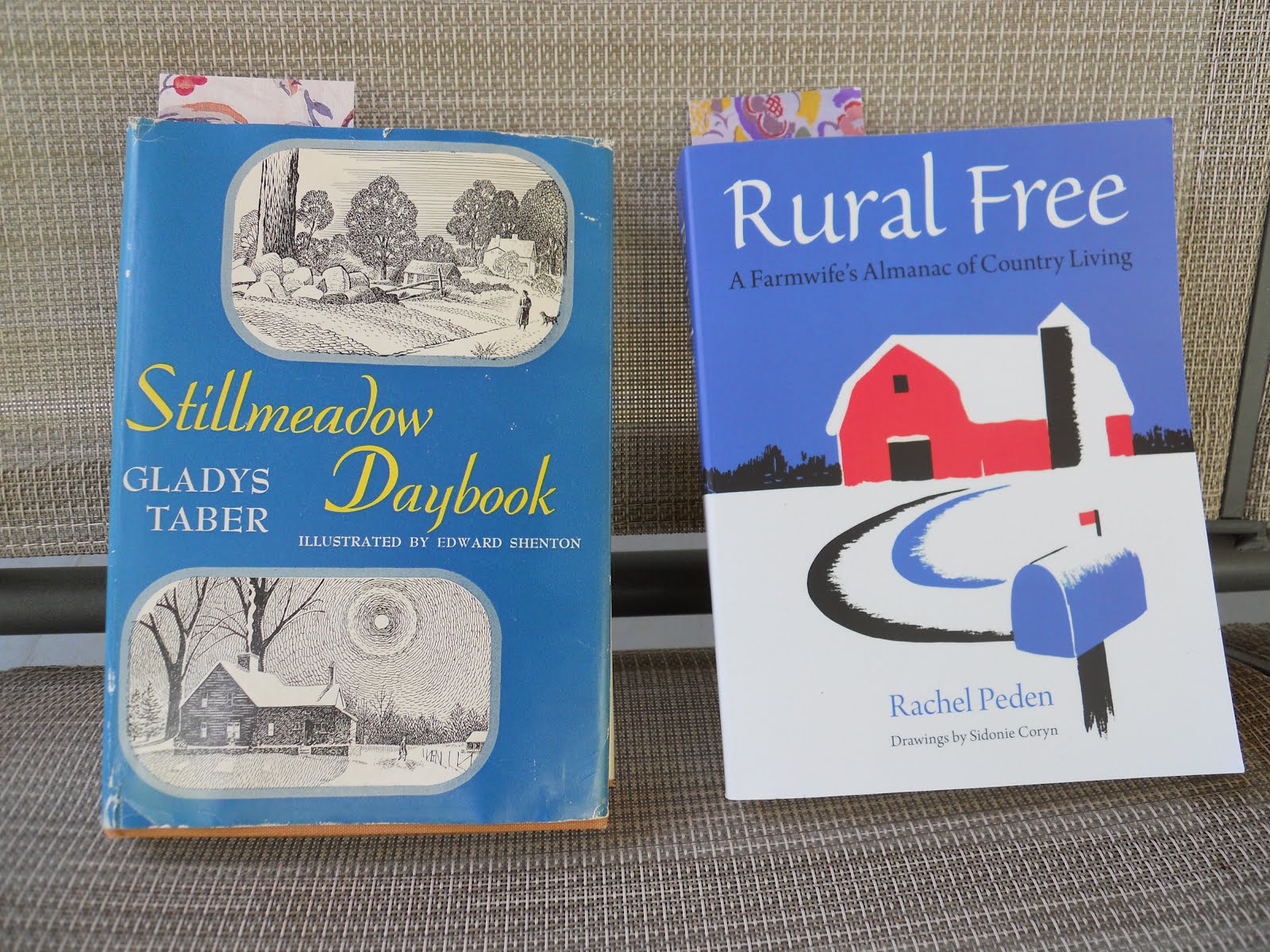
To learn more about this yearlong adventure with Gladys Taber and Rachel Peden, you may click 'A Year with Gladys and Rachel' - the first of my Letter Topics on the sidebar.

I smiled as I read Gladys' May entry, and thought how little we New Englanders have changed over the years. I wondered if we are by nature introspective because so much of our year is spent in seasons that are not conducive to outdoor activity. Of course we can engage in winter sports, though not that many of us do so. Mostly, we rush from car to house and gaze out the window at the beautiful, still winter scene. But come spring and we are possessed with being outdoors. This past weekend I was consumed with planting and weeding. I barely spoke. I hardly thought. I just dug and pulled with that strength and energy which comes only in May. Pretty much all Gladys talked about in this month was flowers. She begins by singing 'a small tune to myself as I watch Jill moving down the stretched string marking the row'
Plant this when maples are in bud,
And feel the magic in your blood,
Plant that when maples are in leaf,
And that's the END of winter grief!
Honestly, I am sure I can feel that 'magic' in my own blood.

Gladys writes of picking scallions and radishes, and 'the miracle has begun again!'
As I snip the tips of the first scallions, I am always feeling that one of the most hopeful things about mankind is that we go right on planting when the season comes, despite bombs, wars, world crises.
And that work, that physical, hard work, keeps our minds from ruminating too much on the bad in the world. We are focused in the best possible way. It is like caring for a young child, or a puppy, this tending of plants. We plant the seeds, we weed around them so they will grow up strong, we protect them as we are able, and with a lot of perseverance and luck, they turn into adult people or dogs or plants.

Gladys tells us that 'the atlas says we have a humid continental climate.'
That means, in my language, it rains too much here and it is damp. But how the growing things love it! Jill has to hoe out rhubarb now and then, it takes over like a giant tropical creature in a rain forest.

One of several rhubarb plants around here


While people in some parts of the world tend and nurture a single tree to get it to grow, we can't turn around without a new tree sprouting up. I've written before that the work our animals do for us is to keep the open pastures from turning into woods. A few years ago, Tom moved the pasture fence, and the whole area that used to be pasture is now full of trees. After the 1938 hurricane, Gladys and Jill set out
six small modest little pines, and now we can only get to the clothes dryer out back by hacking a path between the two most vigorous ones.
And this goes for certain flowers too.
The iris - ah, the iris! Jill moved and separated, moved and separated, gave away, moved and separated, and one desperate day flung her hands in the air and said, "I cannot take it." She dumped a basketful in the swamp, since when we have iris all over the edge of the swamp, and doing nicely.

My own ever expanding iris


Gladys expressed my very thoughts when she wrote
Rhubarb stalks grow tender and rosy and big all over our place.
And as I cut up the tender pieces for a pie, I think the first woman who kept house here must have done the same thing just about now. Maybe she had a pie cupboard and set her pies on the shelves, crisp and juicy from the great Dutch oven.
Everyone I know has a particular place in their hearts for lilacs, and Gladys waxes poetic as she writes of them.
My special love is the lilac. … I am sure heaven is bounded by a white picket fence that never needs repainting, and with lilacs always in bloom hanging deep clusters over it.
When the lilacs are in bloom and the apple blossoms and the white narcissus, New England is an experience in rapture. I love the lilacs too because they are a faithful flower, they grow around old blackened chimneys where houses once stood, they mark out abandoned gardens.
Gladys ends her month with
White lilacs in the moonlight, white fire of moonlight over blossoming apple trees, white little house under the great sugar maples - and Little Sister and Holly [dogs] waiting by the door - we are deep in spring!


And Rachel's words in her May chapter are also more focused on the natural world, which only goes to show that no matter where we live we may all feel the joy, the inexpressible sensations that only spring offers. Perhaps the very transience of the season, of May, makes our senses more acute. We can't miss a moment, for if we do, we have to wait a whole year to catch it again. She begins with a little trip to a neighbor's place.
His lane, through the woods, would be burgeoning with wild flowers now. It is a little lane, off a little road, off a slightly larger road.
Doesn't that just beckon to you? She goes on to list all she sees there, from ferns to mushrooms, and trillium to violets.

She writes of the apple blossoms.
So I came to the apple tree in the fencerow, now in full bloom. The sight thereof was like a blow, and it was necessary to sit down on a clovered terrace and rest from it. Bees had already discovered the glory of the tree: one bumblebee fumbled at a white blossom, and there were so many honeybees busy there that they made a stream of sound like the noise of distant, rushing water. … Nothing in the whole farmscape that morning could compete with the apple tree, neither the luscious pink of redbud in the woods nor the quiet splendor of raw gold on the tall, sprangly sassafras bushes further down the fencerow. It was as if they all stood ungrudgingly back that morning, letting all the attention be turned to the apple tree, giving it the full measure of its hour of glory.
There are seven paragraphs about a blue jay feather. I'm sure that many of us have picked one up and held it for a minute, thinking the blue was gorgeous and then we either dropped it back on the ground or kept it on a shelf for a while, perhaps never looking at it again. But Rachel really sees that feather.
The two halves of the feather are not identical, either in size, color, or angle. The narrower half is basically blue, cross-marked with short black hatchmarks. The wider part blends so subtly into black that one cannot possibly say, "right here is where the blue ends and the black begins." ...
The blue jay's feather has the texture, dry, luxurious sheen of taffeta. This taffeta is made up of a single layer of evenly placed strong fibers (properly called processes) laid side by side. Not one fiber overlaps another; yet normally there is no space between any two fibers - that would make a slit in the feather. You can pull them apart, but you can also run a finger along the taffeta, stretching it without pulling the fibers apart.
She writes,
Every year I think there never were so many maple seeds before, and every year it is true. This year it is spectacularly true.
She goes on to say that when they fall, the pods
brush the house walls with a dry papery whisper; or they strike each other in falling, with a soft, wooden clash. This is a dinner-bell sound to chipmunks. They bite off the hulls from the seeds and stuff their cheeks until they bulge from just below the eyes to just above the shoulders.
This got me thinking about two facts that I thought were unrelated, until reading this. On Saturday my friend Judi, whose garden I featured in my letters five years ago, was saying she has a lot of chipmunks in her yard. And I have noticed that this has been a 'spectacular' year for maple seeds. We have mini-maples all over the yard. It seems that they are connected after all. Maybe the chipmunks come when there is an abundance of food for them to eat. We have just two chipmunks but I'm thinking there may be a little family before too long.

One of the two. The other had just run past.


Rachel describes the baby starlings in nests.
If you bend above the nests and make even the sound of breathing, four enormous yellow-lined mouths fly open instantly, wide as a suitcase, in each nest.
There is a beautiful passage about a perfect day in May.
If a farm woman ever wondered why she wanted to live on a farm anyway, the answer is here today.
Today the tamarisk bush is a bowl of pink foam; the sweet shrub offers its dark red knots to be tied into a handkerchief for all-day fragrance. Lilacs lean toward the driveway, extending their purple and lilac clusters and reminding everyone that the end of the school year is near, with pomp and circumstance coming up at three levels of Commencements. From early morning until sunset newly opened leaves experiment with shadow patterns against the weathered boards of an old shed's wall. The air is as comforting as a cushion leaned back against.
Now little boys boast of the number and size of the snakes they have seen, and marbles and kites have long been forgotten. Fires have gone out in the farmhouses.
… It is a time of ambition greater than any possible fulfillment; of rapture beyond any reasonable, material reason. The joy of having lived to see this day is immeasurable. Some day next winter, when cold and mud and despair threaten to engulf her, let the farmwife remember this day.
I went out and found a few 'shadow patterns' on my own barn.


Before I close, I thought you might like to see maps of where Gladys and Rachel lived. Please do click to see more clearly.

Gladys' home in Southbury is in New Haven County just on the border of Fairfield County.


Indianapolis is just about in the center. Look down about an inch and find Bloomington. Rachel's farm was in nearby Ellettsville.


Gladys Taber lived from April 12, 1899 to March 11, 1980, and Rachel Peden lived from December 17, 1901 to August 16, 1975.


Well, this is it. It doesn't seem possible to me that a year has passed since I first wrote about my plan to read these two books, month by month.

These readings have greatly enriched my life. I have learned immeasurably from each woman. I now pay more attention. Even living a comparatively slow and quiet life, I do not see everything. I am looking more carefully now. I have also learned much animal and weather lore. But most importantly, I have gotten to know two intelligent, wonderful women.

And what comes now? I know that I want to continue this kind of reading.

My other two books by Rachel Peden are not divided by months or seasons so I think I'll read them separately. However, many of Gladys Taber's books are written in monthly or seasonal chapters.

This year winter begins at 6.12 am EST on December 21, the earliest arrival of winter since 1886. On that day I plan to begin reading two chapters called Winter from two books: Country Chronicle by Gladys Taber in Connecticut, USA and The Magic Apple Tree by Susan Hill in Oxfordshire, England; New England and old England. Each book is divided into four seasonal chapters. These two women, though not the same age, are writing within a few years of one another. Country Chronicle was published in 1974 and The Magic Apple Tree in 1982. Susan Hill was born on February 5, 1942 so she was 40 when The Magic Apple Tree was published. Gladys Taber was born on April 12, 1899 so she was 75 when Country Chronicle was published.

The last day of winter is March 19, 2013 so please stay tuned for a first posting around that date!

Sunday, April 29, 2012

April with Gladys and Rachel


To learn more about this yearlong adventure with Gladys Taber and Rachel Peden, you may scroll down to 'Letter Topics' and click 'A Year with Gladys and Rachel.'

As we finish the second to the last month of this year with Gladys Taber and Rachel Peden, I thought it would be nice to offer some photos of, and links to, the women themselves.

I'll begin with a short video in which we see Rachel's landscape and the concerns about preserving it. Toward the end her son, Joe speaks.


Though this is very small, I loved seeing her with books on the shelf and her typewriter in front of her. 1972, only three years before she died.


These are the words which accompanied the following wonderful picture:
Rachel Peden lived from 1901 to 1975. She graduated from Indiana University in 1923. She and her husband Richard lived on the family farm on Maple Grove Road, where they held open houses for children to see daily farm life. For 30 years she wrote a column, "The Hoosier Farm Wife Says..." for the Indianapolis Star under the byline Mrs. R.F.D. She wrote three books, Rural Free, a farmwife's almanac of country living; Speak to the Earth: Pages from a Farmwife's Journal; and The Land, The People, about the family farm.

The child in this picture is her young granddaughter, also named Rachel, who is Past President of the Monroe County Historical Society, and Monroe County Historian.


I so wish I could have gone to this at which the granddaughter pictured above, Rachel Peden McCarty spoke just this month. I was delighted when she left a comment here on the blog once. There is a little bit about her here.

There is a nice piece here. And this was just great to read!

Here is a PDF, but it is the best of all the sites I've come upon. You can increase the size to see it better.


Over the years I've posted a few photos of Gladys which you may find if you click on 'Gladys Taber' under 'Letter Topics.' These two were new to me.

Not sure of the year, but isn't she young and oh, so beautiful!


1955. Gladys and her daughter, Connie, and the Cocker Spaniel, Especially Me aka Teddy. I love that dress. When did women stop wearing such dresses? I miss women who look like this.


I found a cool little slideshow of Stillmeadow, her Connecticut home.

There is a website for The Friends of Gladys Taber, of which I am a member. There is a lot of biographical information, and a list of all her books here. And if you do a search for her name, you will find many results in the blogging world.


And now on to their Aprils.

Gladys begins the month with
Surely never was spring so wonderful, such a miracle!
Isn't this what we all think every time it rolls around?! And this year I thought to myself that every spring I have to relearn the language of the birds, those I haven't heard for months and months. I'd hear a song, and have a moment's hesitation before I recognized it. Oh yes, that's the Song Sparrow. And could that be the Wood Thrush?

Gladys writes of the first flowers:
The early flowers have a special beauty - I always shake with excitement when I find the first clump of snowdrops, fragile, pearl-pure, bending their heads lightly toward the icy dark ground. Crocus makes rainbow patches all over the yard; scilla like bits of the sky snipped out and scattered down.
'Shake with excitement!' Don't you love that? I hope each of you also experienced such joy in your springs.

She writes about her friend George plowing the fields.
I think a man who plows rides the world. You can feel the great old Mother Earth being released from winter rigidity, and giving again her richness to mankind. You feel the mystery of growth which so far man has not destroyed. Plant well, says the soil, and I will nourish you once again.
And as I have felt so many times in the past few months, Gladys could be writing today. She is concerned because
My favorite view near New Milford is destined to go when that gracious and green valley is flooded by the power company. ... It gives one to think. For nothing is secure. Bred in the tradition that a man's home is his castle, we now know that is not so at all. At any door, a tall man may knock, with a paper to sign. Or a great gas main can be laid right through a special cherished garden. We see the denuded forest every time we go to the village, and only a big orangey pump affair protrudes above the ragged earth.
Eventually somebody has got to decide how to protect the rural agricultural areas. For the big cities need tons of milk and it takes pastures and cows for milk. You can never pump it out of a faucet. Thanksgiving tables need fat crispy turkeys and that means turkey farms. As the city developments move out, the farm land diminishes.
Here in New England, it will be a problem, maybe in my time, certainly not long after. The balance must be maintained, particularly in this part of the country where distances are small and so easily swallowed up.
And then, here she is, ever forward thinking, on the local food movement.
The great Midwest can feed us all, I expect, but then the problem of transportation enters in. How many freight cars, how many refrigerated trucks needed to carry vegetables and fruits enough - and meat - and eggs - ... I think it is more feasible in the long run for the egg woman to deliver two dozen fresh eggs a week from the next road over, than to ship eggs from Kalamazoo, Michigan.
Economics is too complex for me. But I have instincts about supply and demand which I believe in. And I shall always feel a carrot next door is better than a carrot from Ames, Iowa, all things being equal.


Rachel starts off her April installment with she and her husband, Richard mixing up the grass seed for fields. Richard has
kept accurate records of grass mixtures used on each field and therefore knows what proportion does best in each. He said: "It's my ambition to have the water clear enough to drink when it runs off this farm. A two-inch rain will run off muddy, and muddy water will carry away three tons of topsoil to the acre. That's as much as a small farmer can build up in a year's good management."
Here Rachel, too is forward thinking and ahead of her time.
There is a particular blessing to be had from walking in a woods or a field from which no other harvest is exacted except that blessing. As the population of the world steadily increases and land is nibbled away for public uses, the human hunger for mere space becomes continually more insistent.
Rachel's own exclamation of spring's delight:
Oh, April, how gay, how welcome you are!
Each month I am delighted with the animal stories offered in Rural Free. April's was about how a mother cow thinks she has hidden her calf from the farmer, but
You go out to the field, and if you're not watching right then, you'll miss the cue. When she sees you coming, she'll look right straight to where the calf's hid, because the thought of the calf pops into her head before the thought of deception.
Such are the things we notice when we live with animals whether they be cows or sheep or dogs. And our lives are richer for the knowledge we attain.

There is poetry in Rachel's description of clothes on the line.
Sheets on the clothesline this morning flap in mighty applause. The sound comes in distinctly through the house walls; and, when they flap, reflected sunlight rolls and leaps from the sheets like crumbs being shaken from a Sunday dinner's tablecloth.
Joe, who was in the above video, expresses what most of us wrestle with all through life.
"Sometimes," remarked the seventeen-year-old son, "I wish I had a broken leg or something, so I could just walk slowly up to the woods - just take my time and see everything, the leaves, the bugs, everything. And enjoy myself."
"Well, goodness," exclaimed I, "you can do that anyway, without having a broken leg!"
"No," he insisted sadly, "if you're all right, you have to be working. You're always in a hurry to get some place else. You don't have time to go slow and enjoy yourself."

Well, as I noted, next month is the end of our visits with these two wonderful women. I find myself feeling sad, and already thinking about ways to continue in some way.

Friday, March 30, 2012

March with Gladys and Rachel


To learn more about this yearlong adventure with Gladys Taber and Rachel Peden, you may scroll down to 'letter topics' and click 'A Year with Gladys and Rachel.'


Around here March means the return of what I call the holy bird trio: the robin, redwing blackbird, and woodcock. We've heard a few tree frogs. The temps have been in the single numbers and in the eighties. Lots of wind, rain/snow mixes, sunshine.

When the end of the month arrives, I am pleased to check in on Gladys Taber and Rachel Peden and see how their months were all those years ago.

As Gladys talked about cleaning her milk glass, I was reminded of something I read just this morning, and thought quite, quite wonderful. The author of The Hours, Michael Cunningham wrote in the Guardian last June.
In Mrs Dalloway, Woolf asserts that a day in the life of just about anyone contains, if looked at with sufficient penetration, much of what one needs to know about all human life, in more or less the way the blueprint for an entire organism is present in every strand of its DNA. In Mrs Dalloway, and other novels of Woolf's, we are told that there are no insignificant lives, only inadequate ways of looking at them.
I, who have lived my life primarily at home with its many pleasures, am always happy to see this life acknowledged and affirmed. Gladys found deep joy in hers and wrote
Small jobs can be important too. Washing the milk glass would never go down in history as an achievement, but how good I feel after I have done it! I sit down and look at the old corner cupboard and think about the days when the milk glass was made - and all the people who cherished it, and they did cherish it or it would have been broken long ago.
Again, and as always, I think of what a fine and fun blogger Gladys would have been. Her thoughts go all over the place. She writes of Shakespeare and milk glass and dogs and spring cleaning one after the other, and all connecting somehow. She can go from discovering the new joy of good television to her love of cheese without skipping a beat. I smile with utter delight when she writes about the hidden treasures found in the yard after the snow goes away.
In the yard itself, old bones, bits of rubber rabbits, and a few dog-food cans turn up, for Holly [the Irish Setter] makes it a point not to go outdoors without carrying something. Three of my missing socks appear too.
She is unfailing optimistic about the world and its people, even as she voices her worries.
As for the world, it has been in a parlous state so long that there is no sense in worrying about the future. It is better, I think, to go on believing in goodness and beauty and truth and in God, no matter how we define these terms each of us for ourselves.
And better to live one day at a time. This is a hard task, often, for we tend to keep going to the past and trying to live it over again or looking ahead and uselessly trying to forecast tomorrow and next week and next year. …
In grief, one can endure the day, just the day. But when one also tries to bear the grief ahead, one cannot compass it.
As for happiness, it can only be the ability to experience the moment. It is not next year that life will be so flawless and if we keep trying to wait for next year's happiness, the river of time will wind past and we shall not have lived at all.
While Rural Free ends with the month of August, March ends Stillmeadow Daybook. Afterward there is a chapter called Full Circle.
As I go out in the morning to pick the white daffodils, I think of the bulbs secure under the snow in the past winter, of the first green spears that lance the early spring light, and I think of next year's garden, too. And I have no feeling of finality when I cut the faded tips of the lilacs that have again budded, blossomed, died. For by now the homespun sweetness of the Dorothy Perkins [rose] is covering the picket fence, and Silver Moon [probably clematis] opens pale ivory buds by the gate.


I don't know if I've ever mentioned that the subtitle of Rural Free is A Farmwife's Almanac of Country Living. Almanac could easily be translated as blog these days. And when I read Rachel's passages, which were columns in the newspaper, I dearly wish I could see accompanying photographs. As descriptive as her words are, I would love to see this view.
… I had been up on the top of that lovely hill, had seen the wide, free-running view, the green barley fields in spring, the snowy blanketed winter wildness, the dull browns and rich reds and the shaded greens marking off the seasons.
Living in the mountains with hills and curves and trees all around me, I would so like to see what Rachel is talking about here.
A whole rainbow, in all its subtly varying tones, was hung in the sky. One end rose out of Jim Scherschel's fencerow a mile away; the other end stood firmly distinct on the top of Clyde Naylor's barn, three miles in the other direction.
Three miles! That's how far we are from town, and I can barely see two tenths of a mile just down our road.

As so often when I read her monthly reports, I am impressed with Rachel's observations, how she really sees what is around her. 'Little' things that I so often miss she pays attention to, and gives deep thought to. Like cocoons.
… gray-brown like winter leaves, nature having given the worm that bit of insight as part its ration of talent. They lie strewn carelessly on the ground, or hang from trees and weedstalks like old dried leaves that haven't quite got around to blowing loose. They are almost hidden, but not quite, for whatever nature makes provision for anything to hide, she also supplies a few eyes capable of finding it, but not inevitably certain to.
Nature is impartial, and it's hard to tell whose side she's on.
Some of the cocoons picked up by delighted human finders will prove to have been discovered already. There may be little punctures in the tough drab paper, or the ends may have been torn open by moth enemies, not from enmity, but from hunger. The difference between enmity and appetite is a matter of who is eating whom.
Rachel ends this month with her beautiful description of 'the greening rain' which
came in the night Tuesday. There were some tossed-up coals of lightening; there was a wind that began in a careful whisper as if trying to waken one person without waking a small sleeper next to him. But the wind's joy increased as it sang until finally it was roaring and shouting and not caring who heard.
And then the rain began, the tonic, greening, transforming rain that comes only once a year.
At gray daylight, silver drops still clung to the undersides of peach limbs; but the rain had stopped, and now every living blade and stalk whose destiny it is to be green was suddenly astonishingly green.
This miracle happens every year at the beginning of spring.
This one rain is as distinct and set apart from all other rains as one handwriting is from another. Later on the grass will be thicker, taller, tougher, but right now every blade is as greenly green as it can ever be.
Cattle notice the difference immediately. Farmers do, too. This morning every farm neighbor you meet will exclaim happily, "My ain't it greened up nice since the rain!"

I shall end my March entry with a New Yorker cover that has been pinned up on the wall of the kitchen stairs for twenty years. Serendipitously, the date is March 30, 1992. It show what March is like around here, and also in the 1950s and 1960s worlds of Gladys Taber and Rachel Peden.


Tuesday, February 28, 2012

February with Gladys and Rachel


To learn more about this yearlong adventure with Gladys Taber and Rachel Peden, you may scroll down to 'letter topics' and click 'A Year with Gladys and Rachel.'


Gladys begins the month with the seed catalogues. Now some of them come in the mail before Christmas. But one thing never changes. The lure of those pictures and words pulls the gardener in every time. Gladys even wrote a bit of doggerel about it.
Ah never blooms so red the rose
As in the garden pages glows,
Never crops so free from pest
As on P. 20 and the rest.
And all the beauties we'll be growing
Blossom in catalogues without our hoeing.
I love it when Gladys tells of days gone by.
… a party for my gang. We just swarmed all over everything and ate like mastodons. Rolled up the Orientals and danced. Finished off with hot chocolate beaten with Mama's Mexican beater and with cinnamon spicing it, and dollops of heavy sweet whipped cream - plus the rest of the tiny heart cakes.
And finally, when Valentine's Day was really over, … a moonlight walk with my beau along the snow-deep streets of the little town.
Light years away from drinking games and more-than-romantic-walks at the end of the day.

Gladys writes of a topic close to my heart. I've written before about mystery heroines who drive me crazy by taking unnecessary chances. Apparently this is not a new phenomenon. I shall quote quite a bit from this section since I found it so interesting.
Jill has been reading the current mysteries. I read two and got so cross. My quarrel with mystery writers is that their heroes and heroines behave so stupidly that I lose patience with them right off the bat. The heroines always go sneaking about dark houses at midnight after a murder, just looking for a good book to read. The heroes rush into black alleys looking for a guy who knows all - and finds him all right. Nobody on the right side ever carries a gun. If he is a cop, he leaves it at home, if a newspaper man, he doesn't care for guns. Hero and heroine always tell all to anybody around, who is, naturally, the murderer or his best pal. They get into strange autos, they go into dives just for the fun of it apparently. And when they really know who murdered Mr. Bascom, they go right up to his hide-out like a Fuller Brush salesman and take him to task in a very moral but impractical way. At this point, I feel they deserve to be killed. … The author always saves them, but are they worth it, I ask.
Having just watched the Westminster Dog Show, it was most interesting to read about the difference between dog shows in the United States and Canada in the 1940s and 50s. Jill, her housemate, is not only a dog handler, but also a well-respected judge in the dog world. They go up to Montreal to a show.
The show was a real experience. Jill judged for six hours, I should say, and in all that time there was hardly a sound. The gallery sat so still that one had to whisper if one wanted a glass of water. There never was anything like this in the United States. At our dog shows you yell to be heard. The concentrated attention was terrific. Jill said it took her an hour to get used to her voice being the sole one booming out as she gave commands.
There was no argument between handlers, nobody protested any score, everyone thanked the judge, thanked the stewards. It was a lesson we shall never forget. Such sportsmanship is a rare and wonderful thing to behold. ...
Most of these Canadians were interested in one aim, to have their dogs educated, to do a better job themselves. If they failed, they accepted it quietly. Whereas often in our country, a judge can be mobbed by disappointed handlers.
In addition to these topics, Gladys tells of an indoor winter picnic, the importance of dogs over dishes, and even weighs in on the debate, still going on today, about who really wrote the works of Shakespeare. And she says,
Country living in these days may be rather effete, with music at the turn of the knob, news over the air waves every few minutes, books coming in the mail - and then you can see and hear a whole opera if so minded, on television.
We live in an age, it seems, when the whole world is at our doorstep, no matter where we may be.
1955!

There is much dismay these days about the end of hand-written letters. Apparently this lament was issued decades before our time. Gladys says,
Letter writing has fallen out of common practice of late.


As is pretty much the case each month, Rachel's writings are centered on the down-to-earth observations of farm life. Yet she is lyrical and poetic in her descriptions of what might be considered the more mundane activities. She sees beauty, and philosophical applications, and often, humor in most everything.
In February a farm is like a child's hand, opened and held up to show that nothing is concealed in it. Without leaves to veil the farm buildings and fields, the naked facts of a farmer's work habits and holdings are revealed even to the casual traveler passing along the road.
Did the farmer get the disk put away after he finished the wheat field last fall, or is it still out in the field rusting away its spring trade-in value? Are the cattle fat or thin? …
Nothing is hidden in February.
In this passage the reader can almost see and smell what she is writing about though probably few of us know it firsthand.
In the doorway of the barn, a wheelbarrow, freshly filled with silage, was standing. Steam was rising up from it into the cold air, like steam from a gigantic kettle of soup just taken off the stove. At this time of winter, silage still has a pleasant pickledy smell, with a suggestion of sorghum. Cattle like it. The cows in the barn could smell the steam and were bawling in happy anticipation.
There are things that bring the reader up short, with a 'whoa, that really was a long time ago,' such as mention of a 'vanilla salesman.' Can you imagine? A man who came around every six weeks or so selling
spices, medicines, nose drops, cough syrup, liniment, fly spray, vitamins, pudding mixes, and cosmetics.
While that made me think it was the 'olden days,' there were things that were startlingly progressive. In a piece about the quail family of nine sleeping in a circle with their heads pointing out for 'extra security' from foxes, she quotes the Wildlife Federation:
Predation is a natural process, and biologists believe the way to more abundant wildlife is not through the killing of predators but through the management and strengthening of the environment.
Rachel is concerned about this environment, which was also quite forward thinking in the very early 1960s. While spring is on its way, she ponders that by summertime there will be a
barrage of roadside spray, giving the summer an early-dead appearance and an unpleasant chemical smell. What the effect of roadside spraying may have on insects and birds and small wild creatures that would have dwelt under the vegetation is not pleasant to think about.
And even then biologists were saying that the 'danger from herbicides and pesticides is greater than from atomic bombs.'
When the early, northbound robins get here, they will be observed by conservationists fearful of the bad effects of roadside spraying. For the danger is in earthworms that come up temptingly at night, exposing their long, pink and gray moist deliciousness to the hungry robins. Earthworms store up DDT in their bodies; but robins do not realize this, and unfortunately, there is no way to warn them.
She tells us the realities of farm life, and adds humor to temper the seriousness.
He takes his family's living in his hands when he decides whether to sell the steers now or borrow $1,500 more from the bank to finish them out for market, and risk a drop in the market price. … Shall he set fifty acres of tomatoes, risking a hot, dry summer and a shortage of hand labor to pick them? … Shall he mow all twenty-four acres of a field and risk getting it rained on before it cures, or shall he cut half and lose the extra time?
But in hauling manure he can never lose. It is life to his fields. Regardless of whether the crop is surplus and gluts the market and swamps the national farm policy, or scarce and precious, the soil has to be maintained. A manure-hauling farmer knows he is doing the right thing.
The only trouble is, everybody else in the community, and everybody driving past, knows it, too. On windy days, a manure-hauling farmer couldn't attract more attention if he were driving a steam calliope.

Three quarters of my year with Gladys and Rachel have now gone by. Reading these monthly essays are a most pleasant way to mark the passing of time, theirs and mine.

Sunday, January 29, 2012

January with Gladys and Rachel

To learn more about this yearlong adventure with Gladys Taber and Rachel Peden, you may scroll down to 'letter topics' and click 'A Year with Gladys and Rachel.'


I don't believe I've laughed as much in the other months as I did while reading Gladys' January entry. She has mentioned in other books that she isn't fond of the telephone, and indeed has a 'phobia.' I know people all these years later who have much the same thing. Her descriptions of the phone service in her area, and her experiences were so funny. They were rather like a literary slapstick comedy.
Well, much has been written about the country telephone. Ours rings apparently without reason, and with nobody on the other end. If we try to call anyone, we get five people in odd places who are justly annoyed at being summoned when we do not want to talk to them anyway. If I get called to the phone, I always hear another conversation going on, and I get so bemused listening to that that I never hear my own. …
After being on a nine-party line for years, we graduated to a two-party line. We felt elated, but it was a short-time elation. For now we only have a sort of dual conversation with the other party on at the same time. And if I get on, as I rarely do, I always hear this clear clipped voice saying, "is this the New York Medical Center?" …
My telephoning is hampered anyway by the fact that I can never understand anybody's name over it or what they want. I hear a dull glug glu and then I say brightly, "Oh yes?"
When her friend Faith Baldwin calls, Gladys is amazed by her telephoning abilities.
The phone is no hazard to her. She can chat over it. I am lost in admiration, in fact so lost that I often miss part of what she says.
She can do a whole novelette in five minutes and all I have to do is say OH. Or, in a great burst of inspiration, YES.
And apparently, the phone company in her area used to change the phone numbers 'every little while'
and our former number invariably goes to some week-end shack by the river. Any misguided soul who tries to call us gets an empty shack. … The phone rings a great deal, but of course it isn't our number but the number of someone else who has now another number!

In writing about getting sick in January, she reminisces about her parents' ways of dealing with illness.
I can well remember how Father always diagnosed his own and told the doctor what it was and what kind of medicine he needed. That settled that. Then he would add some of his own medicines from the big black case he had carried in the Mexican mountains in the early days. He believed if one pill was good, five were bound to work quicker.
Also, he mixed the pills. First he would take what he had ordered the doctor to give him, then add some Rhinitis or aconite or a spoonful of some early remedy of mine. A glass of Bromo Seltzer helped out and a little later a raw onion sliced and placed between two slices of bread, well buttered, salted and peppered was a final sovereign remedy.
It may be, as well, that he was the healthiest man that ever lived, so he never got upset by any of his health measures. Mama on the other hand never took so much as an aspirin. She felt one should just keep a stiff upper lip and throw it off.

As she wrote about her Irish setter, Hollyberry's adventures in obedience training, this dog lover was smiling with delight.
when it comes to the Long Down, she is overcome with melancholy. The Irish almost never care about lying down. So she turns to jelly, rolls weakly on her back and holds sad paws up in the air.
Another Irish setter, Daphne, disrupts the Sit Stay, running off after a pheasant and it took all the other owners an hour to catch her.


Doesn't it seem like every generation remembers winters as longer, the snow deeper, the temperatures colder than now? Just this morning I emailed some friends saying I remembered walking to school in -20 weather. Did I really? It sure seems so to me, but am I suffering from that same memory lapse which afflicts all adults? Gladys says
We do not have as many terrible blizzards as we had twenty years ago. This makes me believe in the men who say our climate is getting milder.
This in a 1955 book!


Tom was loading wood onto the terrace this afternoon, and rushed in to get the camera so he could photograph the bird tracks he saw under the lilac bush. As I read along in Stillmeadow Daybook and Rural Free today, I was so hoping one of them would write about birds so I could include Tom's pictures (click for a better view). Gladys mentioned getting the bird feeders full by the end of the day so there would be food first thing in the morning, but nothing specifically about tracks. You may imagine my joy when the very last essay in Rachel's January entry was entitled Footprints in the Snow.
On the snowy path up to the barn this morning I read again the unintentional autographs of several small creatures that share this farm with us. In the thin snow on the back steps and below them were the scanty, scriptlike tracks of birds. They are shaped like a Y, with three prongs in front, one in the back.


Tom put his hand in the photo to give a sense of the size of the bird tracks.


After noting a few others like those of a rabbit and a mouse, she closes her month with
The birds' autographs were my favorites. With a pancake turner and great care, I managed to get up one whole unbroken autograph and put it in the freezer, to read again, I hope, next July.
Though we didn't do this, I just love it that Rachel Peden did so.


Many of her musings were really like prose poems, whether writing of a barn interior or an icy few days.
Unless a bitter wind is blowing, or rain is beating in through the empty windows, the barn is a snug place on a winter morning. When Dick called me up there this morning, the barn was full of a dusty atmosphere of abundance and content. The cattle are shaggy-coated and fat. The hay they were eating had a pleasant odor, reminiscent of summer. When they opened their mouths for a refill, their fragrant breath came out in a crooked, wafted column, like steam.

The ice show began on Friday, and for three days we lived in a glass world.
Early Friday morning sleet was fall in a rasping, hurried whisper against walks and windows and into treetops. By daylight you could already see what had been accomplished. The bent-over peach tree was a glass tree; the maple branches, dotted with reddish brown buds, were glass-dipped and sung softly as if about to break into tinkling music. The whole farmscape was a wonderland of glass, wet and shining. …
The next day the sun came out, making the ice dramatic. Now the stiff trees turned to silver. The still air had the shine of silver from earth to sky, and every little insignificant weed and bush had been silver-plated. …
On the third day there was no sun. The brilliance dimmed to a gleam. Trees glowed softly under a dull, blue-gray sky. Many were enclosed, separately by a strange pale-gray halo. In the garden, old weeds were transformed into lace, spun delicately like foam. …
That night the moonlight was clear and deep on the crusty snow. Trees stood white and silent, as if they knew what was to happen. Then rain came, melting the glass and silver burdens.

There's a whimsical section which arises from her daughter's school work.
Carol read the health lesson aloud while I washed the dishes in the kitchen, and thus we both learned that the human body is 90 per cent water. To me this sounded like understatement. There are times when a farmwife's body can believe that she is 90 per cent dishwater alone. Add another 5 per cent for laundry, some for washing potatoes and fruits before cooking, and a panful for scrubbing the linoleums in muddy winter weather, and it wouldn't be surprising if the total came out somewhere nearer 135 per cent.

When I finished the monthly readings of Gladys Taber and Rachel Peden, I told Tom that these are some of the most enjoyable times of my month. I look forward to them, I enjoy them completely as I read, and then I have the added pleasure of sharing the words of these two wonderful women with my readers.

Friday, December 30, 2011

December with Gladys and Rachel


To learn more about this yearlong adventure with Gladys Taber and Rachel Peden, you may scroll down to the 'letter topics' and click A Year with Gladys and Rachel.


Gladys begins her December entry with these words
The first snowfall is worth having winter for.
And ends with
My last words on each and every Christmas for over twenty years have been spoken from the heart to all the world, and they are simple, but heartfelt.
God rest you, merry, Gentlemen,
Let nothing you dismay.
In between these marvelous words is a delightful meditation on what many of us feel is the most wonderful month in the year. Even if one isn't a practicing Christian, is there any time so dedicated to thinking of others? Every present we buy, each cookie we bake, the meals we cook are all for others. Not for ourselves.

Gladys writes
I think most mothers get tired during the Christmas rush. I do. There is always a low moment when I fervently wish it were just over and I could SIT DOWN. I wish it were August. And nothing at all going on.
And yet, when the children say, "Thank you for a wonderful Christmas, best we ever had," and one child whispers, "this was just all I wanted - how did you know?" and one child curls up to read the book you have chosen so carefully, and one says, "we never had such a Christmas," suddenly then all the tiredness ebbs away, and a pure happiness floods in.
For in spite of the tinsel and wrappings and struggle over presents, we still have an idea, after all, that Christmas means giving some special joy, an unusual joy to someone. And that compensates for the commercialism which sometimes seems to threaten to engulf Christmas entirely.
And this in 1955!

In addition to the Christmas bustle, there is talk of feeding birds and using herbs and spices, each quotidian subject leading her to higher thoughts.
It is as with much of life, I suspect, the richness is there, if one opens one's eyes to see it, and one's ears to hear it.
[Herbs and spices make] my meal getting romantic. For the whole world comes into the kitchen with saffron and sesame seed, chili powder, curry, basil and bay.

Rachel begins with burning brush on the farm. As her husband monitors this chore, his mind runs free.
his thoughts have gone on a wide, evaluating tour, which is the bliss of brush-burning.
From his field he can see the neighbors' farms and some of their barns and houses. It is a pleasant closeness, without trespass. The farmer reviews the local, unprinted news and his winter work plans.
She then goes on to say that
if he doesn't get back that winter, or for several winters, the brush pile will make a brushy, safe home for rabbits and a few birds, and some other small animals that need homes. It is really better for such use if the brush pile is near a hedgerow; but a brush pile out in the field makes a good oasis for small animals that have to cross from home to hunting ground and do not like to risk their small, important lives traversing too great an expanse of unprotected open space.
When I read this aloud to Tom, it was a completely fresh idea to him. Something he had never thought of before, and now fully intends to implement. It is Rachel's work which I read most often to him because though Windy Poplars does not support us, he is himself a farmer, working with fields and fencing, animals and chickens.

You may recall a letter I wrote about calendars a while back. Well, Rachel has the most wonderful essay called 'Here come the new calendars.' She was writing in much the same time as my mother's calendars.
Calendars come in a variety of sizes, and by diverse ways. Some come by mail, in odd-sized envelopes or rolled up in a tight wrapper. Some are handed out by salesmen at the door or in stores. Some come importantly in cardboard tubes. Some come naked from the press. They have one common purpose, to perpetuate in kindness the memory of the donor in time of money expenditures.
She goes on to tell how each one sits on the kitchen wall as she tries them out in this month before they are needed, and ends
The one that remains the longest on the wall is the one with wide-open spaces around the dates so that memoranda can be written on it. Its white spaces fill up with notes of dental appointments and Fair Board meetings, who called about baling; with telephone numbers, grocery lists, addresses, recipes taken down over the phone, and important farm news such as "barn swallows returned" or "paid on tractor." … When this calendar is used up, it is too valuable to throw away. It belongs with the farm records and receipts and will be called on to help fill out income tax blanks. It's a diary, a volume of family history.
Rachel offers tales of hogs eating coats, an apology from a new neighbor, the description of a growing boy's footprints in the snow, and the poignancy of a children's Christmas show rehearsal.

In just a few pages each month, these women's words fill me with deep wonder and pleasure.

Thursday, December 1, 2011

November with Gladys and Rachel


To learn more about this yearlong adventure with Gladys Taber and Rachel Peden, you may scroll down to the 'letter topics' and click A Year with Gladys and Rachel.


As I finished Gladys' November entry, I sighed and thought how very thankful I am for her, and for the fact that she wrote down all these thoughts and feelings over the years. I think November is my favorite of her writings in Stillmeadow Daybook, so far, possibly because she writes a fair bit about books.
There are many wonderful books which are fine to read, but there are very few that are better reread, and still fewer that should be reread every year. … For me, the test is, can I bear not to read this again? A fine book is like a mine. You get down strata after strata until the very deep lode is reached. This takes time and thought and isn't a business of skipping through once. On the other hand, a book may be pleasant as a shallow running stream and still well worth reading. But the ones to keep, to carry with one wherever one goes - these are precious cargo.

And taste is such a highly individual matter - even near and dearly beloveds can absolutely despise some book you are passionate about.
After having all the children home again for Thanksgiving, she ponders
A family holiday, such as this, gives one a chance to estimate the changes in the children. … the conversation seems like a montage of their lives.
Sometimes one wishes they were little again, yet on the whole I think it is so rewarding to know them as equals that I would not really wish the romper days back.
With these words, she expressed my very thoughts on Thanksgiving a week ago today. We went down the hill and spent the day with our daughter Margaret and her boyfriend Matt, their housemate Dave, our son Michael, Matt's sister Sabrina and her boyfriend Connor. All in their twenties except for one who had recently turned thirty. And Tom had taught them all! Amazing. And in addition, there were five dogs who brought much delight and minor chaos to the day!


We all said afterward that we've not had a pleasanter, richer Thanksgiving since we celebrated here with the kids when they were little. Then they would choose their favorite dishes, and we often had a table filled with everything from lasagna to mozzarella sticks. And this year was the same. They requested my macaroni and cheese, and my Mexican beans and rice. I also made Matt's favorite, apple crisp, and Dave's favorite, brownies. And each of them made something special too, from bruschetta to deviled eggs.


But it wasn't only the food that offered the warm familiarity of past joyous Thanksgivings. It was these same kids only different, more somehow. It is quite a little miracle when you stop and think about it. They are a 'montage' as Gladys says. Margaret and Michael are nine and six at the same time they are twenty-nine and twenty-six. Big emotional stuff, this.

1991


2011


It was quite startling to read words published in 1955 that could have been written today.
Advice to women continues to be handed out largely by magazines and books. We seem to be in an orgy of confessions and case histories. Can my marriage be preserved?; what is wrong with my husband?; whom shall I marry?; I have a jealous husband; I have a stingy husband - my husband does not speak to me for weeks at a time, what shall I do?
I have a secret feeling we do too much of this kind of thing.
Marriage is a pretty individual affair and I doubt whether it can be push-buttoned sucessfully. Possibly I am just old-fashioned, but, I cannot care too much if Mrs. A and Mr. B are one way or another about each other. I would feel it their business, not mine.
I wonder whether this preoccupation with personal relations has spread into private lives from the Hollywood stars' on-again-off-again marriages? If so, it is a pity we do not let the Hollywood great have a little privacy in their lives off the screen. I am sure they would be grateful. They might even be more tranquil if people did not dodge after them every time they stepped from their front doors.
I wonder what Gladys would have made of the Kardashians?!!

She ends her November musings with
The air smells of frost. The house is making the soft breathing sounds very old houses make at night. Embers glow in the fireplace…
Wouldn't I love to be by that fireside.


And how remarkable, how serendipitous it was that Rachel began her November entry talking about the fireplace.
For the fireplace philosopher, it recalls memories of good friends in happy places, of long, satisfying thoughts drawn out before the glow of bright, burning-down embers. A fireplace doesn't warm a whole room, nor even a whole person, very well in deeply cold weather, but where it does warm, such as the skin over the cheeks, the backs of the legs, or the cockles of the heart, it warms generously.
As much as I love a fireplace, and envy every single Christmas picture of a living room which has one, I do know the reality of its heat. After my mother died, and we moved into my childhood home, we had a fireplace built in the living room. What Tom and I didn't know beforehand was that it did indeed heat only the fronts or the 'backs of the legs' - never both at once. And that if we moved away but a foot or two, we were cold. So when we moved here, we put in a wood stove which warms the whole of us. It does have a glass door so we can see the flames but it's not quite the same. There must be a philosophy of life in there somewhere - practical versus beautiful. Always striving for a balance between the two.

Don't we know just the moonlight Rachel is describing here?
By bedtime the moonlight was almost a violence, as if at any minute it might break out into the sound of a mighty rushing. Under the maple trees, shadows lay black and heavy; if they could have been dragged into the woodshed, they could have been chopped up for firewood. On the red cattle beyond the fence, white markings stood out like snow; and looking through the window I counted five dry leaves on the back walk.
As in Gladys' writings I am surprised at how much things are still the same. I thought these words of Rachel's from fifty years ago could have been written today:
Traditionally, farming is a good way of life in America. A farmer hears himself congratulated often and in glowing words: "It's the independent life. You're your own boss on the farm." He accepts this with a smile and some reserve.
It is true. On the farm you are your own boss and can do exactly what you please, as long as that also pleases God and the weather; the government; the neighbors; your children and the neighbors' children and their 4-H clubs; the farm dog; the cattle and hogs; the insects; crop surpluses; the farm tractor, money inflation, and income tax blanks ...
She waxes both poetical and philosophical when she writes of the neighbor's cows coming in from the pasture in the rain
walking slowly, single file. They could have shortened the walk by going straight uphill, but they had plenty of time, and good judgment beside, so they were winding around on an easy level, making a gradual ascent.
The cattle were not being driven in by bad weather; this was their customary time to come in and this was their customary gait, rhythmic and placid. A paired lifting up, putting forward, and setting down of their feet; a rocking forward of their bodies, causing their blocky heads to swing loosely, chins bobbing, as if the heads were mechanically suspended, well-balanced, and effortlessly held at that level.
Fascinated by their appearance of content and leisure, I watched them several minutes and when I returned to my own rainy-day routine, discovered I had absorbed some of their relaxed mood. This is a profit you can take, without investment, from your neighbor's cattle.
I find the deep truths of these two women, often drawn from an observance of both physical and human nature, to offer much the same relaxation to me, their reader so many years later.

Sunday, October 30, 2011

October with Gladys and Rachel


To learn more about this yearlong adventure with Gladys Taber and Rachel Peden, you may scroll down to 'letter topics' and click A Year with Gladys and Rachel.


As I sat down to read the October entries of Gladys Taber and Rachel Peden, I had just eaten Gladys' recipe for French toast, the easiest and most delicious ever!
Cut the crusts off two pieces of bread.
Whisk together an egg and 1/4 (she used 1/3) cup milk.
I then pour the mixture into a 7x11 glass pan, and dip the bread until it has completely absorbed the liquid.
Warm the maple syrup.
Heat up the griddle to 350º and spray with cooking spray.
Cook the bread on both sides. Serve with butter and the maple syrup.

Here is what the outdoors looks like at Windy Poplars Farm on this Sunday afternoon. Last night we had a lovely, gentle, soft snowfall, and the snow is staying unlike the other day when it had all melted by noon.


It seemed strange to see this while reading Gladys' words about the colors of October, but it just shows how very much the landscape changes during what she calls the 'dramatic' month. We begin October with those colors which people from all over the world come to see. As Gladys says, 'everyone knows about autumn in New England.' After the leaves fall off, we have a ground full of color instead. Then they turn brown and blow around. I'm not one for raking. Invariably when I go out to rake, the wind kicks up and my leaf piles quickly blow away. I've learned over the years to just let the leaves stay. They very often settle in the flower gardens providing soil-improving mulch and some protection against the winter cold. It's interesting to me that Gladys didn't mention raking this month. Maybe she also let the leaves be.

Gladys says,
Now is the time to go out to the woods for butternuts and hickory nuts and hazelnuts. ... We carry old gunnysacks and we fill them. ... Staggering under the weight of the sacks, we finally come home, feeling we have done a very worthwhile thing. Never mind that we never do get all the nuts shelled. We crack some with the flatiron on the hearthstone, but we never really get to them all. I surmise it is more fun to adventure in the autumn woods than to dig out the tiny meats afterward with a pick.
I have read in old books about 'going nutting.' But I've never known anyone who did so. When I was a girl, older women would talk about 'going berrying' but as far as I can remember no one ever gathered nuts. I don't even know if there are nut trees in the surrounding woods. I've never heard of any.

As she writes of hanging the blankets on the line for their annual freshening, she is reminded that 'all our blankets have stories about them.' Two that belonged to her grandmother get her thinking about that grandmother's son, Gladys' Uncle Walter, and a walk she took with him after her own mother died.
The street lamps cast a pale lemon glow on his erect figure, his careful hat, his impeccable shoes. All he said was so simple and so short. We walked, and the light fell on him, and the shadows moved. The new-cut grass on the lawns smelled sweet. A little dog nosed along the curb and vanished.
"The Raybolds [Gladys' maternal family name] have always been heavy burden-bearers," he said quietly and as if that were to be expected and accounted for.
At that moment I felt myself one of a dim line stretching back and back and back, of people who went about their business and just bore their burdens. He never said another word to me about mine, he just let me assume I was to bear mine in the family tradition.
It is strange how that simple statement has sustained me down the years. Thereafter, every time I felt crushed by events, I stiffened my spine, and said softly, "well, we Raybolds have always been heavy burden-bearers."
It feels to me that we have traveled light years from this philosophy, to a time when everyone tells everything to anybody. I guess we have learned that it is good and helpful to talk our problems over with someone, but I think we have gone way too far in the opposite direction from the words of Uncle Walter.

I will close this month's letter about Gladys' October chapter with her stirring words:
There is always one moment in a day when I think my heart will break. Such a moment I think all women have, and men too, when all the meaning of life seems distilled and caught up and you feel you can never, never bear to leave it. ... My definition of happiness is just the ability to garner the perfect moments.
And aren't we, her readers, lucky, lucky that she shared them with us.


I suspect that some of us smug New Englanders think we are the only place on earth where the real autumn may be found. Oh, we know that trees turn color in other places, but the show can't be like ours. But if we read Rachel Peden wax poetic about the colors in Indiana, I think we must let our feelings of superiority slip a bit.
Indiana's autumn leaf coloring, like the Grand Canyon, is so magnificent and spectacular that the only way you can describe it, or even believe it, is to understate it.
Let it be said, therefore, that in a hillside around which Maple Grove Road climbs on its way to town, there is a young beech tree that has authority to speak for all beech trees. Its coloring bronzy-yellow leaves shine with a metallic glitter. Enough of them have dropped to make the ground glitter also, around the tree, and yet the tree is not diminished of its glory. Anyone who has seen it will remember its light all winter.
Throw in sweet gum and ash for purple; sassafras for sentimental pink and deeper red; sumac for a glossy bright red; luminous yellow for poplar and papaw and hickory and maple. Add the kaleidoscopic pink, yellow, rose, and red of maples; the quiet, mighty old-hymn brown of oak; the warm, live brown of tall white sycamore; the dark, melodious red of wild blackberry's rough leaves; ... In autumn not an acre, hardly a foot of rural Indiana is lacking in splendor. It is gaudy, breath-taking, unbelievable - it is Indiana in autumn dress.
I am duly humbled!

One of the minor plagues of my life is the fruit fly. Not for me those adorable wire baskets you see in the magazines, filled with lovely lemons and limes. You won't find a beautiful fruit bowl on my kitchen table. I even break the storage rule and keep my tomatoes in the refrigerator. Why? All because of the dreaded fruit fly. So, I was greatly consoled by reading that Rachel was dealing with them in her own kitchen fifty years ago. She knows it as a vinegar gnat.
It is doubtful that any insect has solved the complexities of personal nourishment and storage better than the vinegar gnat has.
If you need some for research on this point, you need only lay a bitten apple on the kitchen table, or a few grapes pulled from their stems, or a tomato weeping over its wasted life. Vinegar gnats will suddenly be there. From where, goodness knows. They arrive quietly, requiring no more space than the wind requires. Their sense of news must be prodigious.
... Gnats never seem to fly very fast, but they fly elusively, as every housekeeper knows who has tried to clap her hands together into a gnat sandwich.
She goes on to talk about the use of fruit flies in the study of genetics, and ends her passage with,
Decidedly, with such an outstanding scientific career possible, the vinegar gnat is wasting its time in the farm kitchen.
The Peden family also goes nutting and afterward,
Carol picked out the black nuts whose hulls cattle had trodden off, and Joe spread them out on the brooder-house roof, where rain would wash them and sun would dry them. I poured the unhulled ones into the driveway; there incoming tires would mash off the hulls.
Speaking of rain, this year that Rachel was writing there was a very dry three weeks. And I learned the most amazing thing. Her husband came in to tell her that the
"spring had started running again. So now I know it's going to rain soon. I don't know why it is, but after there's been a long dry spell, the creeks and springs start flowing again just ahead of the rain."
He was right. Monday evening the long-yearned-for rain began. ... It was perfect weather: it was raining.
She writes of taking the dog, Rose for a walk. 'In the woods there is much for a dog to read, and Rose reads well.' As we walk each day with Sadie, one or the other of us remarks on what she learns about the world. She stops and her nose wiggles as she stares into the trees. She pauses every few yards to smell whose feet have walked this path before her. We humans are sorely lacking in this department.

I shall close the October chapter with a deeply felt passage from Rachel.
For some people autumn is summed up in the magnificent drama of colored leaf. For me, the most poignant, almost unbearably dramatic, thing about it is the passage of wild geese, southbound in a chilly autumn evening, over the farm. There was one time in particular when the children were little ...
They came swiftly, a long, dark line undulating against the blue evening sky, like a dark ribbon tossed into water.
They were high above us, flying diagonally across the clover field. We could see the leaders at the head of the inverted V, and we could hear the weariness in the lonely, beautiful, wild crying. We watched until they had disappeared entirely, and it was as if some part of us had gone with them.
As we turned back to the wagon in the darkening evening, I was aware that some important truth had been summed up in the flight of the dark, vanished birds. It was stated in the cold, clean fragrant air, in the crackling of dry leaves under our feet, and in the blended colors of far-off hills, where already many emptied trees were only bare, dark outlines. It was a statement of acceptance, but not of resignation. ...
There was something there that was immensely lonely and vulnerable, and yet invincible; ... this poignancy in which transience and permanence exist side by side, in the same thing.
Rachel's writing is full of such truths.

Friday, September 30, 2011

September with Gladys and Rachel


To learn more about this yearlong adventure with Gladys Taber and Rachel Peden, you may scroll down to the 'letter topics' and click A Year with Gladys and Rachel.


September begins and ends so differently. I often feel energetic and hopeful at the start, and a bit pensive and introspective as it ends.

Gladys' September chapter is decidely on the pensive side. She notes a few observations from the natural world but most of her writing is concerned with more philosophical leanings. I think this isn't unusual for her. Though she is a country woman, her housemate Jill does most of the actual yard and garden work. Presumably this is because Gladys was busy with her writing. She does picnic and swim and walk and dream outdoors, but she always thinks and thinks, and shares her thoughts with us.

Seeing the school bus, she ponders the difference in school lunches since she was a child. She writes about a school in Mississippi which she supports. I looked it up and it is still in existence - The Piney Woods School. She ponders the conditions of the world and the place of education in that world. She defends the work that teachers do, and bemoans the small salaries.
Some people think teaching is such an easy job, it doesn't deserve the pay of say a bricklayer. Or a laundry delivery-man. Besides, look at those long vacations!
If there be a more arduous job than teaching well, I cannot think what it might be, except to be president of this torn and confused country. In the first place, teaching has to be creative, it has to deal with the countries of the mind which are always difficult, unpredictable, illimitable. It has at once to encourage the dull and slow to their highest understanding and satisfy and ease the burning hunger of the natural scholar. It has to be profound and yet not tedious for the young are impatient. …
Now this long vacation is another thing. This is the time when teachers should be studying and doing research and refilling the well of inspiration. Instead of that, many teachers work. I know of men teachers who do carpentry, hire out as painters. Some clerk in grocery stores. Women tutor or do secretarial work or act as companions to elderly folk.
The summer work experiences may be different now, but there are still a whole lot of teachers who must work in the summer. Even Tom, who doesn't hold a paying job in the summer, spends the long days doing work that we would have to pay someone to do (and hence would not get done) if he didn't. He definitely gets recharged for the school year but it is in doing manual labor outdoors, not in 'refilling the well of inspiration.' I think he read one book all summer!

As I've said many times, the joy of reading older books is in seeing how social and political life was then. Gladys said something that startled me.
When I read about the inter-collegiate debates and that several colleges withdrew their teams as soon as the subject was stated "We should recognize Red China," I was too shocked to speak. One president said quite plainly that he feared if his team drew the positive side, fifteen years hence one or more of its members might be investigated as subversive.
On a lighter note, she writes of taking the dogs to a dog show. She and Jill were very committed to this, and in fact have at this time 'twenty-four Obedience degrees.'

She ponders why sorrows and troubles afflict us, but is centered and consoled by her home place.
The night is full of dreams, as only a September night can be. I feel as if I could hold life in my hand, distilled and crystallized like a special jewel. Here is all the loveliness there is, all the peace, all the joy, all at once realized. Such moments come rarely and come completely. I could, I feel, gather a bouquet of stars and put them in a milk-glass swan compote and they would be there forever.
However, what I really do is to go in with a whirl of dogs and start a good steaming corn chowder …
And this describes the woman perfectly. She thinks the 'big thoughts' but is practical and down-to-earth at the same time. Gladys Taber is a constant joy to read. If you haven't met her yet, she could change your life for the better. I know she has changed mine.


As I said last month, Rachel Peden begins the book with September.
A farm year has, actually, no beginning and no end. Like an old-fashioned roller towel, it begins any place a farmer can get a hold of it. Moving to a new farm, he tries to get there by the first of March, to start his spring work. Or he goes in the fall, having sold all the corn and hay, machinery and livestock he can spare, and leaving the last of the garden to its weedy fate. But for farmers who have children in school, the year begins when school begins. ... a new routine settles down over the farm.
Rachel's main preoccupations as she writes are the creatures and plants of the natural world. Her philosophical writings spring from them. I love this passage about the 'canning moon.'
Farm kitchens are fertile with bushel baskets of green beans, tomatoes, cucumbers, cabbage, corn, or flat baskets of purple or green grapes, all to be got ready for freezer or pressure canner.
A farmer bringing in the morning milk is likely to find the kitchen floor carpeted with corn husks, and from the hog lot comes the happy, gluttonous chompings of hogs stowing away the milky, close-shaved cobs. By these signs the farmer knows freezer and cellar are waxing full.
At noon he will know it even more. He can tell by whatever is in the big, fluted, white ironstone dish just what phase the canning moon is in. In the sign of the green bean, dinner will be green beans and bread and butter. The next day, crescent in the corn phase, dinner will be roasting ears and bread and butter. The third day, in the sign of succotash, dinner includes sliced tomatoes. After so long without pie, a farmer waxes hungry. Even so, he fares better in the canning moon than in the house-cleaning moon, in which there is no assurance even of bread and butter to eat.

And the common cricket:
The song of the cricket is said to instill a note of content into a house. It does, of course, if you are the cricket. It does also, to some extent, if you consider that the voice of the cricket in today's complex world is just the same as it was in an earlier American era, or even in a much more remote civilization. ... The voice of the cricket is a theme of reassurance carried from an ancient civilization into our modern one. If I ever have to dive for survival into an underground shelter, I hope there will be a cricket familiarly "ye-up, ye-up, ye-upping" there.
As with Gladys in her passage about the debating, here is Rachel writing of 'underground shelters.' I fear that we all look back at the middle 1950s into the early 1960s as a peaceful, less stressful time. It wasn't. Just as in another sixty years, people will probably look back at our time as such. When you read a book set in the time, you see how people thought and lived then. People have been happy and worried, contented and fearful always. And this can give us great consolation. I know it consoles me, and gives me a sense of peace in my own time.

Rachel goes on to muse about 'sinkholes,' what we might call 'dumps,' on the farm.
It is the final destination of the worn-out washing machine or the broken-down gas stove, the obsolete cream separator and brooder stove ...
Farmers are reluctant to abandon anything irretrievably. They say "it might come in handy sometime" and let everything accumulate in tool shed, warehouse, or barn until finally a Time comes. ... The sinkhole is ringed with items abandoned on this comforting policy.
Our barn serves this purpose for things that could be useful and are not quite useless yet. But outdoors, up the road and barely hidden, are such things as our old red mailbox - which was actually featured on the blog a couple times, here and here. It may be rustic and appealing but it leaks.


or this old cart that hitched onto a garden tractor we no longer possess


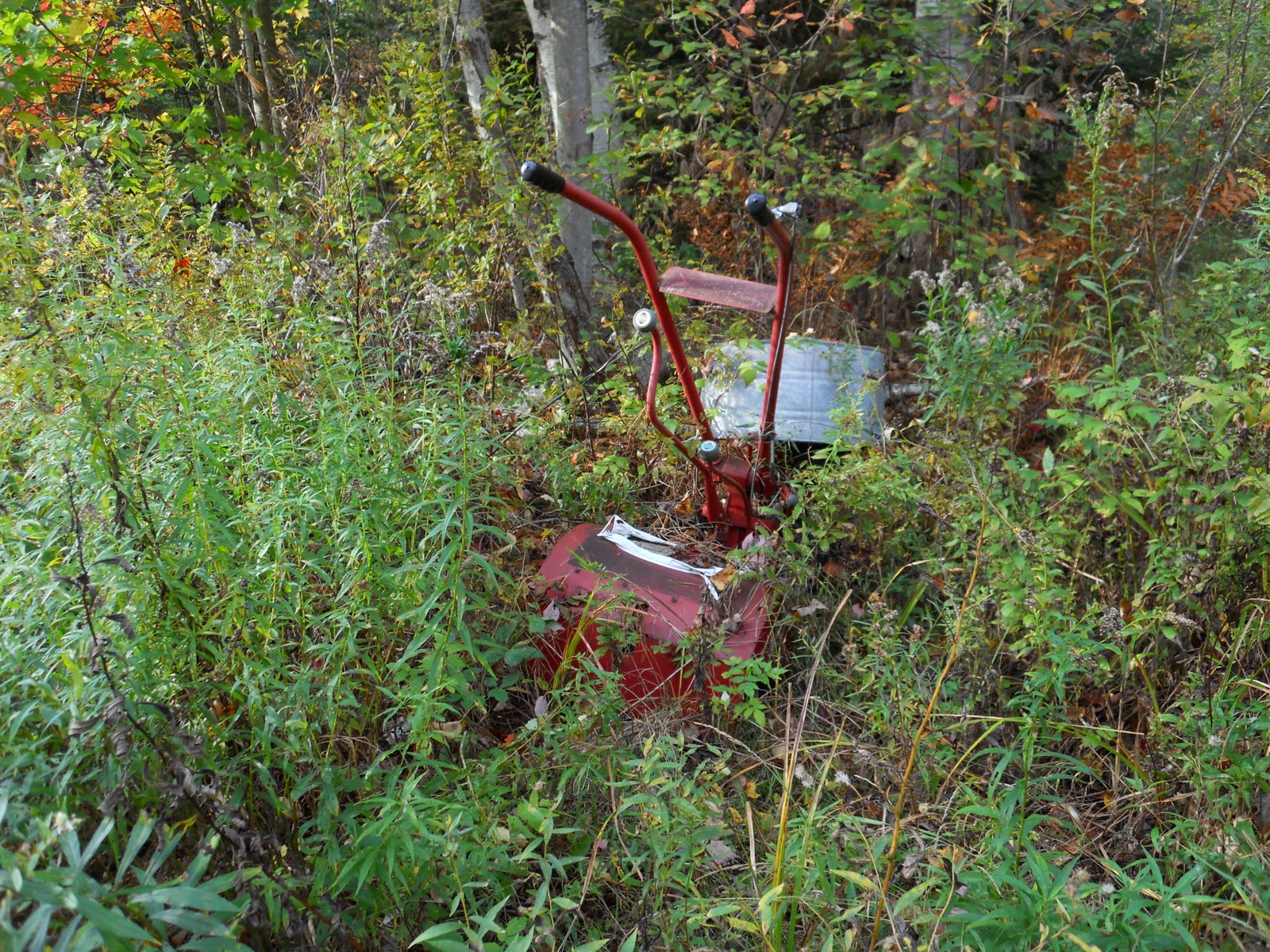
or the tiller which served us well for ages, but which we shall never use again now that we have raised beds in the garden. Tom's thought is 'well, Matt might need it.' I don't think so. They've begun their gardening lives with raised beds, saving themselves the stress and strain and plain hard work of tilling.


or the worst of all, this old wooden garden cart that frankly I didn't even know was there until I went exploring to take these photos. It is growing into the land.


I can't imagine what Tom is thinking, but somewhere in his head, like inside Mr. Peden's, there is the idea that maybe, just maybe there shall be a use in some far future time for a rotten wooden cart. Which connects me to all those years ago when Rachel was alive and writing about her farm in Indiana. And makes me happy.