Sunday, August 8, 2010

Peanut Butter Balls

For the August installment of Matt's birthday present, I made an old family favorite. Easy as can be and delicious.

Mix together:
1/2 cup honey
1/2 cup peanut butter
1/4 teaspoon vanilla

Add 1 cup dry cereal. I use Erewhon crispy brown rice.

Mix together well and roll into balls.
You may roll some in coconut or powdered sugar; add a few chocolate chips or leave them plain.

Saturday, August 7, 2010

Farm and Garden Report - week of August 1

Beginning today, I'm going to change the name of these postings from Farm and Garden Weekly to Farm and Garden Report because as the growing season winds down, there isn't really enough happening to write about each week.

For most of the week, the heat and humidity were just killing me, but then a breeze blew in some lovely cool weather improving my dispostion 100%! I know our temps aren't nearly as high as in other parts of the country but the difference is that we have no air-conditioning in the house. The fans are good as long as you are sitting directly in front of them which of course I can't do all the time. :<)

The total egg count this week was 50.

The big gardening event was harvesting the first yellow beans. Since I don't want to repeat myself, I thought I'd send you here to read more about my beloved yellow beans.

I'm picking, eating, and freezing that Zephyr squash every single day. What a great variety!

We've got lots of green tomatoes, and have had two red ones.


The sweet peas are still so incredible.

Not very clear and precise but I wanted to give you the overall view that I see every day.


The daylilies are almost all gone by. I think that because of the hot July they came earlier than usual and so of course are finished earlier too. I've even got a couple phlox open which doesn't usually happen this early in August.


It's looking a pretty dried out and sad around the garden. It really is time for me to begin to cleanup, and now that the weather is cooler, I will. Here are some views that gardeners rarely post.


The air is quieter these days. I'm not hearing the birds of summer so often. Last evening I was sitting out on the lawn and heard bluejays, chickadees, crows, and crickets. The latter are the singers of August. I heard a loud rustle in the woods close to the house the other day - moose, bear? And each night when we walk out in the north field with the dogs they smell all kinds of fascinating aromas that we can't begin to know. Chet the dog often speaks of what poor noses we humans have. :<) The roadside, so-called 'weeds' are stellar just now. The goldenrod and tansy are so bright and cheerful. I'm a big fan of these flowers.


So now we are in the quiet days of summer; the time between the riot of blooms and the colors of autumn which arrive here by the end of this month. To everything there is a season.

Friday, August 6, 2010

Thereby Hangs A Tail by Spencer Quinn


40. Thereby Hangs a Tail - second in the Chet and Bernie series
by Spencer Quinn
mystery, 2010
unabridged audio read by Jim Frangione
finished, 7/28/10


Several years ago there was a phrase going around - 'may I be the kind of person my dog thinks I am.' Trite perhaps, but true nonetheless. Our dogs, Ben and Sadie, do indeed view us as perfectly wonderful, just the way Chet thinks of Bernie. The reader is all too aware of Bernie's shortcomings. He drinks too much sometimes, he smokes, he falls for schemes and repeatedly pawns precious items to raise money. Of course we learn these things through Chet's words because he is the narrator after all, but while he notes them, he never criticizes or judges or tries to change his beloved human friend. No wonder we love our dogs so much! Chet, in fact hopes Bernie never quits smoking because he loves the smell of smoke and the smoke rings which Bernie makes.

It is really the most marvelous and refreshing way to present a story, through the eyes of a dog. Chet forgets things. He doesn't have a sense of time. He doesn't understand so many human expressions. He loves to eat. He is a real dog in every way and not a cutesy character. Spencer Quinn knows dogs. He really does.

So now Chet has become a part of chez hill farm. Occasionally I'll call Ben, 'our Chet' when he does something particularly Chet-like. I go on and on to Tom about Chet's words and activities. Ah, the power of reading.

It was a pure delight to listen to the second in this series. Jim Frangione was really quite wonderful in his interpretation. I believe the mystery was even better than in the first book, Dog On It which I wrote about here. Bernie and Chet have to find a dog-napped little show dog named Princess. Though she is one of those lap dogs who is quite pampered by her owner, once she and Chet are off on an adventure together, she shows that she is a regular dog who is a real trooper.

Again, the Southwest is so well described. Though I've never been there, I can see it through Quinn's words. As in the first book, Bernie's concerns for his beloved state are expressed. He worries about the aquifer [a body of permeable rock that can contain or transmit groundwater], and the fact that a million more people are expected to move to Arizona in the next ten years. (Can this be true? Could I be remembering wrong?) The desert is both appealing and scary at the same time. It is a completely different landscape from anything I am used to, such as this butte:

And this ghost town:


There is a cast of characters in the book from old hippies who live a nomadic lifestyle in the desert to an unsavory sheriff. Bernie's girlfriend disappears along with the owner of Princess. My only complaint about this particular book is that Chet has a biopsy. Now, we all know in our hearts that he will be fine, but why include it? I headed over to Chet the Dog and was assured by the great posters there that yes, he is okay. But again, why bother to put it in?

Other than that tiny quibble, I love this book and this series. I'm so looking forward to the new one, To Fetch A Thief, coming next month. Four paws up!

Oh, and in case you've read any of the Peter Abrahams YA mysteries, he is the author of the Chet and Bernie books, using the pseudonym of Spencer Quinn. There's more about him here.

Tuesday, August 3, 2010

Tony Bennett's 84th birthday!

July 17, 2010
Arena Santa Guiliana - Perugia

Sunday, August 1, 2010

Farm and Garden Weekly - weeks of July 18 and July 25

In the past two weeks, we have harvested all the leeks, onions, and garlic. I've got enough leeks in the freezer for ten batches of Gladys Taber's leek and potato soup. I pick some of the zephyr squash each day and have quite a bit frozen already.


There are still lots of beautiful daylilies in the gardens, including a new one we just planted in the spring. I love this color.


Now they are sharing top billing with the sweet peas. This has been the best year ever for the old-fashioned, wonderful smelling flower. I bought three different varieties from Renee's Garden, and will get them all again next year:

Antique "Cupani's Original" - An especially strong blooming strain of the first cultivated sweet pea. Perfumed, heat-tolerant and beautifully bi-colored in deep maroon-purple and orchid-violet.


"Painted Lady" - The first named sweet pea cultivar, dating from 1737. Painted Lady is a beautiful rose, pastel pink and cream bicolor that is deliciously scented and heat tolerant. Begins flowering early.


Knee High, "Jack & Jill" - Blooming in dainty salmon-rose and soft mid-blue, our perfumed duet grows just 3 feet tall. These nostalgic and charming flowers bloom early offering heat tolerance and strong garden performance.


Now if I could only post that fragrance!

You've been seeing the monkshood as the banner photo for a few days. It is the only flower in the garden which is that color at this time of year. The blue/purple color is much more common in the spring with the iris, lupines, mountain bluets, lilacs, and violets.

On the farm front, we've decided to section off part of the north pasture. We have fewer animals than we used to, and they don't need so much grazing land. We wanted a bigger area to walk with the dogs. This pasture connects with the yard outside the kitchen door, where the vegetable garden is.


Just as the dogs are shedding, so is Daisy the miniature donkey.

donkey dreads :<)


Two weeks ago today the man up the road who grows blueberries called and said the first ones were available. He used to put up a sign outside his place, but now he doesn't. He just calls whenever he has picked and we go over and buy them. We put them on cookie sheets in the freezer, and when they have frozen we transfer them to freezer bags. During the year, I take some out and put them in a bowl in the refrigerator, and the next day we add them to our morning yogurt.

Last week's egg count was 52 and this week we got 50.

Wednesday, July 28, 2010

The Draining Lake by Arnaldur Indridason


39. The Draining Lake - sixth in the Inspector Erlendur series
by Arnaldur Indridason
translated by Bernard Scudder
mystery, 2004
finished, 7/18/10


In each of Arnaldur Indridason's books I am completely transported to another land, a place utterly unfamiliar to me. As interested as I am in the plot, I am even more interested in the country and its people. In each book, I learn more and more about Iceland - its geography, weather, politics, and people.
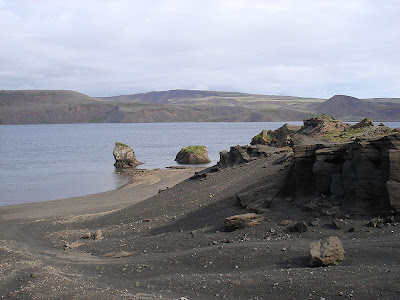

This is Lake Kleifarvatn, the 'draining lake' in the book title. It is pronounced: Kley-varrr-vahtn. It is a real place and it is indeed draining. I read the following online:
At nine square kilometres, Lake Kleifarvatn is the largest lake on the Reykjanes peninsula and the third largest in southern Iceland, although its size tends to vary a bit, especially in recent years. After an earthquake in 2000 the lake started draining rapidly. Like water draining from a sink, its water level began to decrease. This obscure occurrence caught the attention of local as well as international geologists who are still speculating how this was even possible.
A woman who is recording the water level makes a discovery in this lake that never would have surfaced had this draining not occurred. Ribs and a skull are 'standing up' out of the lake bed. Right off the reader realizes that secrets will be revealed that may have been hidden for many years.

The book goes back and forth from the 1950s to the present, and from Iceland to East Germany. Young Icelandic communists were recruited, invited to attend college in Leipzig, a cultural city which bore little resemblance to its pre-war self. The descriptions make the reader feel that it a little hell on earth:
a sorry gloomy post-war place
electricity shortage
old wallpaper peeling from the walls
basement swarming with rats
And the psychological and emotional components of the city are even worse than the physical. Toward the end of the book there are chilling statistics:
East Germany had come the closest of any country to almost total surveillance of its citizens. The security police had headquarters in 41 buildings, the use of 1,181 houses for its agents, 305 summer holiday houses, 98 sports halls, 18,000 flats for spy meetings and 97,000 employees, of whom 2,171 worked on reading mail, 1,486 on bugging telephones and 8,426 on listening to telephone calls and radio broadcasts. The Stasi had more than 100,000 active but unofficial collaborators; 1,000,000 people provided the police with occasional information; reports had been compiled on 6,000,000 persons and one department of the Stasi had the sole function of watching over other security police members.
The idealistic Icelandic students walk into the horror, having no idea of what was really going on. They were sure these people were going to make a better world, and any inconveniences or unpleasant actions performed by the government were temporary and for the greater good.

The sections of the book set in East Germany reminded me of the fantastic film I wrote about here a few years ago called The Lives of Others.

Inspector Erlendur and his colleagues, Sigurdur Óli and Elinborg go to work trying to find out who the skeleton is. The body is a male who was connected to an old radio transmitter, and has been in the water for 40-50 years. They look into missing persons from those years. If you've read the earlier books, or perhaps read about them here, you may recall that missing persons are a particular interest, one might even say obsession, of Erlendur's. Sigurdur Óli notes:
Only two out of forty-five missing-persons cases over the past fifty years have been investigated as criminal matters
There is a flashback to when Erlendur began his career. An older policeman asks him if he has 'a particular interest in crime,' and Erlendur responds that he is 'interested in missing persons.'
I think they may have more to do with crimes than people think. I've got nothing to back me up. It's just a hunch.
This 'hunch' is what guides Erlendur through all such cases. He is haunted by the people left behind when someone goes missing; images such as a woman waiting outside a shop for her boyfriend to come. He goes to work trying to give some solace, some closure to them.

Throughout the investigation, we learn more and more about this country which is so very foreign to most of us.
We're a small community, everyone knows everyone else and is related to everyone else.

'Was he depressive?'
'No more than most Icelanders.'

Many Icelanders suffer serious depression, although most keep it well concealed.

In Iceland there's rarely a real motive behind a murder. It's an accident or a snap decision, not premeditated and in most cases committed for no obvious reason.

'We arrested the same man for burglary five times in one weekend. Every time he confesses and is released because the case is solved. He breaks in somewhere again, gets arrested, is released, burgles somewhere else. It's brainless. Why don't they set up a system here for sending idiots like that straight to prison? They clock up twenty or so crimes before they're given the minimum custodial sentence, then the minute they're out on probation you're arresting the same ones [word inserted in place of a most 'colorful' word in the book] again. What's the point of such madness?"
And Erlendur adds: 'You won't find a more hopeless set-up than the Icelandic judicial system.'

This is not a book I raced through. I didn't even read many pages each time I sat down. Some days I didn't read at all. I finished the one before this, Voices on June 25, and it took me three weeks to read The Draining Lake. I wanted to take time to think about what I read. It is a deep book, and the characters, especially Erlendur but also his children and co-workers get deeper with each book. I've simply never read anything like this series in my reading life.

The first book I read, Jar City, had a section at the beginning about Icelandic names. I think it would be helpful if it were repeated in all the Erlendur mysteries but they haven't been.
Icelanders always address each other using first names, since most people have a patronymic [based on the name of one's father, grandfather or an even earlier male ancestor] rather than a "proper surname" ending in -son for a son and -dóttir for a daughter. People are listed by first names even in the telephone directory. Strange as it may sound to the English ear, first names are therefore used throughout the police hierarchy and when police and criminals address one another. Erlendur's full name is Erlendur Sveinsson, and his daughter is Eva Lind Erlendsdóttir. Matronymics [a name derived from the name of a mother or female ancestor] are rare, although Audur is specifically said to be Kolbrúnardóttir, "Kolbrún's daughter." Some families do have traditional surnames, however, either derived directly from or else modelled on Danish, as a result of the colonial rule which lasted until early in the twentieth century. Briem is one of these traditional surnames, and as such it does not reveal the gender of the bearer - in the case of Marion Briem the ambiguous first name compounds this secondary mystery.
In The Draining Lake, Erlendur's family life isn't as prominent as in the other books, and his colleagues are a bit more in the forefront. One of them is hoping for children, and another has published a cookbook to great acclaim. We also spend some time with Erlendur's earlier, older co-worker who is retired, alone, ill, and bored. He still has insights to offer to the younger man. You could probably read the books out of order, but it has been fun for me to see the characters develop from book to book. Of course as I have noted, the first two haven't been translated into English. I would think all translations would begin with the first book in a series, but the Arnaldur Indridason books aren't the only ones which have been translated mid-series. Even so, I don't feel like I've missed much. I can't praise these books highly enough. If you'd like to read the other book reports, you may type Arnaldur into the search bar. Great, great series!

Saturday, July 24, 2010

The Making of a Home - part 3

So, all of a sudden on a July day, I heard pounding, hammering. I was amazed at the difference in sound from the first days of construction. The earlier sounds were big machines, back up beeps, while the actual building sounds were so much quieter, so subtle that I wasn't sure they were happening at the house. I thought they could be across the main road. I walked down to the kids' land, and there were four guys putting down the ceiling to the cellar/the subfloor to the downstairs. It was such a hot day, yet the fellows were all cheerful.

Such a pleasant occupation, building a house. It really must be one of the best jobs in the world.

From then on, something exciting happened every single day.

July 9


I love the look of the shadows


In one day, on July 12 all these walls and openings happened.

Front of the house


Same wall from the inside


The east wall - opening is for sliding glass doors


Looking out window above sink - south view


July 13 brought the completion of the first floor walls - the poles sticking out are for the front porch


The back of the house - above the sink window on L and dining area window R - south windows


The west side of house - master bedroom window L and master bath window R


On July 14 they framed the interior walls - master bedroom


Laundry room, master bath, closet (master bedroom to R)


Inside of laundry room


July 15 they put up the ceiling for the first floor/floor for the second floor - dining area east and south windows


Up on the top floor


'Climbing my house'


These were taken on the 17th because we had such storms at the end of the day on Friday, the 16th that I couldn't go down. On the 16th, they put up the stairs!


Top part of picture will be two upstairs bedrooms


Here you can see where the loft will begin
- the area left of the stairs


The second week began with the upstairs walls and windows.

Loft windows, all facing east


The two west bedroom windows


On Margaret's birthday they framed the upstairs south wall and windows - I don't know what that is the picture, maybe a reflection.


Margaret and Matthew arrived on their scooters for cake and presents

Thursday and Friday of this week they worked on the roof

Front of house
Back of house


So all this in two weeks time! They've also put in some electrical boxes, and the main electrical panel in the cellar. We are all amazed at how quickly the work goes. And we are so impressed with the quality of the work and the materials.