Tuesday, February 25, 2014

In honor of what would have been George Harrison's 71st birthday


Isn't it a pity
Now, isn't it a shame
How we break each other's hearts
And cause each other pain
How we take each other's love
Without thinking anymore
Forgetting to give back
Isn't it a pity

Some things take so long
But how do I explain
When not too many people
Can see we're all the same
And because of all their tears
Their eyes can't hope to see
The beauty that surrounds them
Isn't it a pity

Isn't it a pity
Isn't is a shame
How we break each other's hearts
And cause each other pain
How we take each other's love
Without thinking anymore
Forgetting to give back
Isn't it a pity

Forgetting to give back
Isn't it a pity
Forgetting to give back
Now, isn't it a pity

Monday, February 24, 2014

Hazel Nina goes to the library!

On January 13, Tom and I went to visit our brand new town library. 


Here is Tom, standing under the faux tree entrance to the children’s section. That evening we were imagining Hazel, who was then only a little over a month old, going into that very room. 


And today she did! 


She pretty much slept all the way through her first visit.


After we left, Margaret had to pop into the store, and while she was gone I read to my granddaughter for the first time - a wonderful book that wasn't around when my kids were little. How could I resist when Hazel's grammy's name is in the title. It's all about a little girl who loves everything fancy - fancy words and fancy clothes.


She despairs of her plain family,


and comes up with an idea to help them become fancier.


And it works!


The book ends so beautifully.


Though my dear little granddaughter slept through the first book I read her, 


I expect I'll read it to her again and again as time goes by.

Sunday, February 23, 2014

Sunday Supper - Wild Rice Buttermilk Pancakes

It's been ages since I did a Sunday Supper posting, so will remedy that this evening. I had some wild rice left over from making Wild Rice and Quinoa muffins the other day, and I had some buttermilk in the fridge that needed to be used, so I found a recipe online for Wild Rice Buttermilk pancakes. I tweaked it a bit, and the pancakes were delicious! The chewiness of the wild rice is wonderful. 


Wild Rice Buttermilk Pancakes

Mix together:
2 cups flour - 1 1/2 cups whole wheat pastry and 1/2 cup white
1 teaspoon baking powder
1/2 teaspoon baking soda
1/2 teaspoon salt
1/3 cup sugar

In a separate bowl, beat together:
2 eggs
2 1/4 cups buttermilk
1/2 teaspoon vanilla
2 tablespoons melted and cooled butter

Stir in:
1 cup cooked wild rice

Cook on medium heat. After my electric griddle wore out, I bought one


that goes on the stove, but I think I'm going to get either another electric griddle or an electric frying pan because I've been finding this stove top edition cooks unevenly. Still, most of the pancakes turned out fine, and were excellent. 


Thursday, February 20, 2014

January Reading

Though my print reading in the long-awaited reads month wasn’t successful, my Kindle reading was some of the best of my life. If I gave grades four would get an A+, two would get an A, and two would get an A-. Just for fun, I’ve put the grades next to the titles.

1. A (also seen as The) Lighthearted Quest - book 1 in the Julia Probyn series A  
by Ann Bridge
fiction 1956
Kindle
finished 1/5/14


I tried a book of Ann Bridge's years ago which people had been raving about called Peking Picnic, and I just couldn't get through it. But I loved this one. I was reminded of a younger Mrs. Pollifax, the senior citizen heroine of Dorothy Gilman's series who travels around the world as a spy. Julia is asked to find her missing cousin who is heir to a Scottish estate. He hasn't been heard from in a few months, and he is desperately needed to keep the place going. Her travels take her to 1950s Casablanca, Marrakech, and Fez, and the modern reader learns of the political and social situations in these places. The descriptions are terrific, and the characters really come alive. I've already bought the second in this 8-part series. She's a wonderful character, a bit like the plucky young women we find in Agatha Christie's books. 


2. Mr. Lynch's Holiday A+
by Catherine O'Flynn
fiction 2013
Kindle
finished 1/8/14


I just loved this book. It is a father and son story. It is an ex-patriate story. It is a financial collapse story. It is a wonderful story. A widower from Birmingham makes a surprise visit to his son who lives in Spain. This book is refreshingly different from anything you might expect. It was a pure pleasure to read. I read her first book, What Was Lost and wrote about it here a few years ago.


3. Last Night at the Lobster A+
by Stewart O'Nan
fiction 2007
Kindle
library book
finished 1/11/14


Of all the books this month, this is the one that means the most to me.

I had a friend in high school with whom I shared a great love of music - but not the same music. If I loved a band, he invariably didn’t, and the music he loved, I hated. Well, now, in my bookish life I have a similar relationship. Les and I both love to read. However, not only do we read different kinds of books, but also, when we do happen to read the same one, we almost always disagree. It is very rare indeed that we both love (or hate) the same title. Almost six years ago, Les wrote a wonderful review of this book, which was mostly about her work experiences years ago at a restaurant. I thought her memories were worthy of being published. She did not care for the book at all. Yet when I read about it, I was sure I would love it, and (no surprise) I did. And as soon as I finished, I ordered the paperback version. It is perfect from the cover to the last page inside. Tom read it and loved it as well. 

Stewart O’Nan has been called the ‘bard of the working class.’ And as a reader, working class people are the ones I want to read about. One of my favorite poems is It’s The Little Towns I Like by Thomas Lux. You may read it here.  I loved all of Rick Bragg’s books. When We Were the Kennedys, and Stuck were two of my top favorite books of last year, and I loved Candacy A. Taylor’s book Counter Culture about waitresses. Just after I finished Last Night at the Lobster, I happened to read this is a local paper.
America’s restaurant and food service industry provides jobs and careers for 13 million people – 10 percent of our nation’s workforce. While restaurants serve as a stepping stone for many – one in three Americans got their first job experience in a restaurant – it’s also an industry of tremendous opportunity, where individuals of all backgrounds are given the opportunity to move up the ladder and succeed. In fact, 80 percent of restaurant owners began their careers as hourly workers in the industry.
As fewer people cook at home, as the restaurant becomes our dining room, doing a good job of managing, serving, and of course, cooking is ever more important. Stewart O’Nan shines his writerly spotlight on the people who do this work, in this case at a Red Lobster restaurant in Connecticut on its last night in business. Cooperate headquarters have decided that it 'wasn't meeting expectations and, effective December 20th, it would be closing permanently.'

I felt like O'Nan was the proverbial 'fly on the wall' taking note of these restaurant workers. He doesn't just bring them to life, he notices them. He pays attention to what they do and how they think and who they are. After reading the book, you may view your restaurant experiences in a different way. 

I loved this book beyond words. I thought it a little masterpiece of writing, and of caring. You may listen to Maureen Corrigan in a five-minute review of the book here. And there's a beautiful, touching New York Times piece here.


4. The Minor Adjustment Beauty Salon - book 14 in the No. 1 Ladies' Detective Agency series A+
by Alexander McCall Smith
fiction 2013
Kindle
finished 1/13/14


I can't really say that these books get better and better because honestly every single one of them in this long series is perfect to me. The author's compassion and caring for the people and their land of Botswana shines through in each book. It is ostensibly a mystery series, and there are always cases that Mma Ramotswe must solve, but really it is a fictional oasis for this reader. 


5. Cold Poison - book 15 in the Hildegarde Withers series A-
by Stuart Palmer
mystery 1954
Kindle
finished 1/17/14


I'm frankly not wild about Hollywood stories, but since Mr. Palmer worked there for some of his life, his settings ring true. I'm coming on to the end of the Hildegarde Withers books so am spreading out my reading. I do so love her character, and policeman, Oscar Piper. 


6. The Springs of Affection 
Stories of Dublin A+
by Maeve Brennan
short stories (autobiographical and fictional)
published posthumously 1997 from two out-of-print collections:
Christmas Eve 1974 and In and Out of Never-Never Land 1969
Kindle
finished 1/22/14


This is a book that I could write songs of praise for. I've never read anything like it. It is quite, quite wonderful. Part of the book is true - her stories of growing up in a suburb of Dublin. And the fictional ones are set in practically the same place and feel just as real. If you don't like short stories, you still might want to give them a chance because honestly, they read like chapters in the lives of various characters. I have Brennan's nonfiction pieces for The New Yorker, and a biography of her on the shelf just waiting. She led a remarkable life which ended sadly. But oh, the work she left behind. She is up there with any great writer you care to name. Really.


7. I'll Never Marry a Farmer 
On Life, Learning & Vegetable Gardening A-
by Lois Hole
nonfiction 1998
finished 1/27/14


I wrote about this one here.


8. The Mysterious Mr. Quin A
by Agatha Christie
short stories 1930
Kindle
finished 1/28/14


The star of this book is Mr. Harley Quin. A play on words. From the dictionary:
a mute character in traditional pantomime, typically masked and dressed in a diamond-patterned costume.
The name Harlequin is taken from that of a mischievous "devil" or "demon" character in popular French passion plays.
The main character is Mr Satterthwaite, who gets involved in various situations, and Mr. Quin always shows up to help him out. He doesn't necessarily do things, but he facilitates others to do them. 

My beloved reference book 


has this to say:
The detection work was usually carried out by Mr Satterthwaite, 'a little bent dried-up man with a peering face oddly elf-like, and an intense and inordinate interest in other people's lives,' but only after he had been inspired by the appearance of the mysterious Harley Quin, a self-appointed patron saint of lovers, who showed himself to his alter ego when a crime was committed which threatened to destroy the happiness of lovers. Satterthwaite without Quin seems a rather pathetic figure who lives life vicariously, but inspired by Quin the magician he is able to solve problems in a dramatic fashion that contrasts vividly with Poirot's application of his little grey cells.
I know I've said it before but Agatha is a marvel. Those who haven't read her think she's all about little Miss Marple and Hercule Poirot, which would have been plenty for this reader, but she also writes about unique characters like Quin and Satterthwaite, and spy novels, and adventure novels, and serious fiction, and on and on. 

So there you have it - my marvelous month of reading. I zoomed through these books in the late hours as I wondered and worried about my new granddaughter Hazel Nina, and waited for her to come home. You may check in the blog archive to the right under December, January, and this month if you haven't heard about her.

Saturday, February 15, 2014

Quote du jour/bell hooks

I'm such a girl for the living room. I really like to stay in my nest and not move. I travel in my mind, and that's a rigorous state of journeying for me. My body isn't that interested in moving from place to place.

bell hooks

Friday, February 14, 2014

Today's poem by Roger McGough

I don’t often say anything when I post a poem. I like the words to speak for themselves. But in this case I want to tell you a little background, which will likely be longer than the poem. First of all, I’ve been meaning to talk about Acorn TV. It is essentially a mini Netflix for Anglophiles. Many years ago I used to buy VHS recordings from the Acorn company. They were not inexpensive, but were the only source of British television programs such as Kavanagh QC. And now, Acorn has their own streaming programs. Some are very new, and others are older shows that may be difficult to find. Right now, the newest Inspector George Gently shows are being streamed. I’ve written about some George Gently books in my letters, but after the fourth in the series, I didn’t care about reading any more of them. This is one of those rare instances where the television version is superior to the book version. It gets better and better with each season, and we so enjoy the stories and the two detectives. The other evening we watched an episode in which a man taught a young boy about a poet named Roger McGough. One of his poems was recited a couple times and, of course, when the show was over I looked him up. You may learn about his life and read some poems here. You’ll be surprised at some of his movie work. 

The moon is full today at 6.53 pm ET, and I thought his poem would be a fun way to celebrate.


Mrs Moon

Mrs Moon
sitting up in the sky
little old lady
rock-a-bye
with a ball of fading light
and silvery needles
knitting the night 

Roger McGough

Tuesday, February 11, 2014

Hazel Nina is home!!

Our granddaughter, Hazel Nina came home from the hospital on Saturday!!


The new family is doing well, and the dogs, Piglet and Lexi love their new baby. (the picture of Lexi was too dark to post)

Sunday, February 9, 2014

50 years ago tonight

As I’ve done a few times in my letters, I checked into my mother’s diary and my diary to compare notes on a particular occasion. On February 9, 1964 my 50-year old mother merely wrote:
Tonight watched T.V. The Beatles were on from England.
and the next day:
Deids and Nan listening to Beatles album. B. gave her allowance early so she could get it.
My almost-16 year old self wrote:
Tonite on Ed Sullivan the Beatles were on. They were wonderful. They’re so adorable esp Paul, Ringo, John + George. their hair is the utmost. They are so wonderful. they sang about 6 songs at 2 diff times. Geesum they’re so great. I love ‘em!
I don't feel a whole lot different about them than I did that long ago night. 

Here's a snippet I was able to find:

Quote du jour/Gladys Taber

In February, after a big storm, the sun comes out with more brightness than at any other time of the year. The winter sky is pale and far away and the snow is the essence of all the white there is. The glory of the sun, with the pale sky and the white snow, is breath-taking. The light has a purity, a dazzling serenity.
Gladys Taber

This February sky isn't pale, but the snow is certainly dazzling.


Friday, February 7, 2014

Today's poem in honor of the late Maxine Kumin

Death, Etc.

I have lived my whole life with death, said William Maxwell,
aetat 91, and haven't we all. Amen to that.
It's all right to gutter out like a candle but the odds are better

for succumbing to a stroke or pancreatic cancer.
I'm not being gloomy, this bright September
when everything around me shines with being:

hummingbirds still raptured in the jewelweed,
puffballs humping up out of the forest duff
and the whole voluptuous garden still putting forth

bright yellow pole beans, deep-pleated purple cauliflowers,
to say nothing of regal white corn that feeds us
night after gluttonous night, with a slobber of butter.

Nevertheless, what Maxwell said speaks to my body's core,
this old body I trouble to keep up the way
I keep up my two old horses, wiping insect deterrent

on their ears, cleaning the corners of their eyes,
spraying their legs to defeat the gnats, currying burrs
out of their thickening coats. They go on grazing thoughtlessly

while winter is gathering in the wings. But it is not given
to us to travel blindly, all the pasture bars down,
to seek out the juiciest grasses, nor to predict

which of these two will predecease the other or to anticipate
the desperate whinnies for the missing that will ensue.
Which of us will go down first is also not given,

a subject that hangs unspoken between us
as with Oedipus, who begs Jocasta not to inquire further.
Meanwhile, it is pleasant to share opinions and mealtimes,

to swim together daily, I with my long slow back and forths,
he with his hundred freestyle strokes that wind him alarmingly.
A sinker, he would drown if he did not flail like this.

We have put behind us the State Department tour
of Egypt, Israel, Thailand, Japan that ended badly
as we leapt down the yellow chutes to safety after a botched takeoff.

We have been made at home in Belgium, Holland, and Switzerland,
narrow, xenophobic Switzerland of clean bathrooms and much butter.
We have travelled by Tube and Metro o'er the realms of gold

paid obeisance to the Wingèd Victory and the dreaded Tower,
but now it is time to settle as the earth itself settles
in season, exhaling, dozing a little before the fall rains come.

Every August when the family gathers, we pose
under the ancient willow for a series of snapshots,
the same willow, its lumpish trunk sheathed in winking aluminum

that so perplexed us forty years ago, before we understood
the voracity of porcupines. Now hollowed by age and marauders,
its aluminum girdle painted dull brown, it is still leafing

out at the top, still housing a tumult of goldfinches. We try to hold still
and smile, squinting into the brilliance, the middleaged children,
the grown grandsons, the dogs of each era, always a pair

of grinning shelter dogs whose long lives are but as grasshoppers
compared to our own. We try to live gracefully
and at peace with our imagined deaths but in truth we go forward

stumbling, afraid of the dark,
of the cold, and of the great overwhelming
loneliness of being last.

Maxine Kumin (June 6, 1925 - February 6, 2014)
Where I Live
New and Selected Poems 1990-2010

Wednesday, February 5, 2014

Today's picture(s) - Hazel Nina is two months old today!

Hazel Nina now weighs 5 pounds, 6 ounces, and is 19 inches long. A miracle! She is progressing every day, and we look forward to our girls coming home soon.


Saturday, February 1, 2014

A Year of Afternoon Gardens - February


This has been an interesting month, and winter in general. We’ve had lots of cold weather with strong winds, and some milder weather, but hardly any snow. Happily for snowboarders and skiers, and for the economy, it has been plenty cold so the mountains can make snow. There have been snowstorms in much of the state, but we’ve seen hardly anything in terms of precipitation.

As I mentioned, we have some thoughts about changing some of the gardens. The one straight ahead, behind the bench, has been orange day lilies for about ten years. 


They are beautiful, but they bloom early and then that’s it for the couple months left in the summer. Last year, we dug some out and put in a few iris and aquilegia and a couple different colored day lilies, but this year we want to do even more. I saw this on Pinterest, 


and thought this is just what I want there - a variety of flowers, in different colors. There are some other spaces where we want to try some flowers too, so I bought a variety of perennial seeds that will live in our zone 3 climate. I ordered from a new-to-me company, Swallowtail Garden Seeds, and we'll start them under the grow lights.

Thursday, January 30, 2014

Today's video/Budweiser commercial

So wonderful. I cry every time I watch it.

Tuesday, January 28, 2014

I'll Never Marry a Farmer by Lois Hole

I'll Never Marry a Farmer
On Life, Learning & Vegetable Gardening
by Lois Hole
nonfiction 1998
finished 1/27/14

Perhaps because my mother died when I was in my twenties, I have looked for, and often found, mentors in many different fields over the years. My favorites are the gardening women. They seem to be particularly strong, no-nonsense sorts of people such as A. Carman Clark, Thalassa Cruso, and now Lois Hole. The sad thing is that they are all dead now, but their words live, and await generations of women, both young and old, wanting to learn how to grow vegetables and flowers, and along the way learn how to live a good life. 

This is a particularly special book. It is partly a how-to manual, covering most vegetables in two page spreads and it is also a reminiscence of a life well-lived as a vegetable farmer. She and her husband Ted tried a few different ways to use their Alberta, Canada farmland - grain, chickens, cattle but “nothing seemed to work out.”  They settled on growing vegetables because of a lucky placement of their home vegetable garden. 
My garden happened to be right next to a well-travelled road, and that seemingly insignificant detail changed our lives forever.
One day two fellows stopped by and wondered if she would sell them some cucumbers, and then came back a week later for more. Lois and Ted thought that if they were this interested then perhaps others would be as well, so they placed an ad in the paper which said
“Hole’s Farm - Vegetables for Sale,” and our phone number. Well, our phone just rang off the hook.
There are occasional philosophical musings such as this one on Healthy Soil.
The soil in which we plant determines what will take root. How we thrive and what we produce depend so much on where we choose to plant ourselves. … People thrive in all kinds of situations - different soils are right for different people. Some grow in a sandier, drier mix - some need extra nutrients and enrichment - some struggle through the clay to reveal their true strengths.
Lois tells us stories of farm life, her children, neighbors, and workers on the farm. She pays homage to a special person who gave her knowledge and inspiration, an illiterate woman who was an expert on the native plants and how to use them. She lived in a hut made of logs and mud, with no running water, and there raised eight children, and took in other kids who had no parents. The author expresses her regret that she didn’t take the opportunity to write down Mrs. Durocher’s wisdom.

Lois Hole was the Lieutenant Governor of Alberta from 2000 until she died in 2005. You may read about her appointment here. In 2011, a rooftop garden, the Ted and Lois Hole Healing Garden was opened at the Royal Alexandra Hospital. Also, part of this hospital is the Lois Hole Hospital for Women. 

The title comes from a time in her childhood when she pronounced to her mother, “No matter what, I’ll never marry a farmer.” Well, she did, and it was the best decision of her life. 

I read this book for the 7th Annual Canadian Book Challenge, and I’m so very happy to have made the acquaintance of Lois Hole. This is a wonderful book, full of wisdom and common sense about gardening and about living one's life.

Tuesday, January 21, 2014

My long-awaited reads month


Even though January has ten more days, I think I’m finished with my long-awaited reads month. I began with Electric Eden by Rob Young and read quite a bit before I realized it was just too dense, too filled with information. I thought I'd try something less scholarly so I picked up Toast by Nigel Slater, and I just didn't like it, and put it down after a few pages. I walked around the house and looked for books I've been meaning to get to for a while, and decided to read a Laurie Colwin book I've owned for years - A Big Storm Knocked It Over. I read many pages and then quit. There was a character I could not stand, and the main character had some kind of weird attraction to him. My last try was Pies and Prejudice by Stuart Maconie. I read about 50 pages. I did enjoy it, but finally gave it up because, though I am a fan of all things English, there were just too many references to names and places I didn't know, though I do think it would be a wonderful read for someone who lives there. So, I'm going to move on to some other reading I have planned for this year. This was fun for me, even though I didn't become immersed in a book or finish one.

Tuesday, January 14, 2014

Stuck by Stacey D. Atkinson

Stuck
by Stacey D. Atkinson
fiction, 2013
Kindle book
finished 12/6/13


Stuck begins with the definition of the word

stuck adj.

1 unable to progress
2 confined in a place

Odette exemplifies both 1 and 2. She is in her early twenties, works at the same convenience store she has worked at since high school; and she is ‘confined’ to living in a trailer with her teenage sister, and her Bingo-addicted mother.
I never pictured my life to be like this: sleeping all day, eating supper for breakfast, working the night shift for a few dollars more than minimum wage, and still living with my mother. But then again, I'd never actually set out a specific plan to achieve my independence. I just fell in step with the routine of life.
She describes her childhood:
Having a Bingo Ma wasn’t easy. There were days when we could only afford to eat plain spaghetti for supper, no sauce even. In the evenings my sisters and I would wait in the living room for Ma to return home from the hall to see if it was a Win Day. On these days we could buy whatever kind of chips and chocolate bars we wanted, even the expensive kinds like Toblerone. …
We’d be on a delirious sugar high for a good week before realizing the money had run out. Then we’d be right back where we started, marking an x on the calendar to count down the days until the next welfare cheque arrived.
Their trailer is a mess with ‘dirty glasses … and lipstick-stained butts’ until Odette has the time to clean. Odette’s paycheck supplements the welfare and Bingo money. She feels responsible for her teenage sister Sophie, whom she fears is heading for trouble. There is an older sister Natalie.
At the age of twenty-five she could already claim a failed marriage and three kids from three different fathers. … To get by, she lived on her monthly welfare cheque just like Ma and got paid under the table for a weekend shift here and there at the fish plant.
The book takes place in Pointe-du-Chene, New Brunswick Canada. It is a fishing village near the city of Moncton. 
Besides the trailer park and the fishermen’s homes, the rest of the village was a thriving cottage community, full of people who celebrated the summer months.
I haven’t been able to find the exact quote, but I recently heard someone on the radio say that the divide in the US now isn’t based on race, but class. And I expect it may be the same in Canada. In Pointe-du-Chene, there are the rich tourists and there are the locals who make their living by fishing, and by catering to the summer visitors. Very rarely do the twain meet, but in Stuck, Odette becomes friendly with one of the Yacht Club young men. She lets herself be a woman of mystery, not telling him her true identity. It is very interesting to see how this plays out. Odette also meets a stranger on the beach where she goes after her night shift ends. 

If you read my book reports, you probably know that I favor the slow, quiet book. I like a book that drops me into a character’s life and lets me live alongside her for a while, getting to know her and the life she lives. I am exceedingly fond of Odette. She is a low-key kind of person, who is involved with her family and community, while at the same time having a dream for something, and somewhere, else. The reader doesn’t know if she will find an opportunity to follow that dream. 

New Brunswick is a bilingual province, and I really enjoyed the occasional use of French in the book. If you don't know the language, you can still get the gist of what a word or phrase means. The sense of place is very strong, and we see that Odette is a product of her home town. 

The word ‘pleasant’ isn’t used very often as a description of a book, and if it is, it is apt to be used in a sort of disparaging way, but I love the word. The thesaurus says:
enjoyable, pleasurable, nice, agreeable, pleasing, satisfying, gratifying, good; entertaining, amusing, delightful, charming. 
And this book is all of those things. It made me happy reading it. I found the ending perfect, yet real. In life most problems are not neatly solved, but we generally find a way to deal with them, and Odette does. It was one of my personal favorites from 2013. You may visit the author’s website here.

 A while ago, I got an email from the author asking if I’d like to read and write about this book. I get a few of these emails every year, and most of them are about books I wouldn’t read in a hundred years, but everything about Stuck appealed to me. I knew I would love it, and I did. She offered to give me the Kindle book, but I bought it for myself instead. It is available as a Kindle book for only $2.99 and is also in print version. 

This is my third book for the 7th Annual Canadian Book Challenge. 


I happened to find a little song called Pointe du Chene girl which I think kind of captures the spirit of Odette.


Tuesday, January 7, 2014

A reading plan for 2014

I had a rather shocking revelation a little while ago. When I posted a list of 2013 over-looked books I heard about on the radio, Aarti left me a comment in which she said
I wonder how much diversity is represented in this list. As a rule of thumb, I usually think that POC authors are much more overlooked than their Caucasian counterparts, so I would hope that at least some of those above are minorities!
I wrote back
I took it upon myself to search the names in google images to see about the diversity because I know you are right about this! Okay, here you go: all Caucasian except for Hilton Als who is African-American. I just went through my list of books read this year, and every single author is white. Granted a fair many are olden days writers, but still, but still. Not very pleased with myself. This will be my own personal little challenge next year to read more POC authors.
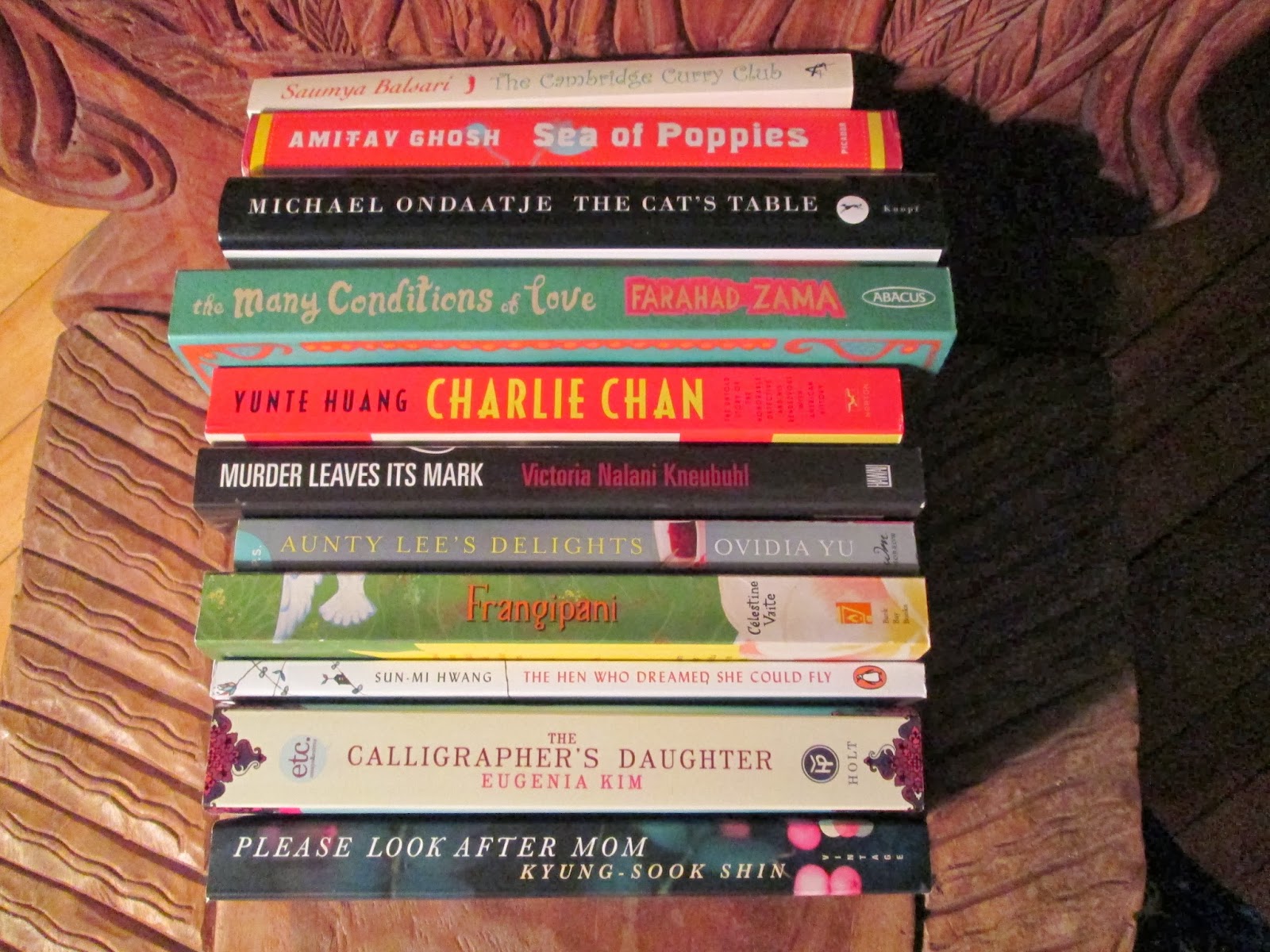
These are the books that I own which were written by writers who are not Caucasian. I hope to read them all in 2014.


January 21 I began with The Cambridge Curry Club, but quit. I tend to not read books about a group of women, each of whom have some grief or embarrassment or trouble in their lives. This was that kind of book - set in a charity shop in Cambridge, England.

Friday, January 3, 2014

Death of Esther the goat

I found myself thinking over the years that maybe, just maybe, Esther would beat the dying rap and live on forever. On one very frustrated day, I looked up the life span of goats, and though the average is 10-12 years, the number 30 jumped out at me. If she wasn’t immortal, then certainly 30 wasn’t out of her reach. But the reality of life which is death caught up with her. And I mean literally ‘caught up.’ Esther wasn’t easy to catch, either by us or the grim reaper. The night before she died, Tom was exasperated for the zillionth time when she snuck in the front door of the barn, knocked the top off the grain can, and started eating. And the very day she died, she was out of the pasture roaming around the lawns. Then Tom came in and said she was down. We called the vet and Tom brought her up to the office and Esther was given that last shot. 

The first photo we have of her is this one from 2002 with Bracelet and Annie, all gone now. 


You’ll notice that Annie the white one is much smaller. She was a pygmy goat, our third. Those were great goats. Small, friendly, companionable. We bought Bracelet and Esther sight unseen. The people said they were pygmies, but we knew the minute they hopped out of the truck that they were not. They were regular sized goats. And they were nothing like the malleable, naturally well-behaved little pygmies we had known. From the start, they were trouble. They lived life on their terms. If they wanted to leave the pasture, they did so. The electric fence didn’t faze them a bit. If they wanted to eat down the 55 day lilies Tom planted in his 55th year, they did so. One of my own personal favorite blog entries is about the goats. 

After Bracelet died two years ago, which I noted in this post, Esther only got worse, though I didn’t think it possible. She was an unstoppable force. She was on the move all the time. I would watch her as she took a bite here of daylily, and a bite there of yellow bean leaves, and wondered why she didn’t stay put and enjoy her meal. I looked it up and found out that goats learn about something by eating it. They learn about a plant for a while, and then move along to learn about the next one. She wouldn’t touch tomato leaves or onions, but most everything else among the flowers or vegetables was fair game.

Tom and I knew that when (if) she died, we would feel a sadness, simply because she was such a personality. And we do. We used to call her our outside dog, because she really liked to hang around us when we were out. But we also feel relief. We have some new ideas about the gardens for this summer, and I have been wracking my brain wondering how on earth we would keep her away. Last year she did some big damage. Several flowers never blossomed because she ate them off while in bud. We had to replant the yellow beans because those leaves were a special favorite. 

The last picture of her was taken Christmas eve day out the window as she walked out of her pasture, across two lawns, and out into the north pasture. Just ‘cause.


So yes, there is relief. But yes, we shall miss her.

Wednesday, January 1, 2014

A Year of Afternoon Gardens - January

If you look on the sidebar under ‘letter topics’ you’ll see ‘a year of morning gardens.’ Back in 2006, I began taking monthly photos of the same spot, and when I had finished, I posted them all in a blog entry. I decided I’d do it again, (can it really be?) 8 years later. This time I’m going to take the photo in mid-afternoon on the first of each month and post it. There are flowers to the left of the patio, and behind the bench in front of the house. It’ll be fun to see the changes as the months go by. My 2006-2007 morning gardens are all the more meaningful to me as two of the dogs are now gone. But our Sadie is still here, and I’ll try and get her in a picture one of the months.