Thursday, August 29, 2013

Today's poem by Victoria Redel


I've paid tribute to my mother a couple times in my letters - once with a birthday remembrance, and again with a poem by Philip Larkin. On what would have been her 100th birthday, I offer a wonderful poem by Victoria Redel.  


Getting Close

Because my mother loved pocketbooks
I come alive at the opening click or close of a metal clasp.

And sometimes, unexpectedly, a faux crocodile handle makes me weep.

Breathy clearing of throat, a smooth arm, heels on pavement, she lingers, sound tattoos.

I go to the thrift store to feel for bobby pins caught in the pocket seam
of a camel hair coat.

I hinge a satin handbag in the crease of my arm. I buy a little change purse with its
curled and fitted snap.

My mother bought this for me. This was my mother’s.

I buy and then I buy and then, another day, I buy something else.

In Paris she had a dog, Bijou, and when they fled Paris in 1942 they left the dog behind.

When my mother died on February 9, 1983, she left me.

Now, thirty years later and I am exactly her age.

I tell my husband I will probably die by the end of today and all day he says, Are you
getting close, Sweetheart? And late in the afternoon, he asks if he should buy enough filet
of sole for two.

From a blue velvet clutch I take out a mirror and behold my lips in the small rectangle.

Put on something nice. Let him splurge and take you out for dinner, my mother whispers
on the glass. 


About this poem:

"This was a poem written as I tried to write another poem. My mother often shows up this way, pushing up in the cracks and lapses of other poems. I am always surprised by the way my mother lives in me and how much—30 years after her death—I am still talking to her, inventing her, feeling her shape me."

Victoria Redel 

Monday, August 19, 2013

Today's poem by William Carlos Williams

This poem is in honor of the first two plums picked from a tree we planted almost a decade ago! They never even made it to our 'icebox.'


This Is Just To Say

I have eaten

the plums
that were in
the icebox

and which
you were probably              
saving
for breakfast

Forgive me
they were delicious
so sweet
and so cold

William Carlos Williams (1883-1963)

Friday, August 16, 2013

Today's picture/supper from the garden


Onions, leeks, and summer squash to be sautéed and served over pasta. 

Sunday, August 11, 2013

Remembering the Bones by Frances Itani


45. Remembering the Bones
by Frances Itani
fiction, 2007
library book
finished 8/8/13


I began my year of reading Canadian authors for the 7th Canadian Book Challenge with Frances Itani's Remembering the Bones. I knew nothing about the book before I began reading - all too rare in my experience, but a state I really love. 
The Master of the Household has received Her Majesty's command to invite Mrs. Georgina Danforth Witley to a Lunch to mark the 80th Birthday of the Queen.
Ninety-nine men and women received the invitation, in all parts of Elizabeth's kingdom, every one of them born the same day.
Within a few pages, Georgie leaves her home in Wilna Creek, Ontario for the airport to attend this luncheon. There's a tiny note of foreshadowing before she gets in the car.
Shouldn't she gather up her things, walk out the front door, come back in, sit for a moment and then depart a second time? It's what characters in Russian novels do - to ward off ill fortune, to ensure a safe journey. But no, she has to get moving.
We read so much now about texting and driving, or eating and driving, or any other activity which may take our attention away from driving the car. In less than a second life may change from that inattention. In Georgie's case all she does is check her wrist to be sure she hadn't forgotten her watch.
Because her attention is on her wrist, she allows the steering wheel to twist slightly to the right. In a split second, the right front wheel slips off the pavement. 
As she lays in the ravine, and is quite certain no one will rescue her, she begins the process of thinking about her life and the people who have been important to her in that life. These remembrances happen via a brilliant device. When she was a girl there was a Gray's Anatomy which used to belong to her grandfather. She memorized the bones, and Frances Itani uses these bones physically and metaphorically as chapter headings. Georgie thinks and remembers and recites and sings to keep her mind working. She's injured, but not drastically so. She would be fine if she could get to a hospital. The problem is that she has said her goodbyes, and told people she will see them when she gets back from England. No one is expecting her, no one will be calling, no one will wonder if they don't hear from her. What a situation. Her memories are her shield against panic. 

One of the things she ponders is her lifelong connection with Queen Elizabeth, whom she refers to by the childhood nickname of Lilibet. There are a lot of us who relate to the Royals in this way. Even in my own family, Tom's mother is about Elizabeth's age, I am Charles' age, Margaret is William's age. As was obvious with the birth of George Alexander Louis last month, there is a world of us who love these people we will never know. Curious, but true.

There are not so many people in Georgie's life that the reader has any trouble keeping them straight. Her memories of her family bring joy, regret, understanding just as would be true of any of us looking back upon eighty years of living. I found her stories very interesting. They were most illuminating of the characters and the times in which they live(d). I was surprised that I could read on like this without thinking about the probable ending, but honestly I was so drawn into the book that I almost forgot that she could die at the end, and when I finished I realized that it didn't matter terribly to either Georgie or me what was the outcome of this accident. I find that utterly amazing. 

This is a wonderful book - slow, pensive, kindly, and beautifully written. And I adore the book cover. 

There is an excellent interview with Frances Itani here, and a stellar review of Remembering the Bones here.


Frances Itani, CM

Frances Itani, novelist, poet, essayist, was born in Belleville, Ontario, and grew up in a small village in rural Quebec. A Member of the Order of Canada, she has a BA in Psychology and English, and an MA in English Literature. Prior to writing, she taught and practised Nursing for 8 years.

Frances has written 15 books, including novels, poetry, short stories, and children's works. Her WWI novel, Deafening (HarperFlamingo 2003), won a 2004 Commonwealth Prize for Best Book (Caribbean & Canada region), was shortlisted for the 2005 International IMPAC Dublin Award and the 2005 William Saroyan International Award, and won the 2003 Drummer General's Award. It was chosen for CBC's 2006 Canada Reads, as well as Radio Canada's Combat des Livres. Her most recent novel, Requiem(HarperCollins 2011), was shortlisted for the Evergreen Award and the Ottawa Book Award, and was one of The Washington Post's top 50 fiction books for 2012.

Two new short novels, Missing (2011), and Listen! (2012) were written for Good Reads (Grass Roots Press/ABC Life Literacy Canada), a series promoting adult literacy and learning. Frances reviews for The Washington Post, and has written for such publications as The Globe and Mail, The Walrus, Canadian Geographic, Saturday Night, and The Ottawa Citizen. She has travelled extensively, has taught for many years, and has been involved in humanitarian and volunteer work all her life. Currently, she is on the Advisory Board for Youth in Motion's Top 20 Under 20. She lives in Ottawa.

Friday, August 9, 2013

Today's poem by Henry David Thoreau

The Summer Rain                                                       


My books I’d fain cast off, I cannot read,
  ’Twixt every page my thoughts go stray at large
Down in the meadow, where is richer feed,
  And will not mind to hit their proper targe.

Plutarch was good, and so was Homer too,
  Our Shakespeare’s life were rich to live again,
What Plutarch read, that was not good nor true,
  Nor Shakespeare’s books, unless his books were men.

Here while I lie beneath this walnut bough,
  What care I for the Greeks or for Troy town,
If juster battles are enacted now
  Between the ants upon this hummock’s crown?

Bid Homer wait till I the issue learn,
  If red or black the gods will favor most,
Or yonder Ajax will the phalanx turn,
  Struggling to heave some rock against the host.

Tell Shakespeare to attend some leisure hour,
  For now I’ve business with this drop of dew,
And see you not, the clouds prepare a shower—
  I’ll meet him shortly when the sky is blue.

This bed of herd’s grass and wild oats was spread
  Last year with nicer skill than monarchs use.
A clover tuft is pillow for my head,
  And violets quite overtop my shoes.

And now the cordial clouds have shut all in,
  And gently swells the wind to say all’s well;
The scattered drops are falling fast and thin,                 
  Some in the pool, some in the flower-bell.

I am well drenched upon my bed of oats;
  But see that globe come rolling down its stem,
Now like a lonely planet there it floats,
  And now it sinks into my garment’s hem.

Drip drip the trees for all the country round,
  And richness rare distills from every bough;
The wind alone it is makes every sound,
  Shaking down crystals on the leaves below.

For shame the sun will never show himself,
  Who could not with his beams e’er melt me so;
My dripping locks—they would become an elf,
  Who in a beaded coat does gayly go.

Henry David Thoreau (1817-1862)

Thursday, August 8, 2013

The 7th Canadian Book Challenge


Maybe it's a crazy idea, but it seems to me that if countries share a border, then they should offer one another's literature in high school and college. With regard to the US, I would think that at the very least those states which share a border with Canada or Mexico should present that country's authors in school. I've lived my whole life less than a couple hours from the Canadian border and never read a book by a Canadian for most of it. When my kids were young, and we got a Bose radio, I was finally able to listen to Morningside with Peter Gzowski and Shelagh Rogers. I thought I'd died and gone to heaven. I learned about Canadian authors and my life became much richer. 

Though I have yet to complete a Canadian Book Challenge, I have still read several books by Canadian authors over the years of the blog. For this year's challenge I visited my library's website and found several books, and I own a fair few. 

This is what John Mutford has to say about his excellent reading challenge:
The Canadian Book Challenge is an annual online reading challenge in which participants from Canada and around the world aim to read and review 13 or more Canadian books in a one year span: Canada Day to Canada Day. Reviews must be posted online and participants are asked to share links to their reviews with other participants.
You may find more information about the challenge here.

Books read:

1. Remembering the Bones by Frances Itani - finished August 8
2. Old City Hall by Robert Rotenberg - finished September 8
3. Stuck by Stacey D. Atkinson - finished December 6
4. I'll Never Marry a Farmer by Lois Hole - finished January 27
5. My Turquoise Years by M.A.C. Farrant - finished February 1

Tuesday, August 6, 2013

Today's poem by Helen Maria Winslow

August

The yellow goldenrod is dressed
In gala-day attire;
The glowing redweed by the fence
Shines like a crimson fire;

And from the hot field’s farthest edge
The cricket’s soft refrain
With mellow accent tells the tale
That August’s here again.

In shining blue the aster wild
Unfolds her petals fair;
The clematis, upreaching, seeks
To clasp and kiss the air;
The brilliant poppy flaunts her head
Amidst the ripening grain,
And adds her voice to swell the song
That August’s here again. 

The dusty thistle by the road
Scatters a silvery spray;
The sun pours down his scorching beams
Upon the fainting day;
The blackberry vine bends with its weight
Of fruit down in the lane;
And adds its testimony, too,
That August's here again.

The wild hop, from the young elm’s bough,
Sways on the languid breeze,
And here and there the autumn tints
Gleam faintly through the trees.
All Nature helps to swell the song
And chant the same refrain;
July and June have slipped away
And August’s here again.


Helen Maria Winslow (1851-1938)

Goldenrod


Blackberries


Though she doesn't mention them, there are lots of apples this year. These will be given to the barn animals.


Also saw brown-eyed Susans, and Margaret and Matthew's ducks!


Monday, August 5, 2013

Fresh Blueberry Cake

This comes from Scatch Made Easy by Judy Whitman. You may find another recipe from it here. 

Although it is called 'fresh' blueberry cake, I have made it in the off-season when my blueberries came from the freezer and it is just as delicious.


Fresh Blueberry Cake

2 eggs, separated
1 cup plus 2 Tablespoons sugar
1/2 cup softened butter
2 teaspoons vanilla
1/4 teaspoon salt
1 1/2 cups flour
1 teaspoon baking powder
1/3 cup milk
1 1/2 cups blueberries

Preheat the oven to 350ºF.
Grease an 8 x 8 inch pan.

Beat the egg whites in the bowl of an electric mixture until foamy, and gradually add 1/4 cup sugar.
Beat until stiff peaks form. (Don't worry if they don't form - mine didn't) Put in a small bowl and set aside.

In the mixer, cream the butter with vanilla and salt. 
Gradually add 3/4 cup sugar and egg yolks. Beat until light and fluffy.

Set aside 2 Tablespoons of the flour.
Sift the rest of the flour and baking powder together.
Add to butter mixture at low speed, alternating with the milk.
Fold in egg whites.

In a separate bowl, lightly but thoroughly toss blueberries with the 2 Tablespoons flour.
Fold into the the batter, and turn into baking pan.
Sprinkle 2 Tablespoons sugar over the top.

Bake for 50-55 minutes, or until center of cake springs back when pressed.
Cool on rack.

If you want, you may sprinkle confectioner's sugar on top before serving, but honestly I found it plenty sweet without. This is a wonderful cake. 

Sunday, August 4, 2013

The Puzzle of the Pepper Tree by Stuart Palmer

44. The Puzzle of the Pepper Tree - book 4 in the Hildegarde Withers series
by Stuart Palmer
mystery, 1933

Kindle book
finished 8/4/13


Until I read this book, the following song was my only knowledge of Santa Catalina Island, California - 26 Miles (Santa Catalina) by The Four Preps, a song that came out when I was ten years old. It played in my head the whole time I was reading the book.


In the decade before The Puzzle of the Pepper Tree was published, the island was developed as a tourist resort by William Wrigley, Jr. of chewing gum fame. Gum was an important clue in the book.


And the poison in the book, aconitine comes from this little beauty, monkshood. Another name for it is 'the queen of poisons.'


From the Santa Catalina webpage:

Santa Catalina Island has served as the location for the filming of over 500 motion pictures, documentaries, television programs and commercials over the past 90 years.  Of those 500, approximately 300 were motion picture productions.  Beginning as early as 1911 and continuing with great momentum through the Silent Film era and the introduction of sound to motion pictures, the Island served as location for more than 225 films.
A character in The Puzzle of the Pepper Tree, Ralph O. Tate is a Hollywood director who is shooting a movie on Catalina, and Phyllis La Fond is
A vivacious blonde who's down on her luck and admits she'd do almost anything to make it in the movies.
Including murder???

A tourist possibility today:
For 2012 we are proud to introduce a number of new expeditions and thrills for your Island vacation, including: Night Zipping, Rock Climbing Tower, Ocean Expeditions and extreme excursions into Catalina Island’s interior in our new eco-friendly, biofuel burning H1 Hummers.
Miss Hildegarde Withers along with another character made her own adventure, thank you very much. They climbed miles of barely accessible rocky land in the rain. They could have easily never been found. A Hummer would have been most welcome that day. She wasn't looking for a thrill, she was trying to solve a murder!

The title comes from
A smooth-limbed, virginal young pepper tree dominated the view from Miss Withers' window at the hotel. … The vacationing schoolma'am had come to take a special interest in this little pepper tree. 
 A California pepper tree


This fourth book in the series finds our heroine solving a case without her friend Inspector Oscar Piper. When she finds out the murder has Manhattan/New Jersey connections, she gets in touch and he takes a train to come out. It is so refreshing, in the 1930s and even now, to see a man and woman on such equal footing. They are friends who share a mutual respect and trust for one another. Neither of them is involved with anyone romantically, so all their energies go into their friendship and their jobs. Neither one is a super-hero. They are regular people doing their best without needing the limelight. The article I linked to in the July Reading post was written in 1996, and lamented how unknown the much acclaimed Stuart Palmer was then. I'm hoping that with these new Kindle editions more and more people will read his fine work. These are mysteries of the highest quality.

Wednesday, July 31, 2013

Wicked Blueberry Coffee Cake

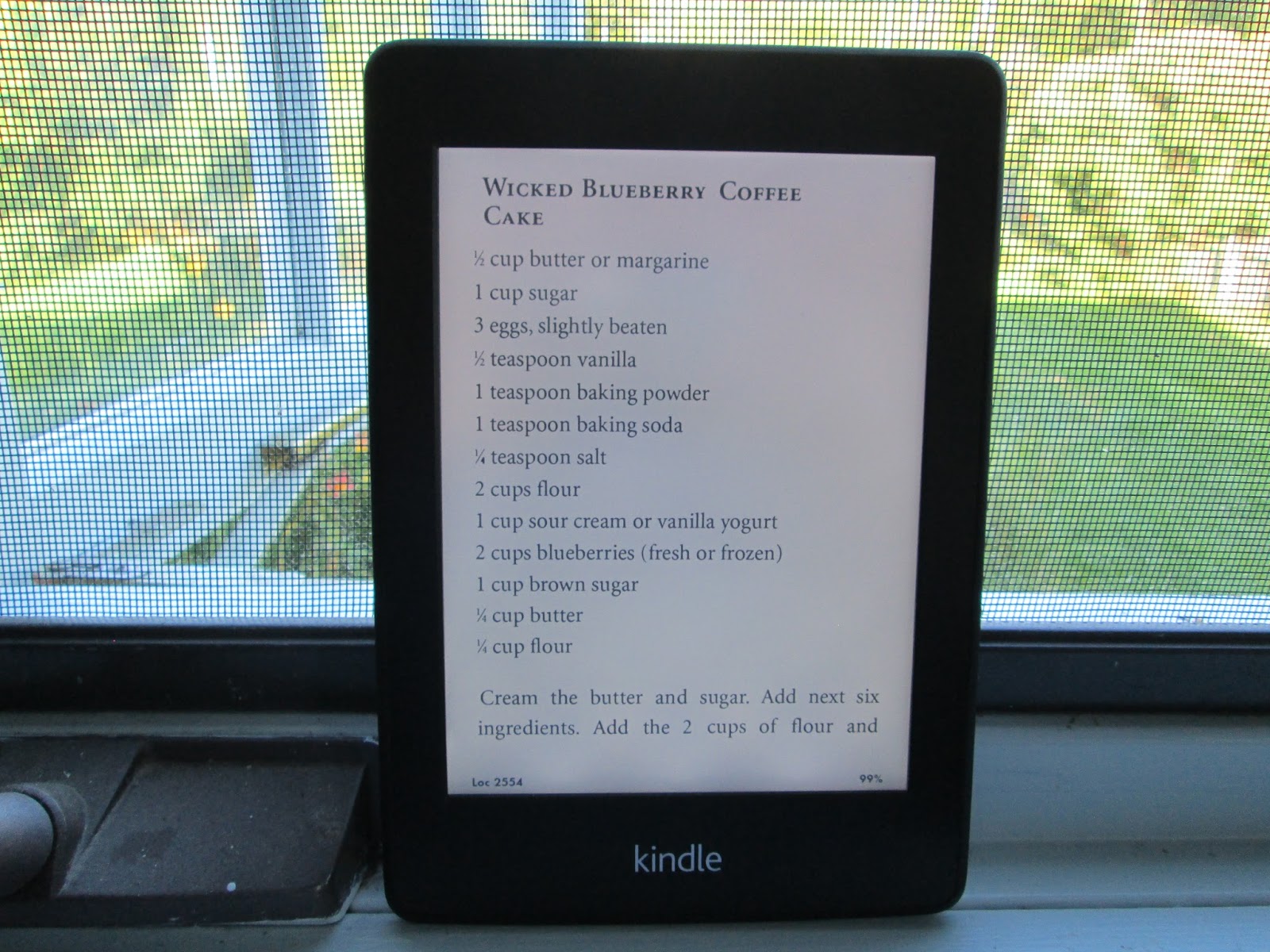
When I read Murder on the Rocks, I planned to make this recipe. And today I did. This is quite a bit different from last Thursday's posting of Blueberry-Yogurt Coffee Cake. Sour cream instead of yogurt (though it was an option); flour instead of cinnamon in the topping; and triple the amount of eggs. Is one better than the other? I think they are equally good. I don't think one can go wrong with flour, sugar, butter, eggs, and blueberries, no matter how they are put together. I hadn't jotted it down yet, so for the first time ever, I made a recipe while looking at my Kindle. 


I know a lot of people are using iPads now for cooking, but I don't have one, and probably never will, so this is the closest I'll get: a recipe from a book on the Kindle.


Wicked Blueberry Coffee Cake

1/2 cup softened butter
1 cup sugar
3 eggs, slightly beaten
1/2 teaspoon vanilla
1 teaspoon baking powder
1 teaspoon baking soda
1/4 teaspoon salt
2 cups flour
1 cup sour cream or vanilla yogurt
2 cups blueberries (fresh or frozen)

1 cup brown sugar (I used Sugar in the Raw, as always)
1/4 cup butter
1/4 cup flour

I used the KitchenAid mixer until it was time to add the fruit. I gently stirred in the blueberries.

Cream the butter and sugar. 
Add eggs, vanilla, baking powder, and soda.
Add flour alternately with sour cream.
Fold in blueberries.
Put into greased 9x13 pan.
In a separate bowl, mix sugar, butter, and flour. 
Spread on top of batter.
Bake in preheated 350ºF. oven for 30 minutes.

I didn't have the 1/4 cup butter softened for the topping, so I mixed the sugar and flour, and then cut in the cold butter with two knives.
Seemed to work just fine.

I ate some on the porch in the waning light of evening. Perfect.

Tuesday, July 30, 2013

July Reading


It's been a very busy month around here, so all my reading has been at bedtime, which means Kindle books only. I haven't sat down during the day to read in weeks. Oh, maybe a page here and there, but that's it. I did only one post for Paris in July; and I gave up the idea of reading Edwin Way Teale's Journey into Summer for now.

Summer is always busier than the rest of the year, but it seems that Tom's retirement is opening up time to do more visiting than we usually do. We have seen just about all our friends in July, times of great joy and conversation; a three-hour brunch on the patio of a local restaurant, going to two movies - Hannah Arendt and 20 Feet From Stardom, a play at the local summer stock theatre - Annie Get Your Gun, and family meals. It has been wonderful. There's been some gardening, and Tom has been working on getting wood together for the winter. But not much daytime reading. I guess that will happen after the summer. Around here we don't have too many months of warm weather so we truly take advantage of them.

In July I 'met' a new author named Stuart Palmer. 


43. Murder on the Blackboard - book 3 in the Hildegarde Withers series
by Stuart Palmer
mystery, 1932
Kindle book
finished 7/29/13


42. Murder on Wheels - book 2 in the Hildegarde Withers series
by Stuart Palmer
mystery, 1932
Kindle book
finished 7/24/13


41. The Penguin Pool Murder - book 1 in the Hildegarde Withers series
by Stuart Palmer
mystery, 1931
Kindle book
finished 7/16/13


I first heard of him in a publication I receive called (Give Me That) Old-Time Detection which features mystery writers from the past. If you are interested, email me (click on the About Me tab, and then View My Complete Profile) and I'll tell you how you may subscribe. It is quite singular in the literary world, and is put together and typed up by one man, Arthur Vidro. He has letters from readers, he finds reviews from years ago, and he has full articles about many writers that are almost unknown today. It's a little known gem. When I first inquired about it, Arthur wrote this to me:
     Ever since its autumn 2002 premiere, (GIVE ME THAT) OLD-TIME DETECTION has been published three times a year.  Since issue #10 we have always included at least 32 pages (sometimes more), not counting the cover.
      We are devoted to discussion of older (pre-1970, usually pre-1960) detective-story writers, their careers, their characters, individual novels or stories ... sometimes we include "lost" pieces, such as a story by Anthony Berkeley or an essay by John Dickson Carr ... when I was lucky enough to meet Mathew Prichard (Agatha Christie's grandson), that led to an interview.  We provided several pages of coverage of the 2005 Ellery Queen Centenary Symposium.
      The more famous of our contributors of new material are Marvin Lachman and Jon Breen.  In addition, we have reprinted reviews by Charles Shibuk and essays by Ed Hoch, Susan Oleksiw, Francis Nevins, Tony Medawar/Arthur Robinson, and Douglas Greene.
      It's hard to pigeon-hole us, but we do focus much more on the Golden Age style than on the Hard Boiled style.
After my introduction to Stuart Palmer within its pages, it was a recent post on the At the Scene of the Crime blog which got me to begin reading Palmer in earnest.

There's a terrific piece about Stuart Palmer here. 


Palmer's sleuth is an amateur who is very smart, fearless, and so much fun. Her name is Hildegarde Withers. She is a 'spinster' who is 39 years old when we first meet her. She teaches third grade in New York City, and lives with a couple roommates in an apartment. In the first book, she actually becomes engaged to Inspector Piper of the NYC police at the end, but by book two they have decided they are happier being great friends, detecting companions, and single. Pretty bold for a writer in the 1930s to feature a woman who is frankly contented to be a 'working woman.' And what a woman she is. I've never read about anyone like her. It is hard for me to understand why Jane Marple became so very well-known while Hildegarde Withers remains a hidden treasure. She is amazing. I've read about the old movie versions starring Edna May Oliver and James Gleason, and since they aren't available on Netflix, I may just buy them. 

Though there is a bit of screwball comedy in the books, they are mostly quite serious, and well thought out mysteries. It is also a treat to read about an amateur sleuth who is respected and supported by the police. The plots are intriguing, the characters terrific, and the writing good. I couldn't ask for more. I've just begun the fourth one. I do so enjoy reading through a series one right after the other. Though I've read that many people don't enjoy this, I find it great fun. 

I really liked The Broken Rules of Ten, a prequel to The First Rule of Ten and The Second Rule of Ten. 

40. The Broken Rules of Ten - prequel to the Tenzing Norbu series
by Gay Hendricks and Tinker Lindsay
mystery, 2013
Kindle book
finished 7/13/13


It was really wonderful to read about Tenzing Norbu as a young boy living in the monastery with his father. Ten lives part of the year there, and the other months with his free spirited, alcoholic mother. The poor boy didn't fit into either parent's lifestyle. He learned to depend upon his two friends, who are still important to the older Ten. It was most interesting to see what life in a Buddhist monastery was like - the food, the rituals, the order of life. Hendricks and Lindsay can't write fast enough for me. I love this series. The books have sparked my interest in Buddhism and I've bought two books to help me learn more: The Buddhist Catechism by Henry Steele Olcott, and Taking the Path of Zen by Robert Aitken. I also bought a sweet sounding book called The Dalai Lama's Cat by David Michie. This is one of the things I love best about reading. When I read The Guernsey Literary and Potato Peel Pie Society, I mentioned in my book report a quote from the book which I began to call 'the Guernsey effect' - 
That's what I love about reading: one tiny thing will interest you in a book, and that tiny thing will lead you onto another book, and another bit there will lead you onto a third book. It's geometrically progressive - all with no end in sight, and for no other reason than sheer enjoyment.
39. Dodsworth in Paris - book 2 in the Dodsworth series
by Tim Egan
children's fiction, 2008
Kindle book
library book
finished 7/13/13


This was a precious little children's book for early readers. Dodsworth has a companion duck who can't help getting into trouble, which makes for delightful reading. One of his adventures is making their money into paper airplanes and flying it off the Eiffel Tower, causing Dodsworth to get a job in the city in which he was supposed to be merely vacationing. I'd like to read the whole series, but will borrow the print versions instead of reading them on my Kindle. This was supposed to be a reading for Paris in July, as was a great movie I saw called Waiting for Fidel, but I just didn't have the solid time to sit down and give either the book or movie the time they deserved. I may write about the movie sometime.

The latest Maisie Dobbs book was great. I thought it one of the best in the series. 

38. Leaving Everything Most Loved - book 10 in the Maisie Dobbs series
by Jacqueline Winspear
mystery, 2012
Kindle book
library book
finished 7/9/13


The title figures into both the case Maisie has taken on, and her own personal life. I skipped book 9, Elegy for Eddie, because I found the story too painful after reading some of it. Things happened in that book to the main, ongoing characters, but I felt that Jacqueline Winspear caught me up so I knew what had occurred. Honestly, this is one of my favorite series ever. I love Maisie, her dad, and Billy. They are drawn with such care that the reader really does know them well by now. In this book, a woman from India has been killed. She had been living in a sort of hotel for servants who had been let go once they moved to England with British families, and were no longer needed. What a horrible thing. We meet the owners of the place who are no saints themselves though they talk as if they are doing the women a great service. The whole thing was very sad to read about, but still the mystery and the story of Maisie's inner thoughts are simply excellent. I love the slow, quiet writing where every single word is important. The stories are always complex and multi-dimensional. I've learned so much over the years of the books. 

This monthly books format is working out well for me, though sometimes I do miss writing longer book reports. I intend to do so for the two challenges I've joined - Sherlock Holmes and the Canadian Book Challenge. 

Thursday, July 25, 2013

Blueberry-Yogurt Coffee Cake


This recipe comes from a cookbook given to me by my friend Les. 


She knows that I love regional recipes, and this book offers them along with informative sidebars about the Pacific Northwest area, and photographs from older days. Perfect. I turned to it today to find a recipe for our first blueberries of the year.


I've mentioned before that a man down the road grows them, and we buy enough for summer eating, and then winter eating from the freezer. This is one of the best recipes ever! Sweet, buttery, and full of blueberries.

Blueberry-Yogurt Coffeecake

(From the cookbook) 
This coffee cake is a summer favorite at our house which I often make a day in advance. I reheat it covered with foil in a 300º F. oven for 20 minutes. It can be warmed faster in the microwave, but I enjoy smelling the sweet, lingering aroma that drifts out of the oven as it reheats. Don't let its unusually thick batter worry you. It will push the sugar-cinnamon topping up as it bakes, and will sink down when it is removed from the oven. 


This is one of the few coffee cakes that improve with age.

Topping
1 cup sugar
2 teaspoons cinnamon
2 tablespoons butter, chilled and cut up

Coffee Cake
1/2 cup softened butter
1 1/2 cups brown sugar (I used Sugar in the Raw)
1 egg
1 teaspoon baking soda
2 cups all-purpose flour
1 cup plain yogurt
1 teaspoon vanilla
2 cups blueberries, fresh or frozen

Preheat oven to 350º F. and butter a 9 x 13-inch baking dish. (I used cooking spray)
Using a fork, blend the topping ingredients together in a small bowl. (I used 2 knives) Set aside.
In the bowl of an electric mixer, cream together the butter, sugar, and egg. 
Add baking soda, flour, yogurt, and vanilla and mix on medium speed for 2-3 minutes.
Pour the cake batter into the baking dish and sprinkle blueberries over the top.
Gently press them into the batter.
Sprinkle the cinnamon-sugar topping over all.
Bake for 45-50 minutes. If using frozen blueberries, increase baking time to 1 hour.

Wednesday, July 24, 2013

Sunday, July 21, 2013

Quote du jour/Gladys Taber

One lovely thing about the February landscape is that I can look out and not see one solitary Japanese beetle anywhere on all our acres. And last summer the air was black with them. We did all the usual things to control them, and if we ever sat down to relax, a million more would begin champing their jaws on whatever they missed before.

We felt very bitter, for the Japanese beetle is a newcomer in our valley. I for one feel the Government should make a war on this burden of mankind, allocating taxes and using the Army. One less bomb might be dropped in the ocean.

Gladys Taber
Stillmeadow Seasons 1950


Yuck 


An example of the destruction


Two minutes work last evening - I brushed them off into hot, soapy water.

Thursday, July 18, 2013

Today's song/Mandela - Abdullah Ibrahim

In honor of Nelson Mandela's 95th birthday, 


this beautiful song by Abdullah Ibrahim.

Tuesday, July 16, 2013

Today's picture(s) by George Henton - The Taksim Square Book Club


In Pictures: The Taksim Square Book Club

George Henton Last Modified: 24 Jun 2013 18:51
Al Jazeera English


Protesters stand silently and read books in central Istanbul, in stark contrast with scenes of violence.

Istanbul, Turkey - After weeks of violent clashes between police and protesters across Turkey a new form of resistance has emerged - the "Standing Man".

Standing silently, and initially alone, Turkish performance artist Erdem Gunduz stood, with his hands in his pockets, facing the Ataturk Cultural Centre in Taksim Square, Istanbul, for eight hours.

With extraordinary speed, Gunduz become the latest symbol of the resistance movement. In days that followed, thousands of people would emulate his solitary act, standing silently, for minutes or hours, in places across Turkey.

The contrast with the images of tear gas clouds and water cannon could not have been greater. Faces obscured by masks and helmets were revealed to show expressions of quiet contemplation.

Violent scenes are still occurring around Turkey, including in Istanbul once again this past weekend, but the Standing Man protests continue unabated.

The following images explore one aspect of the protest in Taksim Square, ongoing since before the communal standing took off. Public reading and informal education has been notable since the earliest days of the protest, but has since merged with the Standing Man to form "The Taksim Square Book Club".

The chosen reading material of many of those who take their stand is reflective, in part, of the thoughtfulness of those who have chosen this motionless protest to express their discontent.


A woman reads the philosophical essay The Myth of Sisyphus by French author Albert Camus in Taksim Square. The book focuses on the search for meaning in the absence of God.

Gabriel Garcia Marquez's Leaf Storm centres on a family in limbo following the death of a man passionately hated, yet tied to the family.

Turkish writer Tezer Ozlu's book, Old Garden - Old Love, is a collection of short stories.

Irvin David Yalom's historical novel When Nietzsche Wept is about a prominent physician, Josef Beuer, falling in love with Lou Salome, who was believed to have spurned Friedrich Nietzche's romantic overtures.

A man reads the Turkish book Resurrection Gallipoli 1915, written by Turgut Ozakman on the Battle of Gallipoli, while a woman beside him reads George Orwell's Nineteen Eighty-Four.

George Orwell's dystopic novel Nineteen Eighty-Four centralises around a police state with total government surveillance. 


A man reads a Japanese novel, Hard-Boiled Wonderland and the End of the World, by Haruki Murakami - while another woman enjoys Orwell's Nineteen Eighty-Four, a popular choice of the Taksimites.

One woman reads The Speech, which is the text of of a speech delivered by Turkey's first president, Mustafa Kemal Ataturk, at an assembly in 1927 - while another woman (right) reads a biography of Ataturk.

A woman reads The Metamorphosis by Franz Kafka, a darkly absurdist novel about a travelling salesman who turned into a giant bug.

A man reads The Crisis of the Modern World, a critique of the modern world from the point of view of traditional metaphysics, by French author Rene Guenon.

A man reads Three Days with my Mother, a book about a novelist with writer's block, by Belgian author and director Francois Weyergans.